Philippines’ BoP posts $1.47-billion deficit in July, first in three months
Key Takeaways
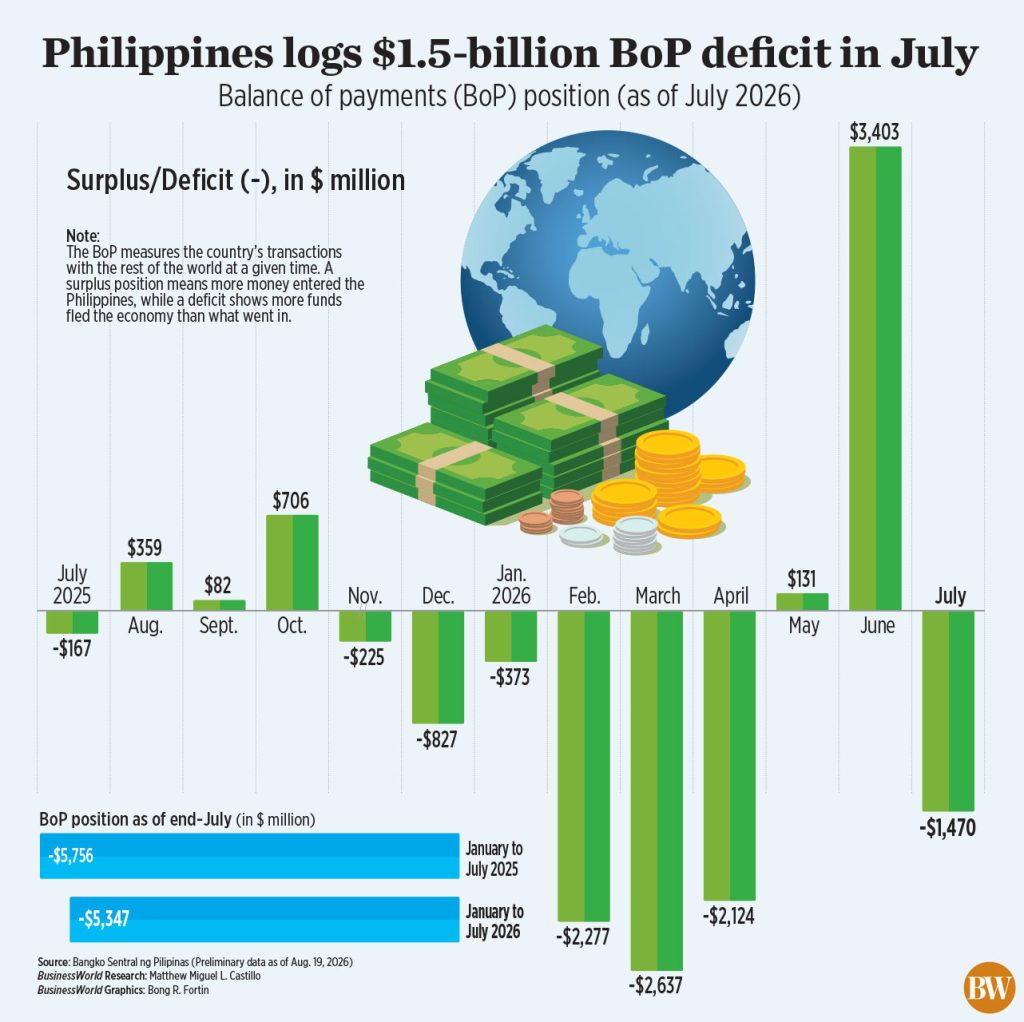
- •The Philippines recorded a $1.47-billion balance of payments deficit in July, reversing June’s $3.403-billion surplus.
- •The BSP said the monthly shortfall was linked to the trade gap, portfolio investment outflows and external debt-related payments.
- •In the seven months to July, the country’s BoP deficit narrowed to $5.347 billion from $5.756 billion a year earlier.
- •Gross international reserves fell to $103.317 billion in July, the lowest level in 18 months and the fifth straight annual decline.
- •At end-July, reserves covered 6.7 months of imports and about 3.7 times short-term external debt.
By Katherine K. Chan, Reporter
THE Philippines’ balance of payments (BoP) position swung to a deficit in July for the first time in three months, according to data released by the Bangko Sentral ng Pilipinas (BSP).
Central bank data released late on Wednesday showed that the country’s BoP position stood at a $1.47-billion deficit in July, a reversal from the $3.403-billion surplus recorded in June. On a year-on-year basis, the BoP gap widened from $167 million.
This was the first time since April that the monthly BoP position posted a deficit.
“The overall balance of payments, which captures the transactions of the country with the rest of the world, recorded a $1.5-billion deficit in July 2026,” the BSP said in a statement.
BoP refers to a country’s economic transactions with other nations. A deficit means the country spent more than it received, while a surplus indicates more funds entered the country. Under central bank accounting, the overall BoP position is ultimately reflected in movements in the country’s international reserves, so persistent shortfalls feed through into the level of the Philippines’ dollar buffers over time.
“The July BoP deficit reflected the country’s persistent trade gap, portfolio investment outflows, and external debt-related payments, particularly after June benefited from sizeable foreign borrowing inflows,” Union Bank of the Philippines (UnionBank) Chief Economist Ruben Carlo O. Asuncion said in a Viber message.
Jonathan L. Ravelas, senior adviser at Reyes Tacandong & Co., said the month-on-month reversal was due to higher foreign exchange outflows, including external debt payments and stronger dollar demand for imports.
“While the year-on-year deterioration looks significant, monthly BoP figures are often influenced by the timing of large transactions and should not be viewed in isolation,” he added via Viber.
In the seven months to July, the country’s deficit stood at $5.347 billion, narrower than the $5.756-billion gap in the same period a year earlier.
“The year-to-date BoP position reflected the continued trade-in-goods deficit and net outflows from foreign portfolio investments,” the BSP said.
“These were partly offset by the sustained net inflows from personal remittances of overseas Filipinos (OFs), foreign borrowings by the NG (National Government), trade in services, and foreign direct investment,” it added.
The Philippines’ trade-in-goods balance, or the difference between the values of exports and imports, widened to a $30.81-billion gap as of end-June from $24.48 billion a year earlier.
UnionBank’s Mr. Asuncion said the narrower year-to-date deficit shows that the Philippines’ external position remained manageable.
“Moving forward, developments in global financial markets, trade flows, remittances, tourism receipts, and foreign investments will be key determinants of the BoP outlook,” he added.
Mr. Ravelas said the country needs to maintain a healthy balance between foreign exchange earnings and import requirements to protect its external position from persistent global risks.
“The Philippines continues to benefit from strong structural dollar inflows, but maintaining a healthy balance between foreign exchange earnings and import requirements will be crucial to keeping the external position stable amid ongoing global economic and geopolitical uncertainties,” he said.
The central bank has said that trade imbalances and tighter financial conditions will continue to weigh on the country’s external position until next year.
It projects the BoP deficit to widen to $10.7 billion, or -2.1% of gross domestic product (GDP), by yearend from $5.7 billion, or -1.2% of GDP, in 2025.
18-MONTH LOW GIR
Meanwhile, the central bank’s dollar reserves stood at $103.317 billion as of July, down nearly 2% from the $105.418 billion recorded a year earlier, revised data showed.
This was the lowest level of gross international reserves (GIR) in 18 months, or since the $103.271 billion posted in January 2025.
It was also the fifth straight month that the GIR level declined on an annual basis.
Month on month, the BSP’s dollar reserves fell 1.36% from $104.745 billion.
The lower reserves were largely due to the central bank’s net foreign exchange operations, according to the BSP, as the weak peso during the period required intervention. Reserves are the buffer the BSP draws on to smooth exchange-rate swings and cover the country’s foreign currency needs, which is why the GIR level is tracked as a gauge of external stability.
At end-July, the local currency stood at P61.432 versus the greenback, about 7.2%, or P4.126, weaker than P57.306 in the same period last year, BSP data showed.
The central bank also said GIR fell after the National Government withdrew from its foreign currency accounts with the BSP to pay external debts, with total withdrawals exceeding deposits.
However, these drags were partly offset by “income from the BSP’s investments abroad and upward valuation adjustments in the BSP’s gold holdings due to the increase in the price of gold in the international market.”
Dollar reserves are the central bank’s foreign assets, held mostly as investments in foreign-issued securities, foreign exchange and monetary gold, among others.
These are supplemented by claims on the International Monetary Fund (IMF) in the form of reserve position in the fund and special drawing rights (SDRs).
The Philippines’ reserve position in the IMF stood at $725.2 million as of July, reflecting a 0.52% year-on-year decline from $729 million.
Meanwhile, the BSP’s gold holdings climbed to a two-month high of $17.49 billion, up 26.89% from $13.783 billion a year earlier.
Its SDRs — or the amount the Philippines can tap from the IMF’s reserve currency basket — also increased 1.22% to $3.937 billion from $3.89 billion.
In the seven-month period, the BSP’s securities slipped 7.95% to $67.157 billion from $72.958 billion a year earlier. These are highly liquid and marketable debt securities, excluding investments under the Asian Bond Fund (ABF) and Bank for International Settlements Investment Pool (BISIP).
The central bank’s foreign currency and deposits plunged by about 75% to $1.879 billion during the period from $7.516 billion last year.
By contrast, the BSP’s other reserve assets nearly doubled, rising 85.4% to $12.129 billion as of July from $6.542 billion a year earlier. These include overnight investment, repurchase agreement pool, due from or to brokers, accrued interest receivables, and investments under ABF and BISIP.
At end-July, the country’s GIR level was equivalent to 6.7 months’ worth of imports of goods and payments of services and primary income, more than double the three-month standard.
It could also cover about 3.7 times the country’s short-term external debt based on residual maturity. The three-month import cover is a long-standing international benchmark of reserve adequacy, while the debt coverage sits well above the one-to-one ratio suggested by the Guidotti-Greenspan rule of thumb.
The BSP expects foreign reserves to shrink to $104 billion this year from the $110.8 billion it held in 2025. The BSP publishes BoP and reserve data monthly, making the August figures the next reading against the central bank’s full-year projections for the deficit and the GIR.
