Philippines Slips to 61st in Fraser Institute's 2026 Economic Freedom of the World Ranking
Key Takeaways
- •The Philippines placed 61st out of 165 economies in the Fraser Institute's 2026 Economic Freedom of the World index, down one position from the prior edition.
- •The country's overall economic freedom score rose to 7.16 in 2024 from 7.07 in 2023, staying above the midpoint of 5 on the index's 0-to-10 scale.
- •Despite the improved score, the Philippines lost ground in the standings because other economies in the 165-country sample advanced more quickly in the comparative index.
- •The 2026 edition evaluates economic freedom across five areas: the size of government, the legal system and property rights, sound money, freedom to trade internationally, and regulation.
- •Rankings in the 2026 report are based on the most recent comparable data, reflecting conditions in 2024.
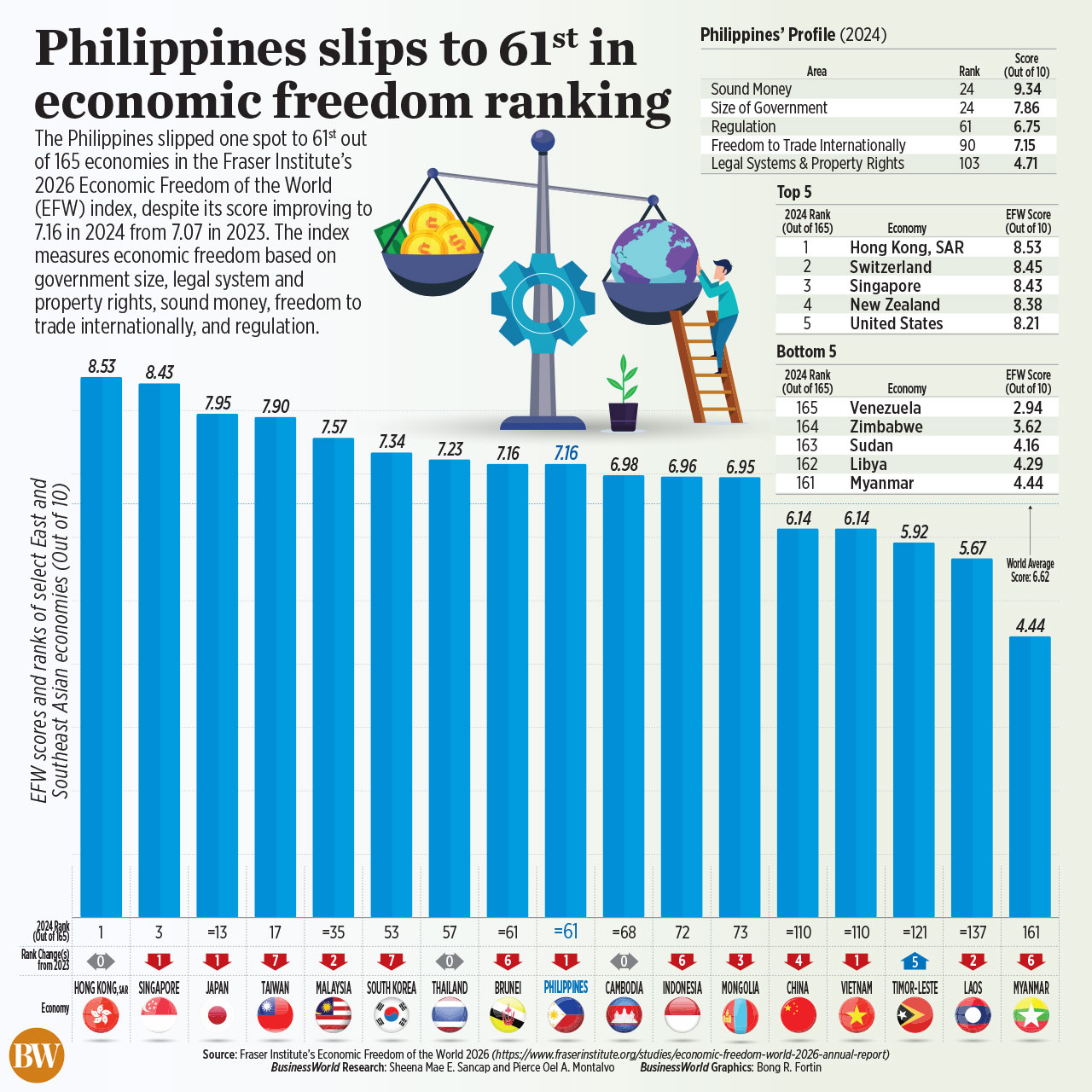
The Philippines fell one spot to 61st out of 165 economies in the Fraser Institute's 2026 Economic Freedom of the World (EFW) index, even as the country's overall score improved to 7.16 in 2024 from 7.07 in 2023.
The annual index is produced by the Fraser Institute, a Vancouver-based Canadian public policy think tank, and scores jurisdictions on a scale of 0 to 10, with higher values indicating greater economic freedom; the Philippines' 7.16 sits above the scale's midpoint of 5. The 2026 edition measures economic freedom across five broad areas: the size of government, the legal system and property rights, sound money, freedom to trade internationally, and regulation.
While the Philippines' score rose from the prior year, its ranking slipped by one position, reflecting faster gains elsewhere in the 165-economy sample. Because the index is comparative, positions are determined by how jurisdictions perform relative to one another rather than by score changes alone, so an economy can improve in absolute terms and still lose ground in the standings. Rankings in the index are based on the most recent comparable data available, with the 2026 edition reflecting conditions in 2024; under the same methodology, subsequent annual editions will draw on more recent figures.
First published in 1996, the EFW report is among the most widely referenced international measures of economic freedom, drawing on data covering government spending, taxation, the quality of legal institutions, monetary stability, trade barriers, and regulatory practices — areas it consolidates into a single comparable score for each jurisdiction.
Full results, including country-by-country scores, are available in the Economic Freedom of the World 2026 Annual Report published by the Fraser Institute. The findings were reported by BusinessWorld.

