On economic and fiscal targets until 2028
Key Takeaways
- •The DBM has not yet posted the 2027 National Expenditures Program and Budget of Expenditures and Sources of Financing on its website.
- •Actual GDP growth in 2024 and 2025 came in below target, while inflation remained aligned with both target and actual figures.
- •The actual budget deficit was higher than projected in both 2024 and 2025, and the 2026 deficit target of P1.66 trillion may be exceeded.
- •The latest official projection places the deficit-to-GDP ratio at -4.8% by 2028, compared with the President’s earlier goal of -3%.
- •The article says the administration’s priority legislative agenda for the 20th Congress was being finalized by the Office of the President and the Legislative-Executive Development Advisory Council Ad Hoc Team.
I am waiting for important 2027 budget materials to be released on the Department of Budget and Management (DBM) website, especially the National Expenditures Program (NEP) and the Budget of Expenditures and Sources of Financing (BESF). These are supposed to be submitted to Congress and made publicly available soon after the President’s State of the Nation Address (SONA). They are not posted yet as of this writing.
The NEP details the budget plan for the coming year, while the BESF provides budget data for three years — the previous year (actual), the current year (programmed), and the next year (proposed) — as well as revenue programs for concerned agencies such as those under the Department of Finance, spending and revenues of local governments, financial statements of government corporations, a list of public-private partnership projects, and public debt, both foreign and domestic, together with the amortization payment schedule.
The DBM website currently has the “2027 People’s Budget Priorities Framework Briefer” for both Expenditures Priorities and Macro and Fiscal Environment. I checked the latter because it contains macroeconomic and fiscal assumptions and targets through 2030. I limited the projections to 2028, which is the end of the current Marcos Jr. administration, since that is the horizon most directly relevant for judging whether the current targets line up with the remaining years of the term.
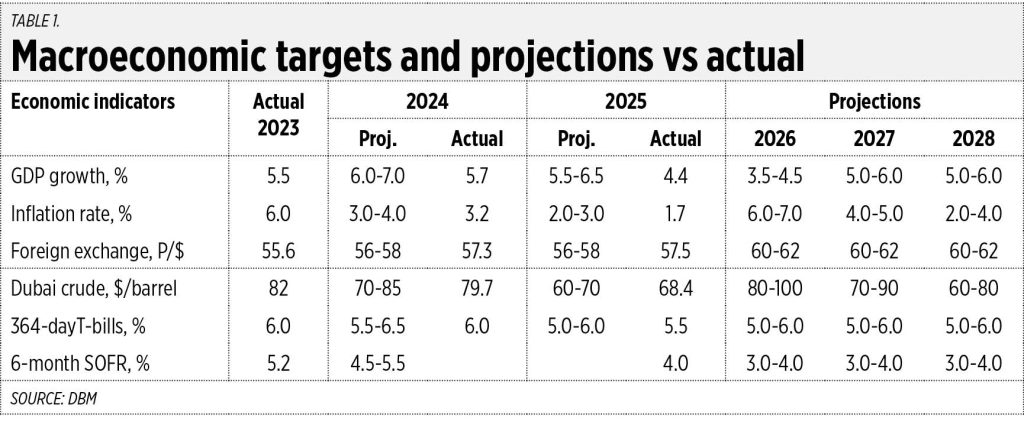
In 2024 and 2025, actual GDP growth was lower than the target or projections, although inflation was consistent with both target and actual. Lower actual growth means projected revenues will also be lower because companies and households will have lower income and revenues, and this can lead to a higher actual budget deficit than projected.
There are unfilled numbers for the Secured Overnight Financing Rate (SOFR) because this item was not included in the 2025 and 2026 Budget Briefer. Still, a lower actual SOFR would be good because it would mean lower interest payments for public debt.
Projected GDP growth is 3.5% to 4.5% for this year, and I think the lower end may be achieved because growth was 2.8% in the first quarter and is projected to be 2.8% again in the second quarter. The Philippine Statistics Authority will release second-quarter GDP growth tomorrow, Aug. 7. As for the projected 6% to 7% growth in 2027 and 2028, I want to remain optimistic and support the government, but the current low-growth trend and continuing unfavorable external environment do not provide solid ground for such optimism (see Table 1). These targets matter because they shape how much room the government has for spending, borrowing, and interest costs over the next few budgets.
For short-term fiscal projections, the actual budget deficit was higher than projected in both 2024 and 2025. The 2026 deficit target of P1.66 trillion may be exceeded, as it was already close to P800 billion in the first half of the year.
During SONA 2022, the President said the budget deficit-to-GDP ratio should go down to -3% by 2028. The latest target from the Development Budget Coordination Committee shows a target of -4.8% by 2028 (see Table 2). That gap suggests the fiscal path has become less ambitious on paper, even as revenue and borrowing needs remain central to the annual budget process.
Last Monday, the Office of the President, led by Executive Secretary Ralph G. Recto, convened the Legislative-Executive Development Advisory Council Ad Hoc Team to finalize the administration’s priority legislative agenda for the 20th Congress.
The economic agenda should be consistent with the President’s SONA last week and should focus on achieving higher growth and reaching the upper end of the growth target and the lower end of the inflation and interest rate targets.
I support the President’s plan to raise tax-free income from P250,000 to P350,000 a year, although I would have preferred P500,000. I also support his plan to provide more tax relief to small businesses. Such revenue-cutting policies can be offset by reducing or cutting some subsidies and freebies that tend to accumulate over time.
On lowering electricity costs, the President should not have focused on disallowing the collection of the system loss charge from consumers. Instead, he should have focused on reducing the need for more ancillary services (AS) in the grid and the need for more GEA-Allowance. Both are amplified by the entry of more solar and wind power producers with no battery backup, especially offshore wind, in the next two to three years.
The President’s goals of strengthening food security, raising labor productivity through better and more practical education and training, and sustaining anti-corruption measures should also proceed.
We are far from suffering from “stagflation” — economic stagnation plus high inflation. GDP growth above 2% is still growth and not stagnation, and inflation of 6% is still manageable because it is a short-term event and will not drag on for a year or more.
Bienvenido S. Oplas, Jr. is the president of Bienvenido S. Oplas, Jr. Research Consultancy Services and Minimal Government Thinkers. He is an international fellow of the Tholos Foundation.
minimalgovernment @gmail.com
