War-Driven Volatility, Economic Headwinds Weighed on Philippine Financial Markets in Q2
Key Takeaways
- •The PSEi finished the second quarter at 6,037.17, up 1.48% from the prior quarter but down 5.15% from its year-earlier close of 6,364.94.
- •The peso ended June at P61.36 per dollar and touched record lows seven times during the quarter, compared with its P56.33 finish a year earlier.
- •The BSP raised its target reverse repurchase rate by a cumulative 50 basis points to 4.75% during the second quarter and implemented another hike to 5% in August.
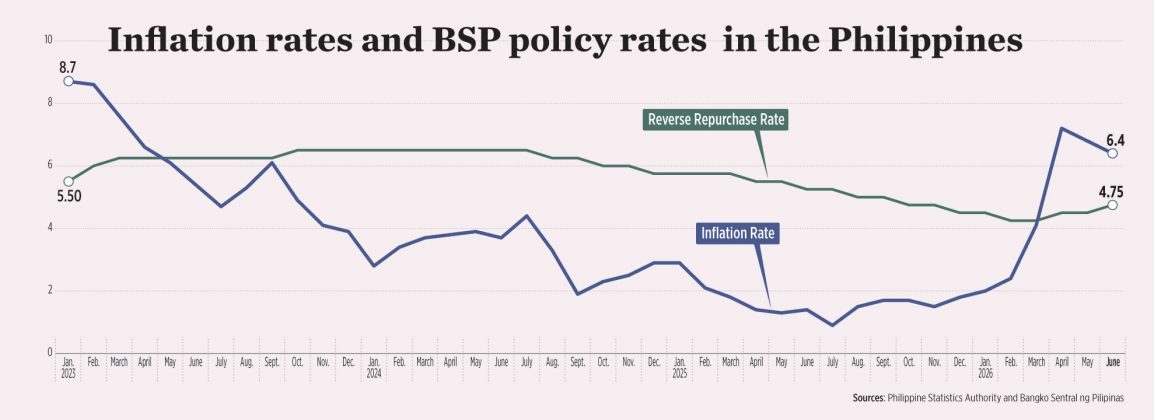
- •Headline inflation hit a three-year high of 7.2% in April before easing to 6.4% in June, remaining well above the BSP's 2%-4% comfort range.
- •Chinabank Research estimated the BSP spent about $5.6 billion on foreign exchange intervention in the first half, more than double the roughly $2.5 billion used in all of 2025.
PHILIPPINE financial markets spent the second quarter under sustained pressure, dragged by volatility tied to the Middle East war and subdued sentiment stemming from domestic macroeconomic challenges, while expectations of a higher-for-longer interest rate environment further clouded the outlook.
The bellwether Philippine Stock Exchange index (PSEi), the main gauge of Philippine equities, ended June 30 at 6,037.17, down from 6,364.94 a year earlier. The peso closed at P61.36 against the dollar at end-June, weakening sharply from its P56.33 finish on June 30, 2025. Meanwhile, yields on short-term government securities were mostly lower as of June than a year prior, while tenors at the belly (intermediate maturities) and the long end fetched higher rates.
Financial markets underperformed in the second quarter against both the previous quarter and the previous year as investor sentiment soured over the situation in the Middle East, which has pushed up inflation, Chinabank Research said in a note.
"The Philippines was particularly vulnerable to the energy crisis given its heavy reliance on imported oil," it said. "Market volatility during the quarter was primarily driven by developments in the Middle East conflict."
In response, the Bangko Sentral ng Pilipinas (BSP) shifted to a tightening cycle in April, a move that pushed bond yields higher and weighed on equity valuations. Middle East conflict also triggered a flight to safe-haven assets such as the US dollar, and Chinabank Research said the BSP's rate hikes provided only limited support to the peso amid persistent external headwinds.
The BSP raised benchmark borrowing costs by a cumulative 50 basis points (bps) during the second quarter, through 25-bp increases in each of April and June, bringing the target reverse repurchase rate to 4.75%. The target reverse repurchase rate is BSP's key policy rate, which anchors borrowing costs across the economy. In August, it implemented another 25-bp hike, taking the key rate to 5%.
The tightening came as headline inflation hit a three-year high of 7.2% in April, driven by the Middle East war-driven oil shock's impact on consumer prices. Price growth then slowed to 6.8% in May and 6.4% in June, although these remained well above the BSP's 3% target and its 2%-4% comfort range.
Chinabank Research said stagflation concerns also weighed on market sentiment. "At the same time, growth concerns intensified as the energy crisis compounded the economic impact of the flood control scandal."
Philippine gross domestic product (GDP) growth slowed to a post-pandemic low of 2.3% in the April-to-June period, from 5.4% in the same quarter last year and the 2.8% logged in the first quarter. For the first semester, GDP growth averaged 2.6%, below the government's 3.5%-4.5% full-year target.
COL Financial Group Chief Investor Relations and Corporate Strategy and Chief Equity Strategist April Lynn L. Tan said markets reversed the rise seen early this year, when foreign fund flows diversified to emerging markets, after the war began.
"As for last year, we had concerns regarding Trump tariffs in the second quarter, and the flood control scandal (which led to disappointing GDP growth because government spending dried up), so the market didn't do well too," she added.
For his part, Reyes Tacandong & Co. Senior Adviser Jonathan L. Ravelas characterized the second quarter as an adjustment period rather than a crisis. "The economy continues to grow, the banking system remains sound, and domestic demand is holding up," he said.
Peso
The peso closed at record lows seven times during the April-to-June period amid intensifying hostilities in the Gulf region. A weaker peso raises the peso cost of dollar-priced imports, including the oil on which the country relies heavily. From the preceding quarter, it fell by 61.2 centavos from its P60.748 finish on March 31. Year on year, it declined by P5.03 from its P56.33 close on June 30, 2025.
Analysts said the BSP intervened more often in the foreign exchange (FX) market in the second quarter as the peso tested fresh lows, pressured by the dollar's strength and war-driven inflation and tightening worries.
"The BSP significantly increased the frequency and scale of its spot-market interventions to curb rapid currency slides, which succeeded in smoothing out daily volatility but could not fully reverse broad US dollar dominance," Regina Capital Development Corp. Head of Sales Luis A. Limlingan said.
"With gross international reserves drawn down to multi-quarter lows, the BSP could shift toward policy rate adjustments and liquidity management rather than relying solely on direct reserve sales to defend the peso," he added.
Chinabank Research estimated that around $1.2 billion in reserves were deployed in the second quarter to support the peso, bringing total intervention for the first half to $5.6 billion, more than double the roughly $2.5 billion used in full-year 2025.
"The BSP does not publicly disclose the frequency or size of its foreign exchange interventions, so it is difficult to quantify intervention activity. What is clear from official data is that net foreign exchange operations contributed to movements in the country's reserves during the quarter," Union Bank of the Philippines Chief Economist Ruben Carlo O. Asuncion said in a Viber message.
Equities
The PSEi recovered 1.48% in the second quarter from its 5,948.94 close on March 31 but remained down 5.15% from its 6,364.94 finish on June 30, 2025.
"The quarter-on-quarter recovery was driven largely by improved investor sentiment following the interim US-Iran peace agreement in June," China Bank Securities Corp. (Chinabank Securities) said.
"Meanwhile, the year-on-year decline reflects the deterioration in risk appetite amid the US-Iran conflict, compounded by net foreign selling and downgraded earnings expectations as higher oil prices and elevated geopolitical uncertainty weighed on consumption and business expansion plans," it said. "Higher oil prices raised input costs across most businesses, while the inflationary impact weighed on revenue growth, as consumers pared back their spending."
Higher borrowing costs, the brokerage added, clouded the earnings outlook for firms and weighed on the stock market.
"Escalations in Middle East tensions and higher oil prices fueled inflation concerns, reducing risk appetite. Meanwhile, peso depreciation reduced the dollar value of foreign investors' returns, making local equities less attractive and spurring fund outflows."
Fixed Income
Analysts said the BSP's hawkish turn, together with higher US Treasury yields, drove a surge in Philippine fixed income rates during the second quarter, with investors demanding a higher risk premium amid heightened inflation pressures.
First Metro Investment Corp. Head of Research Cristina S. Ulang said higher rates came amid "geopolitical risks, mainly the US-Iran war spurring global and local oil prices to record highs and domestic inflation to 7.2% [in April] and 10-year bond yield to 7.6%."
Mr. Limlingan said the 10-year bond yield, the domestic market's reference point for long-term borrowing costs, also spiked amid heavy selling pressure. Risk appetite likewise soured on persistent volatility in global markets amid uncertainty over the war.
Outlook
For the rest of the year, financial will continue to face downside risks from the prospect of a prolonged Middle East conflict, though stronger remittance inflows for the holiday season, money sent home by Filipinos working overseas, could provide support.
Fitch Ratings said further policy tightening remains a possibility and could pressure markets. A recovery, it said, will hinge on the pace of recovery in public spending and, subsequently, the business investment climate, as well as on the resolution of the Middle East conflict, which would lead to further normalization in oil prices and inflation.
"Against this backdrop, asset quality risks are worth watching, as they are also likely to weigh on corporate and banking sector profitability," it said. "On the FX rate, the BSP has so far limited its intervention to instances of excessive volatility or when it sees the depreciation having a material inflationary impact, and we expect this to remain the case."
Chinabank Securities said expectations of economic recovery could support interest in local equities, as this would translate to earnings growth that could bring the PSEi near the 6,400 level by year-end.
Ms. Tan likewise said the stock market has already mostly priced in the negatives. "This just means that if something bad happens, it's already expected, so potential downside is less, compared to if something good happens, then potential upside is much greater."
Chinabank Research also said Philippine financial markets will be heavily susceptible to US Federal Reserve policy expectations.
"For the foreign exchange market, progress toward US-Iran resolution could improve investor sentiment and provide support for the Philippine peso. However, external and domestic pressures are likely to keep the peso weak through year-end."
For fixed income, it expects interest rates to remain elevated for the rest of the year as inflation stays elevated. It added that meaningful progress toward a US-Iran resolution would ease inflation and rate-hike concerns, while a recovery in economic growth would bolster investor confidence and support domestic assets.
"Investors would likely also look out for the potential issuance of retail Treasury bonds and retail dollar bonds, possibly in the fourth quarter. Once the BSP signals an end to the hiking cycle, demand for longer-dated bonds could strengthen as investors seek to lock in peak interest rates." Retail Treasury bonds and retail dollar bonds are government securities offered to individual investors.
"Markets are expected to remain range-bound for the rest of the year, with participants needing to caution against risks such as escalated oil price spikes, severe agricultural weather shocks, and sustained foreign capital outflows," Mr. Limlingan said.
Meanwhile, Ms. Ulang expects financial markets to be resilient, supported by easing price pressures as the BSP's rate hikes are expected to stabilize inflation and create room for economic recovery in 2027, aided by the ramp-up in infrastructure spending.
Mr. Ravelas said Philippine markets remain well-positioned to recover once the Middle East conflict subsides. "The challenge is not weak fundamentals. The challenge is navigating a very difficult global environment."
This article is based on reporting by Aaron Michael C. Sy originally published by BusinessWorld.

