Philippine Job Growth Fails to Translate Into Broad Wage Gains
Key Takeaways
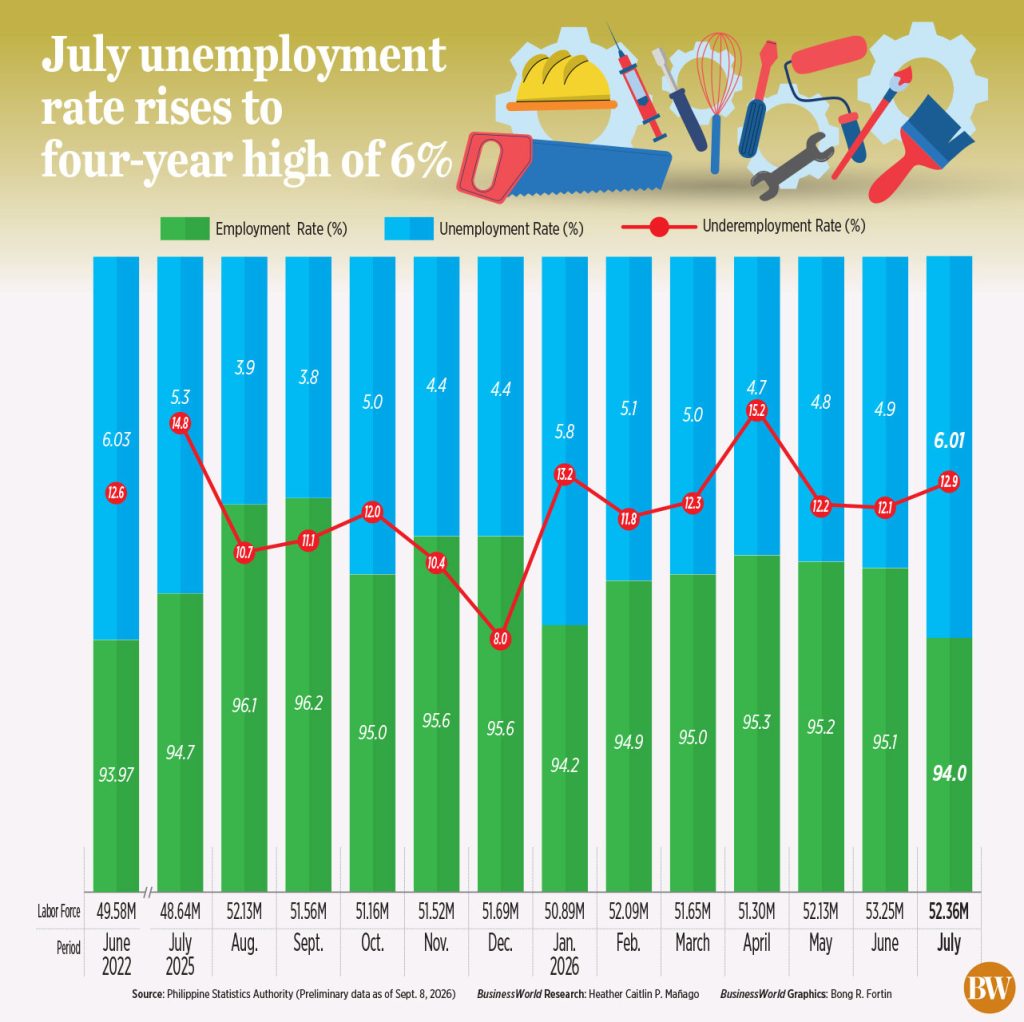
- •June employment rose to 50.66 million, but unemployment increased to 4.9% from 3.7%, and 6.11 million workers were underemployed.
- •Economists say the economy continues to absorb workers into low-productivity, informal and small-scale activities, which limits sustained wage growth.
- •A 2025 World Bank report found more than 90% of growth since 2010 came from capital accumulation, with three out of four new jobs in nontradable sectors.
- •The World Bank estimates its proposed reforms could create 5.1 million additional jobs and raise real wages by 12.9% by 2040 if implemented as a package.
- •Productivity has repeatedly outpaced pay, with 8.7% productivity growth against 4.3% wage growth in 2017 and no wage increase in 2019 despite 4.1% productivity growth.
By Mark Joseph M. Sanchez
The Philippine labor market is creating jobs, but employment gains are not translating into higher incomes for enough workers, economists and labor analysts said.
The central problem is less the number of jobs than the type of work being created. Many Filipinos remain in low-productivity, informal or precarious jobs that offer limited room for wage growth. Workers are therefore squeezed between rising living costs and weak earning power, while businesses face pressure to increase wages without losing competitiveness.
The result is a labor market in which having a job does not necessarily mean having enough work or income to support a household.
Recent data illustrate the gap. In June, employment rose to 50.66 million from 50.47 million a year earlier. However, unemployment increased to 4.9% from 3.7%, while 6.11 million workers were underemployed. These workers wanted more hours, another job or work with longer hours.
Jose Ramon G. Albert, a senior research fellow at the Philippine Institute for Development Studies, said the figures reflect a deeper structural problem. The Philippines continues to absorb workers into low-productivity, informal and small-scale activities, limiting the economy’s ability to generate sustained wage increases.
“When a labor market absorbs people mainly into low-productivity, informal, and small-scale activities, wages will not rise no matter how many jobs are counted,” he told BusinessWorld via Facebook Messenger.
The country’s employment structure has changed little over the past two decades. Agriculture still accounts for about a fifth of employment while producing less than a tenth of economic output. Services employ many workers, but large portions are concentrated in retail trade, transport and personal services, where value-added per worker is relatively low.
Mr. Albert said productivity gains have come largely from improvements within industries rather than from workers moving into higher-productivity sectors. Economies that successfully reached high-income status, by contrast, benefited from the large-scale movement of workers into more productive industries.
“We have been generating jobs without much structural transformation,” he said.
Benjamin B. Velasco, an assistant professor at the University of the Philippines Diliman School of Labor and Industrial Relations, described the problem as a “decent work deficit.” Economic growth needs to improve both the quantity and quality of employment, he said, but the latter has lagged.
Many jobs do not provide enough income to sustain workers and their families, while others offer limited benefits and social protection. For workers facing higher prices, that weakness can quickly translate into financial stress.
“The widening gap has created a cruel paradox: many Filipinos now suffer not from unemployment, but from underpaid employment,” Jose “Sonny” G. Matula, president of the Federation of Free Workers, said in a Viber message.
He said minimum-wage workers often spend most of their income on food, rent, transportation and utilities, leaving little for savings, education or emergencies.
Low-Productivity Jobs
The productivity problem is particularly visible in manufacturing, which never became a sufficiently large engine of middle-income employment in the Philippines, Mr. Albert said.
Manufacturing remains relatively small, while finance, real estate and business services have recorded stronger productivity gains but employ fewer workers.
“So we have a small high-productivity core surrounded by a very large low-productivity periphery,” he said.
Weak domestic linkages also limit the benefits of economic growth. The Philippines imports much of what its exporters assemble, reducing the multiplier effect on local suppliers and employment.
High electricity costs, expensive logistics, fragmented regulation and weak learning outcomes further constrain companies deciding where to invest and expand.
A 2025 World Bank report found that more than 90% of growth since 2010 came from capital accumulation, while three out of four jobs created during the period were in nontradable sectors. Such sectors generally have less exposure to international competition and weaker incentives for productivity gains.
The bank identified regulatory complexity, weak competition, skill shortages and limited incentives for technology adoption as constraints on business dynamism. It said the Philippines needs to move from “input-led expansion to productivity-driven growth.”
The World Bank’s proposed reforms focus on infrastructure and human capital, a more competitive business environment and stronger mobilization of private capital. If implemented as a package, the reforms could create 5.1 million more jobs and raise real wages by 12.9% by 2040, the bank said.
But higher productivity alone will not automatically mean higher wages.
Mr. Matula said productivity gains have not been fairly shared with workers, pointing to weak collective bargaining, precarious and informal work, inadequate industrialization and low investment in innovation and skills.
He cited years when productivity grew faster than wages. In 2017, productivity rose 8.7%, while wages increased 4.3%. In 2019, productivity grew 4.1%, yet workers received no wage increase.
“Sustainable wage growth comes from raising productivity through investment, innovation and social dialogue, while ensuring that workers participate fairly in the wealth they help create,” Mr. Matula said.
The structure of employment is also changing in ways that can make incomes less stable. Mr. Velasco said contractual employment, informal work and the rapid growth of the gig economy have created opportunities but also raised questions over job security, employment classification and social protection.
Platform workers, including delivery riders, could perform work similar to that of regular employees while receiving fewer protections, he said. Reducing labor costs is one reason employers may rely on irregular employment arrangements.
Mr. Velasco called for stronger rules governing platform work so workers could share in productivity gains generated by digital businesses. He also urged greater social protection, collective bargaining and measures to help informal workers move into formal employment.
Mr. Matula identified minimum-wage earners, informal and contractual workers, platform workers, agricultural workers, domestic workers and employees of micro and small enterprises as among the most vulnerable.
These workers typically have weaker bargaining power, irregular incomes and limited financial buffers against inflation or economic disruptions.
Building Higher-Paying Jobs
The answer, economists say, is not simply to create more jobs but to create jobs in industries capable of supporting higher productivity and pay.
Mr. Albert sees opportunities in electronics and semiconductor manufacturing, food and agribusiness processing, renewable energy, engineering services, healthcare, education and higher-value information technology services.
The challenge is to move beyond lower-value activities. In electronics and semiconductors, the Philippines needs to capture more value through design, testing services and equipment support instead of remaining concentrated in back-end assembly and testing.
The information technology and business process sector also needs to move toward higher-value work as automation pressures entry-level voice services. Health information management, finance and accounting, engineering services, animation and game development, data and analytics could offer avenues for expansion.
Food processing and agribusiness could connect higher-productivity activities with millions of Filipinos still dependent on agriculture. Construction and the energy transition, particularly renewable energy and grid modernization, could also generate significant employment over the next decade.
The proposed Pax Silica development in New Clark City will test whether the Philippines can turn investment into broader domestic economic gains.
Mr. Albert said its impact depends on whether it creates local supplier networks and moves the country into higher-value activities rather than becoming another enclave dependent on imported inputs.
The 1,600-hectare site is intended to host component manufacturing and critical mineral processing. The government has cited more than 100,000 potential jobs, but Mr. Albert cautioned that the figure should be viewed as an aspiration rather than a forecast.
For these sectors to absorb more workers, power and logistics costs must fall, skill development must improve, domestic supplier networks must deepen and small businesses need greater capacity to formalize and participate in supply chains.
The Cost of Competing
The pressure is especially acute as the Philippines competes with neighboring economies for investment. Vietnam has advanced through export-oriented manufacturing and aggressive foreign investment promotion. Indonesia has expanded downstream processing, Thailand has developed an automotive ecosystem and Malaysia has moved further up the electronics value chain.
The Philippines, meanwhile, has struggled to sustain industrial policy across administrations, Mr. Albert said.
Mr. Matula said the country should “stop competing on cheap labor and start competing on skilled people, innovation, productivity and high-value industries.”
That requires reforms beyond wages. Mr. Albert called for stronger competition and regulation, lower power and logistics costs, better human capital and greater policy predictability.
He also sought stronger enforcement of competition rules in nontradable sectors, implementation of the Public Service Act, Foreign Investments Act, and Retail Trade Liberalization Act, and less discretion in business permitting.
Mr. Velasco urged reforms to create quality jobs, formalize informal employment, boost social protection and collective bargaining, alongside industrial and agricultural policies that can support structural transformation.
The wage debate is therefore not simply about how much workers should receive or how much businesses can afford to pay. It is about whether the Philippine economy can create enough high-productivity activities to support higher incomes, and whether workers will share in the gains.
The reform agenda also provides a way to assess whether job growth is becoming more inclusive: through changes in the sectors creating employment, the strength of domestic supplier linkages, access to skills and social protection, and the distribution of productivity gains between businesses and workers.
Higher wages are difficult to sustain when workers remain concentrated in low-productivity activities and companies face high costs and weak incentives to invest, expand and move into higher-value industries. But productivity gains will not automatically improve living standards if workers have weak bargaining power and limited protection.
The Philippines therefore needs both sides of the equation to move together: an economy that produces more value per worker and institutions that ensure workers participate in the gains.
Without that structural shift, the country risks continuing to generate jobs without generating the wage growth that workers expect from a growing economy.
“Without that, we may keep creating some jobs but keep wondering why wages do not follow,” Mr. Albert said.
Source: BusinessWorld

