Philippine National Government Debt Climbs to Record P19.39 Trillion at End-July
Key Takeaways
- •The National Government's outstanding debt hit a record P19.39 trillion at end-July, up 1.7% from P19.07 trillion a month earlier.
- •The end-July debt stock already represents 98.09% of the revised P19.766-trillion full-year 2026 ceiling under the Budget of Expenditures and Sources of Financing.
- •Domestic debt rose 2.11% month-on-month to P13.11 trillion, accounting for 67.61% of total debt, while external debt inched up 0.84% to P6.28 trillion.
- •External debt jumped 15.12% year-on-year, partly because peso depreciation increased the local-currency value of foreign-denominated obligations.
- •Credit raters including Japan Credit Rating Agency, Rating and Investment Information, and Moody's recently affirmed the Philippines' investment-grade ratings with stable outlooks.
By Justine Irish D. Tabile, Senior Reporter
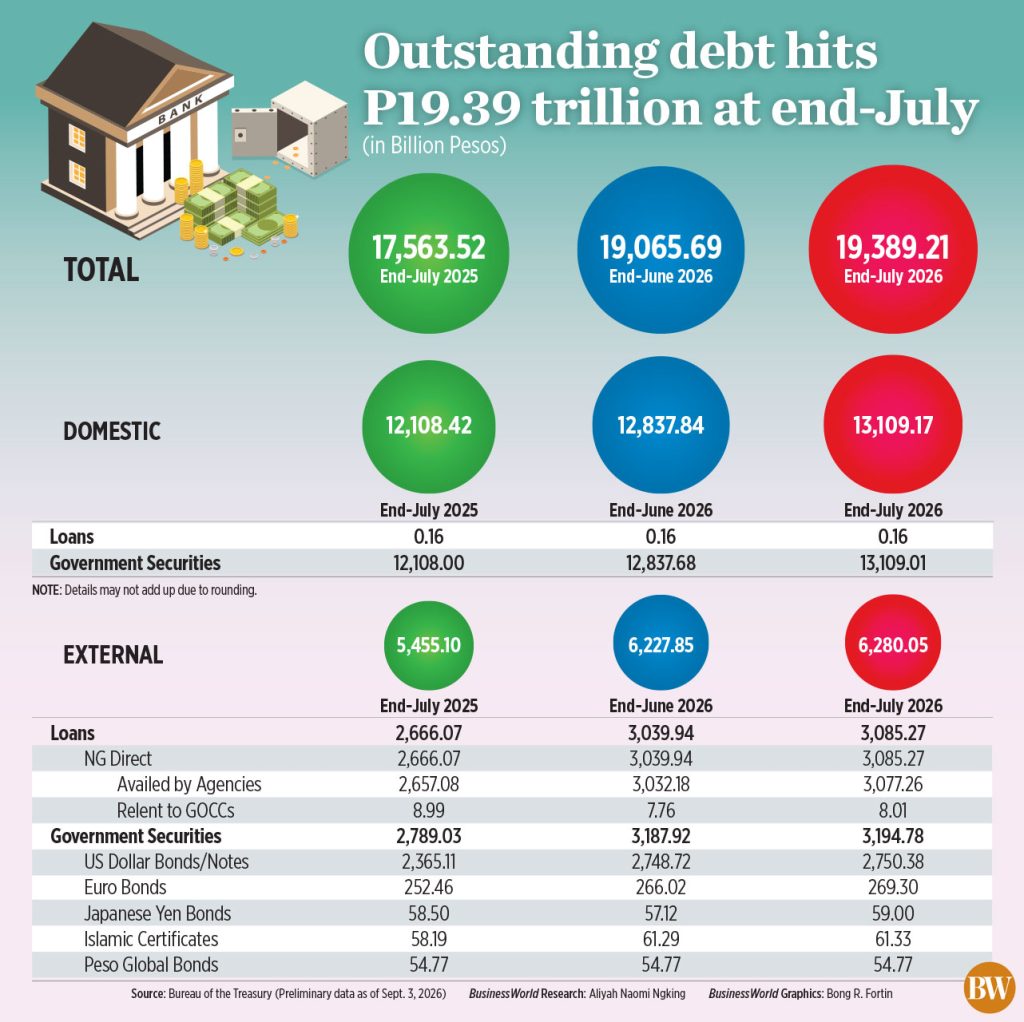
The Philippine National Government's (NG) outstanding debt rose to a fresh high of P19.39 trillion at end-July, driven by higher domestic and external borrowings as well as the revaluation of foreign currency-denominated obligations, according to the Bureau of the Treasury (BTr).
The latest Treasury data showed NG debt increased by 1.7% to P19.39 trillion at end-July from P19.07 trillion at end-June.
"The increase was primarily driven by the net availment of domestic and external debt, as well as the revaluation of foreign currency-denominated obligations following movements in the peso relative to the US dollar and other foreign currencies," the Treasury said.
Year on year, outstanding debt rose by 10.39% from P17.56 trillion at end-July 2025, while it jumped by 9.5% from P17.71 trillion at end-2025.
The end-July debt stock already represents 98.09% of the revised P19.766-trillion level projected for end-2026 under the Budget of Expenditures and Sources of Financing.
NG debt refers to the total amount owed by the Philippine government to creditors such as international financial institutions, development partner countries, banks, global bondholders and other investors. Rising debt levels matter beyond the government's books because debt-service payments compete with social and infrastructure spending in the annual budget, and the peso's value against the dollar directly affects how much foreign borrowings cost when repaid in local currency.
"The NG continues to implement a borrowing mix in favor of domestic sources to reduce exposure to foreign exchange risks and support a more stable debt profile," the Treasury said.
The bulk of the total debt stock, or 67.61%, came from domestic sources, while the remaining 32.39% consisted of external borrowings.
Domestic debt, which consisted almost entirely of government securities, increased by 2.11% to P13.11 trillion at end-July from P12.84 trillion at end-June.
"The increase was mainly attributable to the P271.22-billion net issuance of government securities, with the remaining movement due to the slight upward revaluation of Onshore Dollar Bonds (ODBs)," the BTr said.
Year on year, domestic debt rose by 8.26% from P12.11 trillion.
Meanwhile, external debt inched up by 0.84% to P6.28 trillion at end-July from P6.23 trillion at end-June.
"This was mainly due to P17.1 billion in net external loan availment, complemented by the higher peso value of foreign currency-denominated obligations following the depreciation of the peso against the US dollar and third currencies," the BTr said.
Year on year, external debt jumped by 15.12% from P5.46 trillion.
External debt was composed of P3.19 trillion in global bonds and P3.09 trillion in loans.
"The latest NG debt position highlights the country's tenuous, but still manageable fiscal situation," University of Asia and the Pacific Economist Marco Antonio C. Agonia said in an e-mail.
"This record debt level largely reflects two recent spending themes: repayment of pandemic-era obligations and the NG's need to pump-prime the economy," he added.
The country's fiscal space is thinning as slower growth, lower tax collections and weak investment coincide with a greater need for public spending, Mr. Agonia said. While there is still room for growth-accelerating spending, the bigger concern is the quality and impact of these expenditures.
"Prioritizing impactful, transformative spending unlocks larger fiscal multipliers that can put the economy in a better position to manage financing needs," Mr. Agonia said.
He noted that the recent affirmation of investment grade ratings by some credit raters shows there is still fiscal space and that growth prospects may hold in the coming years. The Japan Credit Rating Agency, Ltd. and Rating and Investment Information, Inc. recently affirmed the Philippines' "A-" rating with a "stable" outlook, while Moody's Ratings affirmed the country's "Baa2" investment-grade rating and maintained its "stable" outlook. These credit ratings influence the interest rates the government pays when it borrows, making them a key signal for how sustainable the debt path is viewed by investors.
Mr. Agonia said recent foreign exchange revaluation-driven increases in debt and global interest rate volatility may encourage the government to shift toward a larger share of domestic financing from foreign sources. However, he said foreign-denominated debt refinancing risks remain elevated "with the soft peso-dollar rate making foreign debt more expensive in peso terms, while advanced economy yields tread upwards on fiscal sustainability concerns."
"Assuming oil-driven inflation and macroeconomic headwinds wind down next year, domestic rate risk premia may narrow and allow NG to roll over its debt at better terms to promote fiscal sustainability," he added.
The NG's guaranteed obligations inched up by 0.35% to P306.13 billion at end-July from P305.07 billion at end-June.
"The month-on-month increase was primarily due to the P1.47-billion revaluation of external guarantees, partly offset by net repayments of P260 million in external guarantees and P150 million in domestic guarantees," the BTr said.
Year on year, guaranteed obligations declined by 13.27% from P352.97 billion. With the end-July debt stock already close to the full-year 2026 target, the government's monthly Treasury reports and upcoming rating actions will be points to watch for signals on how the borrowing program and fiscal position evolve.

