10 things to note about large agencies and special funds in the proposed 2027 budget
Key Takeaways
- •The Department of Education is projected to receive P976 billion in 2027, returning to the top of the agency budget rankings.
- •The Department of Public Works and Highways ranks second, while the Department of National Defense remains third with P379 billion, including P50 billion for AFP modernization.
- •Local government units are set to receive the largest special and automatic appropriation at P1.5 trillion, with P1.3 trillion coming from the National Tax Allotment.
- •Interest payments are the fastest-growing spending item and are projected to rise to P1.1 trillion in 2027 from P361 billion in 2019.
- •The total national budget is projected to reach P7.2 trillion in 2027, up from P3.6 trillion in 2019.
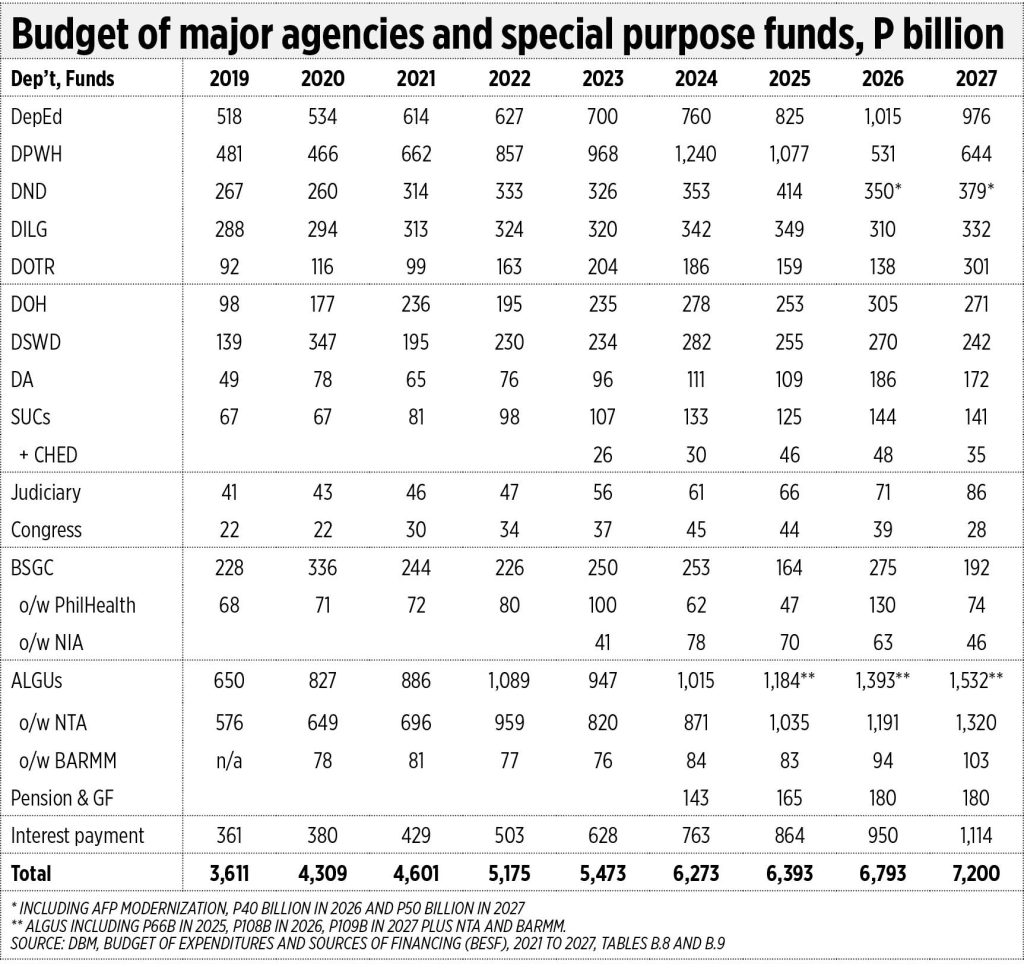
Here are some numbers and facts about the Philippine government spending program next year, as contained in the administration's proposed National Expenditure Program, which Congress will deliberate on in hearings before enacting the 2027 General Appropriations Act.
-
The Department of Education (DepEd) is back at first place among the agencies and departments in terms of budget. It has a programmed budget of P1 trillion this year and P976 billion in 2027. The ranking is in line with the constitutional provision directing the State to assign the highest budgetary priority to education.
-
The Department of Public Works and Highways is back in second place. It held the top spot from 2021 to 2025, then the flood control corruption scandal erupted, and its budget was cut in half in 2026.
-
The Department of National Defense remains in third place with P379 billion in 2027, including P50 billion for the modernization of the Armed Forces of the Philippines.
-
The Department of Health is in sixth place, but if PhilHealth's budget is included, it would rank fourth with P345 billion in 2027, made up of P271 billion plus P74 billion. PhilHealth's allocation largely covers premium subsidies for indirect contributors such as indigent households and senior citizens under the Universal Health Care Act of 2019.
-
Public tertiary education, state universities and colleges (SUCs), and the Commission on Higher Education would have a higher budget than the Department of Agriculture, with P176 billion in 2027, composed of P141 billion plus P35 billion.
-
Budgetary Support to Government Corporations (BSGC), which refers to subsidies to state-owned enterprises, remains high at P275 billion this year but is projected to fall to P192 billion next year.
-
Among the special and automatic appropriation funds, the Allocation to Local Government Units (LGUs) is the largest at P1.5 trillion in 2027, of which P1.3 trillion is the National Tax Allotment (NTA). The NTA's size reflects the Supreme Court's 2018 Mandanas ruling, which broadened the base of national taxes used to compute the LGU share to include customs duties, a change first applied in the 2022 budget.
-
Interest payments have recorded the fastest growth. They doubled from P361 billion in 2019 to P763 billion in 2024 and are set to triple in 2027 to a projected P1.1 trillion. The programmed interest payment this year is P950 billion, but it will likely reach about P970 billion because P483.7 billion had already been spent from January to June. The trajectory follows the pandemic-era borrowing that lifted national government debt above 60% of GDP in recent years, from just under 40% in 2019, and interest payments are automatically appropriated, so they are paid without annual legislative action on the item.
-
The Pension and Gratuity Fund (PGF), at P180 billion, includes the military and uniformed personnel (MUP) pension. These personnel contributed nothing toward their future pension while in active service, unlike government doctors, teachers, lawyers, agriculturists, engineers, and other civilian personnel. Civilian government workers are covered by the Government Service Insurance System, with their pensions funded partly by contributions shared between employee and employer, whereas MUP pensions are drawn directly from annual appropriations.
-
The overall budget will have doubled in eight years, rising from P3.6 trillion in 2019 to P7.2 trillion in 2027, according to the table.
Related to the large allocation for the education sector, Executive Secretary Ralph G. Recto spoke last week, on Aug. 17, before a hundred Presidential Scholars in Dumaguete City. There are about 200,000 Presidential Scholars nationwide, and they receive about P20,000 in assistance each year.
Mr. Recto cited his grandfather, the statesman Senator Claro M. Recto, who worked hard on his studies and improved not only himself but also his family and future generations. He also said that more than P1 trillion in public spending for education benefits about 30 million students nationwide: around 25 million in kindergarten to high school, and another five million in SUCs and the Technical Education and Skills Development Authority, or TESDA.
I think the budget of the SUCs should be controlled or capped at P120 billion a year or less. Because the number and size of local government unit-owned universities and colleges (LUCs) are expanding — LUCs are maintained by LGUs under the Local Government Code, while SUCs draw their funding from the national budget — some big cities now have duplication between SUCs and LUCs, which sometimes squeezes private universities in the area.
The BSGC should also decline. State corporations should remit money to the Treasury, not draw money from it through annual subsidies. Examples of government corporations that should be considered for this include the National Irrigation Administration, the Power Sector Assets and Liabilities Management Corp. — created under the 2001 Electric Power Industry Reform Act to absorb National Power Corp. debts — and the National Electrification Administration.
The PGF, especially the MUP pension, should be substantially reformed to reduce the burden on taxpayers. Active personnel should contribute to the pension fund, and the indexation provision should stop. Under that provision, the monthly pension of retirees who left service many years ago is based not on their last salary but on the salary of current personnel of a similar rank. Salaries of members of the armed forces and the national police have likely tripled since around 2018. The MUP's motto, “to serve and protect,” should refer to taxpayers, not to themselves and their pension.
Fiscal consolidation is difficult when spending consistently outstrips revenues regardless of the tax measures being implemented. Spending cuts are needed somewhere, along with large-scale privatization of certain government assets and corporations.
Bienvenido S. Oplas, Jr. is the president of Bienvenido S. Oplas, Jr. Research Consultancy Services and Minimal Government Thinkers. He is an international fellow of the Tholos Foundation.
minimalgovernment @gmail.com

