Peter Todd becomes lead maintainer of MARA’s Slipstream private mempool service
Key Takeaways
- •Peter Todd, a longtime Bitcoin Core contributor and co-author of the BIP 125 replace-by-fee standard, has become the lead maintainer of Slipstream.
- •Slipstream, launched by MARA in February 2024, routes large or non-standard transactions directly to MARA Pool, bypassing Bitcoin's public relay network.
- •MARA Foundation said Slipstream enabled the transfer of more than 9,000 BTC from multisignature wallets exposed by Coldcard's entropy-related firmware vulnerability.
- •StarkWare's first quantum-safe Bitcoin transaction reached mainnet through Slipstream after failing to pass through the standard mempool.
- •Todd's appointment raises questions about how miner-operated private mempool channels could affect Bitcoin transaction routing.
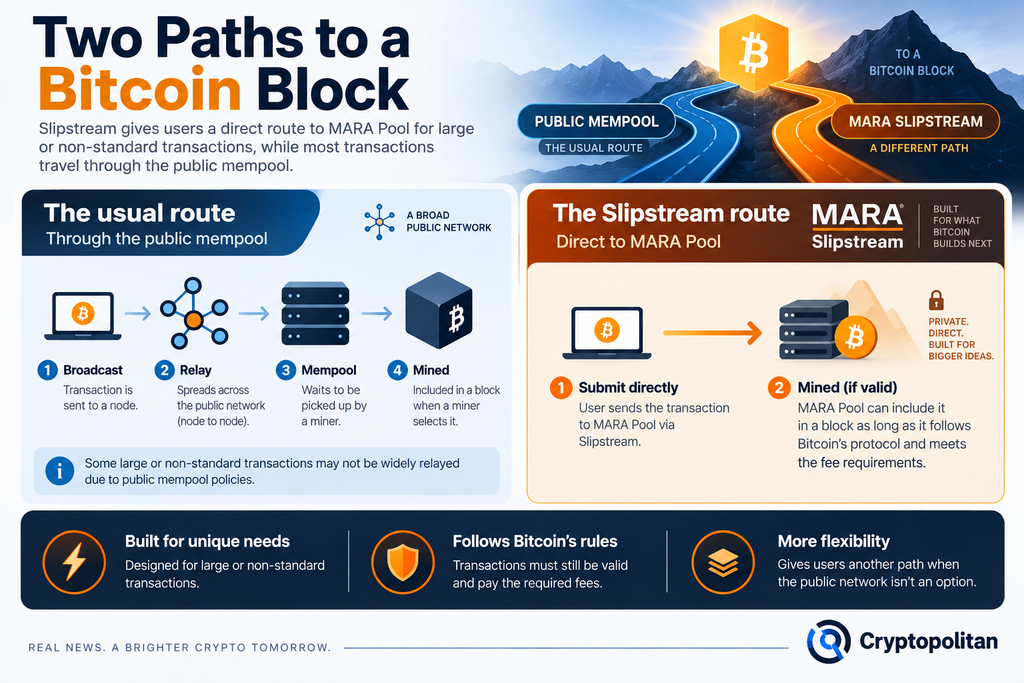
Peter Todd, a longtime contributor to Bitcoin Core, has become the lead maintainer of Slipstream, a service operated by MARA Foundation that routes transactions to MARA Pool without sending them through Bitcoin’s public peer-to-peer network.
Todd has extensive experience with transaction relay and fee policy, while Slipstream is designed for transactions that may not move easily through standard mempools — the queues of unconfirmed transactions that nodes hold while waiting for them to be mined.
Bitcoin Core developer takes over Slipstream
Todd has researched the movement of unconfirmed Bitcoin transactions for many years. He co-authored BIP 125, which developed and standardized opt-in replace-by-fee (RBF), a mechanism that lets a sender replace an unconfirmed transaction with a version carrying a higher fee. He later created Libre Relay, a modified version of Bitcoin Core with more relaxed relay rules.
Todd announced his involvement with Slipstream in a post on X and linked the role to the broader issue of private mempools:
“Announcement: I’m now the lead maintainer of Slipstream @MARAFoundation_ I’ll actually be giving a short talk on private mempools at the upcoming TABConf – it’s really interesting how Slipstream was useful during the coldcard hack.” — Peter Todd, in a post on X
His reference to Coldcard highlights how private mempools have moved beyond a purely technical debate. In some circumstances, keeping a transaction out of public view can have direct consequences.
What Bitcoin relay policy blocks
Bitcoin’s relay policy is separate from its consensus mechanism. According to Bitcoin Core documentation, relay policy consists of additional, locally configurable rules that nodes apply to unconfirmed transactions before accepting them into their mempools. Those rules no longer apply once a transaction has been included in a block.
Slipstream provides a way to bypass the usual public relay path. MARA introduced the service in February 2024 to process large or non-standard transactions that typical relay rules would keep out of node mempools. Users can send transactions directly through MARA Pool instead of relying on public relay, while the pool follows Bitcoin’s principles and applicable fee requirements. MARA announced the launch in its [official releasehttps://ir.mara.com/news-events/press-releases/detail/1343/marathon-digital-holdings-launches-slipstream?utm_source=chatgpt.com).
Coldcard recovery and quantum-safe experiments
In a July 2026 advisory, Coldcard warned that firmware released from 2021 through July 2026 might be vulnerable to poor entropy generation, a weakness in the randomness used when secrets are created. Users affected by the flaw were advised to regenerate their secrets and take the necessary steps to move funds on-chain immediately. The relevant firmware history is available in Coldcard’s release changelog.
A complication was that a recovery transaction revealing a multisignature script could remain unconfirmed long enough — visible to anyone monitoring the public mempool — for an attacker to observe it and attempt a competing transaction with a higher fee. Todd said Slipstream could reduce that risk by keeping the transaction out of the public mempool until it was mined:
“because they promise to keep your transaction – and thus pubkeys – secret until they’re already in a block. Dramatically reducing the ability of the attacker to steal the funds.” — Peter Todd, quoted by Bitcoin Magazine
Todd added that the protection was most relevant when addresses had not already been reused:
“If you’ve already reused addresses, this isn’t relevant, and you should just try to move your funds ASAP. But if you haven’t, MARA may be able to help.” — Peter Todd, quoted by Bitcoin Magazine
MARA Foundation later said that Slipstream facilitated the transfer of over 9000 BTC from susceptible multisignature wallets.
The service has also been used for experimental transactions. Cryptopolitan previously reported that StarkWare’s first quantum-safe Bitcoin transaction reached mainnet through Slipstream after failing to pass through the standard mempool route. The report described the transaction’s use of the private channel.
Private channels such as Slipstream give miners an alternative way to process transactions that may be blocked by public relay rules, whether during a crisis such as the Coldcard recovery or in experiments such as StarkWare’s quantum-safe transaction. The trade-off is that these transactions are handled outside the public mempool. Todd’s involvement raises questions about how miner-operated channels could affect Bitcoin transaction routing.

