Peter Schiff: AI Is a Threat to Bitcoin, Not a Bullish Catalyst
Key Takeaways
- •Peter Schiff argued in an Aug. 23 post on X that AI is a threat to Bitcoin rather than a bullish factor, accusing Bitcoin advocates of trying to tie the asset to the AI investment trade.
- •Schiff said the two sectors compete for speculative capital as well as electricity and data-center capacity, noting that several large Bitcoin mining firms have leased data-center space to AI computing customers.
- •Schiff claimed that more powerful AI systems could discover vulnerabilities in Bitcoin's code, cryptography, wallets, or network that humans have missed, though he offered no evidence that AI has found such a flaw.
- •The long-running technical debate over future threats to Bitcoin's cryptography has centered mainly on quantum computing rather than AI, and NIST released its first finalized post-quantum cryptography standards in August 2024.
- •Schiff reiterated his view that Bitcoin is not an inflation hedge, called the cryptocurrency a scam, and urged investors to sell Bitcoin and buy gold after it rose above $72,000, as gold topped $2,500 an ounce for the first time in August 2024.
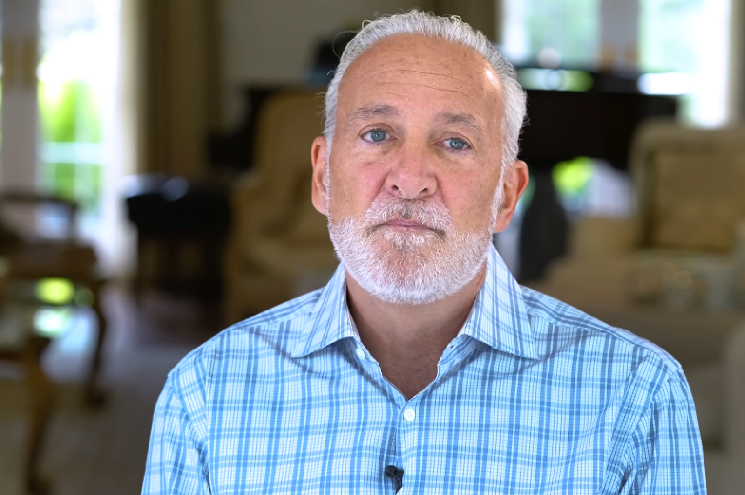
Peter Schiff, the longtime Bitcoin critic and chief economist at Euro Pacific Capital, has argued that the rise of artificial intelligence is not a bullish development for Bitcoin, pushing back against attempts to link the cryptocurrency to the booming AI sector.
In an Aug. 23 post on X, Schiff said Bitcoin advocates were trying to associate the asset with AI in the hope that investors would treat Bitcoin as part of the broader AI investment theme.
"Bitcoin pumpers are trying to hitch Bitcoin to the AI wagon, hoping investors will see it as part of the AI trade," Schiff wrote. "They have it backwards. AI isn't bullish for Bitcoin; it's a threat to it."
Competing for capital and infrastructure
Schiff laid out several reasons for his position. First, he believes the two sectors are competing for speculative investment capital, noting that AI has become one of the biggest themes in financial markets — a theme visible across asset classes, with chipmaker Nvidia, whose processors power much of the AI build-out, briefly becoming the world's most valuable listed company in 2024.
He also pointed to competition for electricity and data-center infrastructure. Both sectors are heavy power users: researchers at the Cambridge Centre for Alternative Finance estimate that Bitcoin's proof-of-work mining consumes electricity on the scale of a medium-sized country, while the International Energy Agency projects global data-center electricity demand to rise sharply as AI computing expands. In practice, the two industries have also overlapped, with several large Bitcoin mining firms leasing data-center capacity to AI computing customers in an effort to monetize their power infrastructure beyond mining.
The most significant part of his argument, however, concerns Bitcoin's security. Schiff believes advanced systems could potentially identify weaknesses in Bitcoin's software or cryptographic infrastructure that have not been discovered by humans.
"Plus, as AI becomes more powerful, it could discover vulnerabilities in Bitcoin's code, cryptography, wallets, or network that humans have missed," Schiff wrote.
He argued that this matters because Bitcoin's security and limited supply ultimately depend on software and cryptographic mechanisms continuing to function as intended. Schiff did not provide evidence that AI has currently discovered such a vulnerability in Bitcoin. The long-running technical debate over future threats to Bitcoin's cryptography has centered mainly on quantum computing rather than AI; in August 2024, the U.S. National Institute of Standards and Technology released its first finalized post-quantum cryptography standards as part of a broader effort to prepare encryption systems for future generations of computers.
Schiff calls Bitcoin a "scam"
Earlier on Aug. 23, he wrote that "AI is not a scam, but Bitcoin is," while also dismissing criticism of his longstanding position on the cryptocurrency — a stance he has maintained publicly for more than a decade as one of Bitcoin's most prominent skeptics.
Schiff has repeatedly argued that Bitcoin holders would have been better off selling the asset and buying precious metals instead. Responding to a post about Bitcoin's historical gains, he wrote: "Yes, I could have made a lot of money with Bitcoin. But that's old news. Over the last five years or so I've been better off not owning Bitcoin. It's the Bitcoin HODLers who have left a lot of money on the table by not selling!"
His comments have also focused on inflation. On Aug. 21, Schiff said he did not view Bitcoin as an inflation hedge and argued that investors should choose gold or silver instead.
"I don't think Bitcoin is an inflation hedge," he wrote. "But I noted that other people think it is. They are wrong."
Schiff similarly dismissed Bitcoin's recent rally, arguing that inflation expectations and easier monetary conditions would benefit precious metals more than the cryptocurrency. On Aug. 20, after Bitcoin moved above $72,000, he described the move as "a fakeout, not a breakout" and urged investors to "Sell Bitcoin, buy gold." His gold advocacy comes as the metal has traded at record levels, topping $2,500 an ounce for the first time in August 2024.
Source: U.Today

