Peter Obi Endorses SmartBallot App; Hands-On Review Finds Privacy Gaps in Registration and Data Policy
Key Takeaways
- •Peter Obi announced his endorsement of SmartBallot on his official X account, urging supporters and NDC candidates to register on the platform for community organising and voter coordination.
- •Both the app and website make birth date, gender and a social media username mandatory at sign-up, even though the privacy policy describes some of these as conditional or does not list them at all.
- •Features for saving and bulk-importing offline voter details allow admins to record information about people who never registered, and the privacy policy offers no explanation of consent or protections for those individuals.
- •Apple's App Store privacy label states that identifiers and usage data may be used to track users across other companies' apps and lists advertising data, while the website shows no cookie notice and the privacy policy omits advertising purposes.
- •The FAQ claims the app supports voting, complies with INEC guidelines and cannot trace votes, but the privacy policy says the app is separate from INEC systems, and corporate records leave ambiguous which entity operates the platform for Nigerian users.
Nigeria Democratic Congress (NDC) presidential candidate Peter Obi has urged his supporters and the party's candidates to register on SmartBallot, an application built for grassroots mobilisation and election monitoring. A hands-on review by Technext of the sign-up process on both the app and the website — together with an examination of the platform's privacy policy, terms of service and FAQ — revealed several gaps that anyone handing over personal and political details should know about. The endorsement matters for precisely that reason: it invites a political support base to hand over personal and political details the platform's own documents handle unevenly.
Obi announced the endorsement in a post on his official X account on Sunday. "I urge our supporters and NDC candidates to register on SmartBallot," he wrote. He described the platform as a tool for organising communities and coordinating voters and agents.
What the registration requires
Technext completed the sign-up on the Android app and opened the website's registration form without submitting it. The app marks a long list of details as mandatory: full name, username, email address, password, birth date, gender, an invitation code, a social media platform and username, plus the user's state, local government area (LGA), ward and polling unit. Only the polling unit code is optional.
The website takes a different approach. Its form states "No invitation code needed" and instead sends a request to group admins. The platform's X account, by contrast, instructs interested users to send a direct message in order to receive an invitation code. Both versions request the same core details, including birth date, gender and a social media username. The website's form, available at SmartBallot's site, adds an optional selfie, which it says "helps the admins recognise you." It also makes agreement to being contacted by phone, SMS or email mandatory. The page states that admins will confirm users' identities on WhatsApp, yet the form as displayed contains no field for a phone number.
After registration, the app displayed an "Application Being Processed" message alongside a countdown to the 2027 presidential election, set for January 16, 2027. The countdown frames the timing: the geographic details the form collects — state, LGA, ward, polling unit — are the same units through which parties organise agents and mobilise voters, the exact work Obi described.
Where the policy and the sign-up diverge
The privacy policy, in effect since August, lists date of birth as collected "where legitimately necessary" and gender as collected "where voluntarily supplied or legitimately required." Both sign-up routes make them compulsory. A social media username, also compulsory, does not appear among the items the policy lists at all. The policy mentions profile photographs but does not explain how selfies submitted for admin recognition are used or stored.
The policy acknowledges that membership of political groups may reveal a person's political opinions. The Nigeria Data Protection Act (NDPA) treats political opinions as sensitive personal data. For a mobilisation platform endorsed along party lines, that is no edge case: the profile built at sign-up — group membership, home area down to the polling unit, a linked social media handle — is exactly the kind of data the policy itself concedes can reveal political opinions. The document promises an "appropriate lawful basis" for processing without naming one. It also leaves open who controls the data, noting that the company, an institution or a SuperGroup operator could each act as a controller or a processor.
The policy is silent on one feature the website promotes: an offline notepad for reaching neighbours without smartphones. The app's store notes mention saving voter details and bulk-importing offline voters. That means admins can record the details of people who never signed up themselves, and the policy does not address how those individuals are protected. For those individuals, no sign-up flow — and therefore no stated consent step — ever occurred.
Tracking and cookies
Apple's App Store privacy label, which is filled in by the developer and not verified by Apple, indicates that identifiers and usage data may be used to track users across other companies' apps. The label also lists advertising data. The privacy policy's list of uses includes no advertising or marketing purposes.
The website presents visitors with no cookie notice. Technext found no banner or consent prompt on the homepage or the registration page, and the policy never mentions cookies, referring only to browser information and device identifiers. That leaves visitors with no stated way to know what is tracked or to opt out — meaning the clearest public statement of tracking currently comes from a developer-filled store label rather than the platform's own policy.
Claims that do not align
The FAQ describes the app as a voting platform for "citizens," states that it complies with Independent National Electoral Commission (INEC) guidelines, and cites the older NDPR as well as the US CCPA. The privacy policy, however, states that the app is not used for voting in the national election and is separate from INEC's systems. The FAQ also asserts that "No one — not even SmartBallot — can trace your vote," while the policy commits not to claim end-to-end encryption unless the architecture actually provides it. Read together, the two documents give prospective users conflicting accounts of what the platform does and what it guarantees.
Who is behind the app?
The website names Streamsync Tech Ltd. as the operating company, with addresses in Toronto and Lagos. The Corporate Affairs Commission (CAC) lists SmartBallot Technologies Limited, registered in August and currently active. A separate CAC entry for Streamsync Tech Ltd, registered in 2020, shows as inactive, and Technext could not confirm whether it is the same company as the Toronto firm. The terms of service refer to a "Canadian SmartBallot entity" and a "Nigerian SmartBallot entity" without naming either.
The NDPA requires data controllers and processors of major importance to register with the Nigeria Data Protection Commission (NDPC). A search for Streamsync on the NDPC repository returned no record in either the major-importance list or the list of licensed data protection compliance organisations. That is not proof of a breach, since the NDPC designates who qualifies. The policy says only that the company may undertake registrations where required, without stating whether it has done so. Which SmartBallot entity a Nigerian user is actually transacting with, and where the operator sits in the NDPC's framework, are questions the available records do not yet settle.
Technext could not obtain comment from the company or from Obi's team before publication. A response from either side, and any policy update covering the compulsory fields, the selfie, offline voter records and cookies, would resolve several of the questions this review leaves open.
What users report
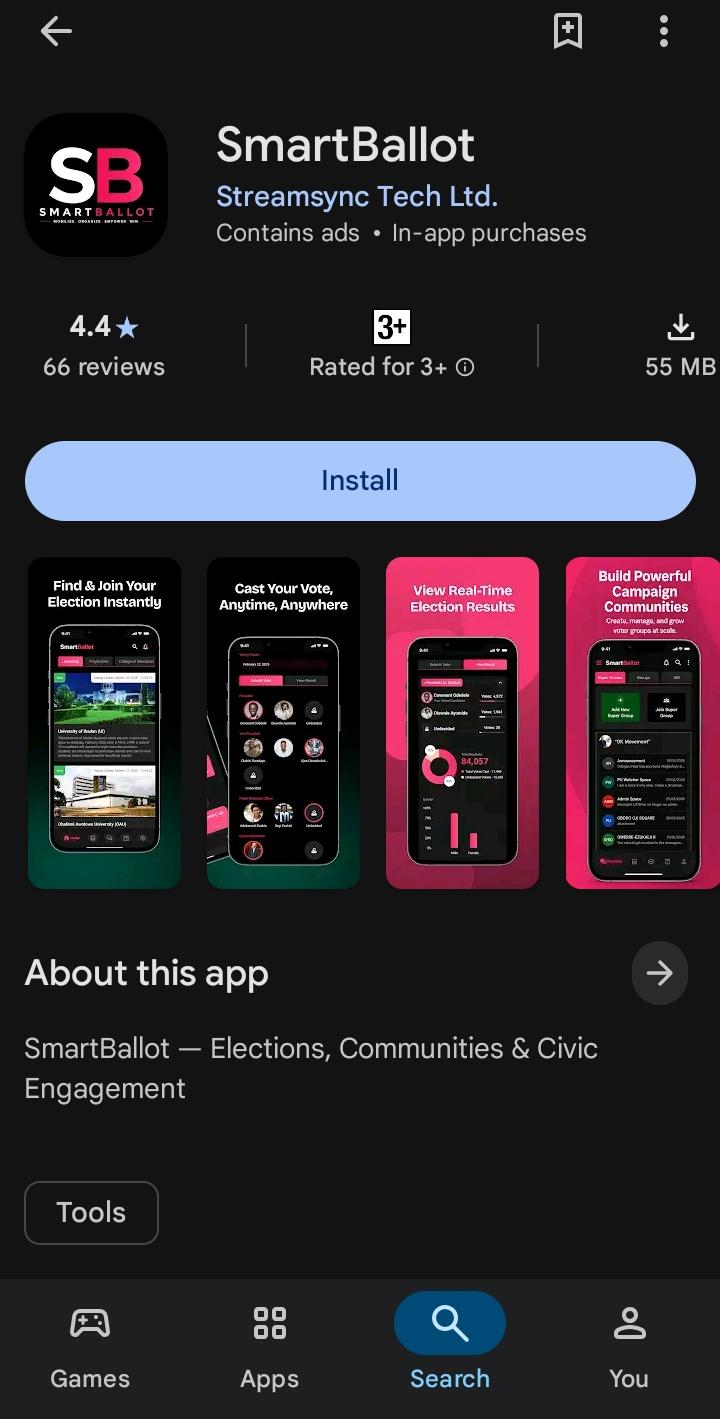
The app holds a 4.4 rating on Google Play, but reviews from late October mostly describe problems. One user reported being unable to create an account after repeated "username has been used" errors. Another had waited more than two weeks for access. A third could not register without an invitation code, which matches the app's mandatory field. Until those issues are fixed, some of the people the endorsement targets cannot register at all — the first concrete thing to watch as the app's own countdown to January 16, 2027 runs on.

