Peter Brandt Prefers Monero as XRP Rally Faces Overhead Supply Pressure
Key Takeaways
- •Peter Brandt named Monero (XMR) as his preferred trade among the altcoin charts he compared, because its prior overhead supply has already been absorbed.
- •Brandt set a conditional XRP objective of $2.16 from a possible inverse head and shoulders pattern on the daily timeframe, cautioning that selling pressure from higher-priced buyers could interrupt the recovery.
- •Solana received a favorable assessment for its cup and handle formation, which Brandt judged stronger than the comparable pattern developing in XRP.
- •The $2.16 XRP target is distinct from Brandt's earlier $5.40 projection shared on September 21, which came from a separate longer-term structure on the monthly chart.
- •Brandt stated his approach prioritizes price behavior over fundamentals, noting he did not need to understand Monero's fundamental narrative to assess its chart.
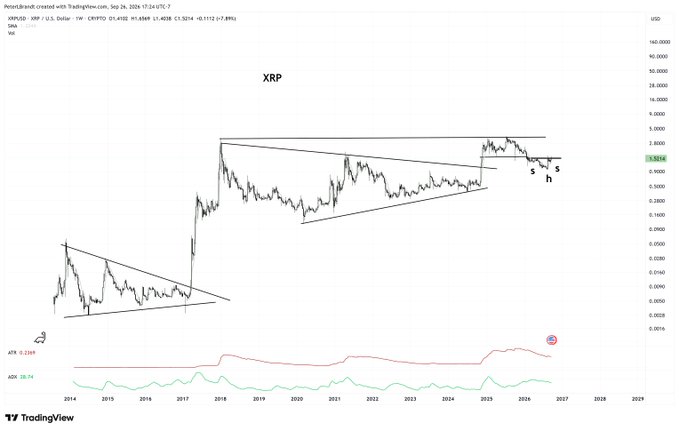
Peter Brandt has named Monero (XMR), a privacy-focused cryptocurrency, as his preferred trade among the altcoin charts he recently compared, saying the cryptocurrency's prior overhead supply has already been absorbed, in contrast to XRP. The veteran trader nonetheless identified a potential XRP advance toward $2.16, while cautioning that substantial selling pressure from higher-priced buyers could interrupt the recovery.
Brandt's preference reflects chart structure rather than an evaluation of either cryptocurrency's underlying technology. Alongside XRP and Monero, he examined Solana (SOL), Ethereum (ETH), and Stellar (XLM) over the same period, highlighting differences in resistance and chart formation. For XRP, the bullish objective remains conditional: the developing pattern could still change, and investors who bought at higher prices may sell as the market approaches their entry levels.
Brandt Favors Monero as XRP Faces Supply Barriers
Brandt described Monero as the strongest choice among the altcoin charts under review, arguing that its previous overhead supply had already been absorbed and that this left a clearer technical path for price.
“Of these, my favorite by far is XMR,” he wrote on X.
That assessment explains why a bullish XRP price target did not make XRP his preferred trade: a chart can suggest potential gains while still showing barriers along the route to them.
Overhead supply refers to potential selling from holders who purchased above the current market price. When prices recover, some of those holders may exit near their original purchase levels, limiting further progress — a dynamic that can turn prior resistance into a persistent ceiling. Brandt identified the issue as a significant negative for XRP, where it creates resistance that could interrupt a recovery toward the $2.16 objective. His comparison focused on the relative burden visible across charts covering the same period.
Solana received a more favorable assessment for its cup and handle formation — in classical charting, a rounded base of trading followed by a shallower pullback — which he considered stronger than the corresponding pattern developing in XRP. Ethereum showed considerable congestion, reflecting trading concentrated within a crowded range, though Brandt distinguished that congestion from the overhead supply he identified in XRP. Stellar also faced overhead supply, although he judged its burden smaller. These distinctions shaped his preference for Monero without establishing guaranteed outcomes for any asset.
For Brandt, the distinction concerns both the potential move and the resistance that could delay it. His favorable reading of Monero addresses the latter issue, while XRP's measured objective describes a possible destination without resolving the supply problem along the way.
Brandt added that he did not need to understand Monero's fundamental narrative to assess its chart. His stated approach prioritizes price behavior, with Bitcoin the exception to his broader indifference toward cryptocurrency fundamentals.
Daily XRP Target Differs From Earlier Monthly Projection
The $2.16 objective derives from a possible inverse head and shoulders pattern on the daily timeframe, which Brandt measured using daily closing prices rather than intraday highs and lows. The setup features three troughs, with the central trough deeper than the two surrounding it. Projecting the pattern's height upward produces a measured objective, subject to the structure developing as anticipated.
An earlier daily XRP chart highlighted a cup and handle formation, which Brandt suggested could become the right shoulder of the larger reversal structure. In his assessment, that shoulder remained short and poorly formed. More formation appeared likely, although he explicitly stopped short of calling further development necessary.
Brandt cautioned that chart patterns can evolve into different configurations as trading continues, meaning a projected destination does not establish that the market will reach it.
“Targets or objectives are not sacred,” he wrote.
The $2.16 figure also differs from Brandt's earlier $5.40 projection for XRP, shared on September 21. That assessment came from a monthly chart and addressed a separate, longer-term structure on that higher timeframe, reflecting how chart analysis can produce distinct objectives on different timeframes. He did not describe $2.16 as a replacement for $5.40, nor did he identify the lower figure as a required intermediate stop toward the higher objective.
In a September 26 comment, Brandt said XRP's chart alone could justify considering a trade. He later asked XRP supporters not to interpret his technical criticism as a personal offense. The Monero preference, in that sense, sits alongside — not in place of — his conditional XRP objective.

