Pentagon Keeps Anthropic Supply-Chain Designation in Place as Legal Fight Moves to Appeals Court
Key Takeaways
- •The Pentagon is maintaining its supply-chain-risk designation on Anthropic despite Commerce Secretary Howard Lutnick's public statements expressing trust in the company.
- •Anthropic won an August 27 ruling from US District Judge Rita Lin, who found the Pentagon's action under 10 U.S.C. § 3252 involved unlawful First Amendment retaliation and denied due process.
- •A separate supply-chain-risk designation issued under 41 U.S.C. § 4713 remains in place and is being challenged by Anthropic in the D.C. Circuit.
- •Commerce's June export controls on Anthropic's Fable 5 and Mythos 5 models were lifted after the company worked with the government on additional safeguards.
- •Anthropic signed a $200 million prototype agreement with the Department of Defense in July 2025 to build frontier AI technologies for national-security work.
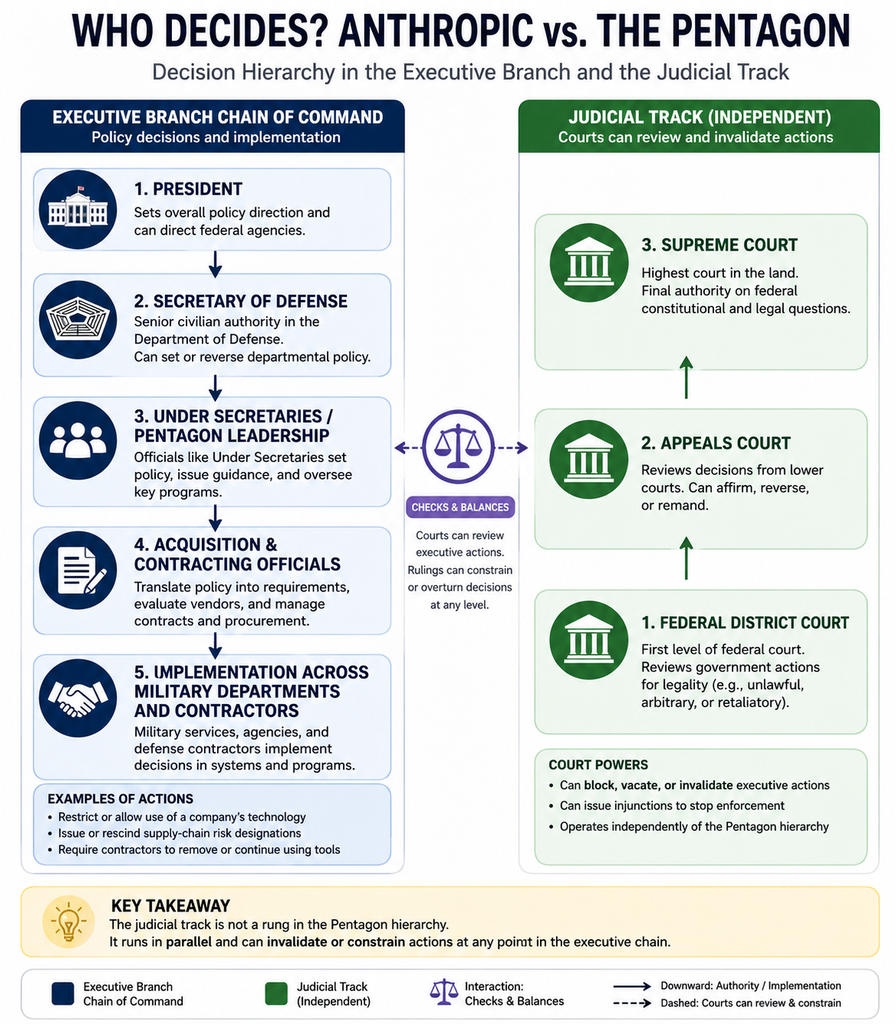
The Pentagon will maintain its existing ban on Anthropic, despite signals from other cabinet members that the broader conflict has ended. For now, the Department of Defense's remaining designation can only be reversed through a court ruling or by the Pentagon itself — and on Thursday, senior Pentagon officials made clear that the latter is highly unlikely.
That leaves the courts at the heart of the dispute. The stakes extend beyond Anthropic: the outcome could help define how far the US government can go in penalizing an AI contractor that refuses to lift its own limits on military uses of its technology. The case lands at a moment when major AI labs have been recalibrating their posture toward defense work — some, like OpenAI and Google, have loosened or rewritten their policies on military applications over the past two years, while Anthropic has sought to keep explicit conditions on how its models are used.
Michael's post cut against Lutnick's thaw
Emil Michael, the Under Secretary of Defense for Research and Engineering, wrote on X that “Anthropic is still a designated Supply Chain Risk at @DeptofWar and for the Defense Industrial Base.” He closed the post with “Thank you for your attention to this matter!”
The remark came after Commerce Secretary Howard Lutnick's positive comments about the company. Lutnick told Mike Allen of Axios, “We trust Anthropic,” explaining that the company had “done what we asked” and was “back on the right side.”
Anthropic co-founder Tom Brown joined Lutnick in Chapel Hill, North Carolina, during the G20 Innovation Ministerial on September 2, further feeding the impression that relations had improved.
But the issues Lutnick and Michael were addressing were entirely different.
Two feuds, one company
The thaw Lutnick described largely concerns the Commerce Department. In June, the government imposed export controls on Anthropic's Fable 5 and Mythos 5 models over concerns that safeguards could be bypassed to expose advanced cybersecurity capabilities. Those restrictions were later lifted after Anthropic worked with the government on additional safeguards.
The Pentagon dispute is separate. Defense officials confronted Anthropic over the limitations the company wanted to place on military use of Claude. Anthropic says it drew two red lines — one concerning fully autonomous weapons and the other concerning mass domestic surveillance — while leaving operational decisions otherwise with the military.
According to an earlier report from Cryptopolitan, the Pentagon and the Trump administration clashed publicly with Anthropic over these limits while simultaneously seeking to expand agreements with other AI giants in Washington.
The financial implications are considerable. An official Department of Defense announcement shows that Anthropic signed a $200 million prototype agreement in July 2025 to build frontier AI technologies for national-security work. A sustained supply-chain-risk designation can carry consequences beyond a single contract, since defense primes often avoid suppliers formally flagged as risks when building systems for the Pentagon.
The courts, not Commerce, hold the switch
Anthropic has already won one major round. On August 27, US District Judge Rita Lin in San Francisco ruled in Anthropic's favor over Pentagon actions taken under 10 U.S.C. § 3252. She found unlawful retaliation under the First Amendment, a denial of required due process under the Fifth Amendment, and concluded that the designation was contrary to law and arbitrary and capricious.
Cryptopolitan reported after the ruling that Anthropic welcomed the finding that the designation was unlawful and reiterated its desire to work with the government on national security.
The ruling, however, did not erase every Pentagon action. The department also invoked 41 U.S.C. § 4713, creating a separate supply-chain-risk designation that Anthropic is now challenging in the D.C. Circuit.
Michael's post therefore does not overturn the California ruling; it simply highlights what remains unresolved.
What to watch next
For Anthropic to clear the Pentagon's remaining supply-chain designation, the D.C. Circuit must rule in its favor or the Defense Department must abandon the action. Until then, Lutnick's reconciliation with Anthropic does not amount to a Pentagon reversal.
The next decisive signal is more likely to come from Washington's appeals court — or from the Pentagon itself — than from another warm exchange at a technology summit. The judicial track can constrain or invalidate executive action; it is not another rung in the Pentagon hierarchy.
Will the Pentagon create a new restriction? Or will Anthropic prevail on the legal defects identified by Judge Lin? The answers to those questions open the next chapter of the dispute, rather than simply determining whether Anthropic “wins” or “loses.”
