Pentagon Adds Military ChatGPT and Grok to GenAI.mil as Anthropic's Claude Remains Locked Out
Key Takeaways
- •Military editions of ChatGPT and Grok are now available on the Pentagon's GenAI.mil portal to a defense workforce exceeding 3 million personnel.
- •Both tools are accredited for Controlled Unclassified Information at Impact Level 5, permitting use on sensitive but unclassified government work.
- •GenAI.mil launched roughly nine months ago with Google's Gemini and has enrolled more than 1.7 million users, functioning as a multi-model marketplace.
- •Anthropic's Claude remains excluded from the portal even after U.S. District Judge Rita Lin struck down the Pentagon's supply-chain risk designation on August 27, 2026, with a D.C. Circuit appeal pending.
- •The dispute arose after Anthropic sought written assurances against use in fully autonomous weapons or mass domestic surveillance, while the Pentagon demanded unrestricted access.
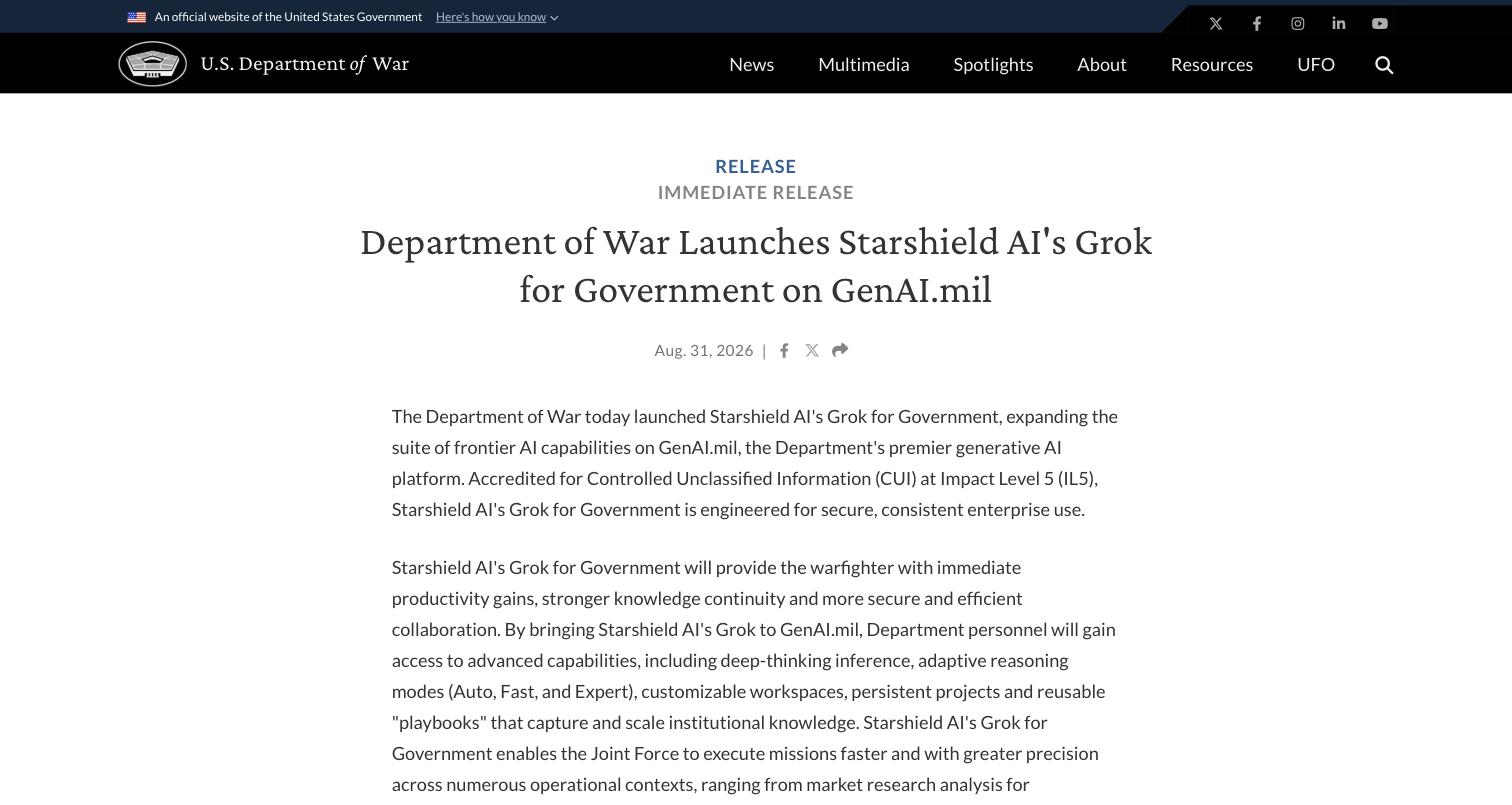
The Pentagon on Monday deployed military versions of OpenAI's ChatGPT and xAI's Grok on its GenAI.mil portal, extending the tools to 3 million defense personnel. Anthropic's Claude, meanwhile, remains excluded amid an ongoing court battle over the safety limits the company sought.
The deployment marks one of the largest institutional rollouts of commercial generative AI to date, and it reflects a broader shift in how frontier AI labs — which built their businesses on consumer and enterprise subscriptions — now view government and defense contracts as a major market.
1.7 million users enrolled in nine months
GenAI.mil serves as the Department of War's one-stop shop for commercial AI. Personnel can use frontier models without routing sensitive data through consumer applications, and the military versions omit the data collection built into most consumer products.
Both tools received accreditation for Controlled Unclassified Information at Impact Level 5, the tier covering sensitive but unclassified government work, allowing them to handle such data at scale. IL5 accreditation is a common threshold for commercial cloud and software vendors seeking to serve U.S. government customers, and it places the Pentagon's AI portal in the same compliance tier used for much of the government's day-to-day unclassified but sensitive work.
The portal launched roughly nine months ago with Google's Gemini as its first model. The department says more than 1.7 million users have enrolled out of a workforce exceeding 3 million. With Grok and ChatGPT now added, the portal has become a multi-model marketplace, which the Pentagon framed as a way to avoid reliance on a single supplier.
ChatGPT Mil stems from a government program at OpenAI and an enterprise partnership forged between the two parties in 2025. It offers chat, files, projects, and custom GPTs for document-heavy unclassified work spanning planning, policy, logistics, and administration.
The department also highlighted Starshield AI, the secure-satellite unit of SpaceX that runs on Starlink technology. Its release lists deep-thinking inference, three reasoning modes called Auto, Fast, and Expert, and reusable "playbooks" designed to capture institutional knowledge. Applications range from acquisition market research to supply chain work for logisticians.
The department said Grok enables forces to "execute missions faster and with greater precision." The two releases differ in emphasis: the Grok announcement centers on mission execution, while the ChatGPT announcement focuses on administrative desk work.
Judge Rita Lin saw a First Amendment problem
Although Anthropic won a federal court ruling lifting the national security blacklist, its Claude models remain excluded from the GenAI.mil portal, with a parallel challenge proceeding in the D.C. Circuit Court.
In late February, Defense Secretary Pete Hegseth designated Anthropic a Supply-Chain Risk to National Security, as Cryptopolitan reported. The move followed President Donald Trump's order for federal agencies to stop using the company's technology.
Anthropic, which signed a $200 million Pentagon deal in July, had sought written assurances that its models would not be used in fully autonomous weaponry or mass domestic surveillance of Americans. The Pentagon pushed for unrestricted access for all legal purposes and set a deadline of February 27, which was not met. The standoff highlights a tension running through the AI industry: several frontier labs have published usage policies restricting military and surveillance applications, while government buyers have pressed for unrestricted access to commercially available models.
Anthropic called the label "unprecedented," noting it is normally reserved for foreign adversaries, and vowed to fight it. The company cited its history as the first frontier lab to operate models on classified U.S. networks and to support warfighters since June 2024. It also pointed to federal procurement law, arguing Hegseth lacks the authority to prevent contractors from using Claude for non-defense work.
U.S. District Judge Rita Lin, who expressed First Amendment concerns during an early March hearing, issued a final 59-page ruling on August 27, 2026, officially striking down the Pentagon's supply-chain risk designation. Lin said the government responded harshly after Anthropic went public with the dispute, and that the crackdown "doesn't seem to be really tailored to a stated national security concern."
Anthropic's lawyer, Michael Mongan, told the court that the designation had never before been applied to a U.S. company. The company is asking the court to lift the supply-chain risk designation.
For now, defense staff have access to OpenAI and xAI tools, while Anthropic remains locked out of the portal pending the outcome of the D.C. Circuit Court appeal. That outcome could shape not only Claude's fate on GenAI.mil, but also how much leverage AI companies retain to set conditions when selling their models to the U.S. government.
