Peninsula Manila's Spices Revamps Indian Menu with Chef-Consultant Bal Krishan Sharma
Key Takeaways
- •Spices restaurant at the Peninsula Manila introduced new Indian menu items created by chef-consultant Bal Krishan Sharma, who trained the in-house kitchen team for just over a week.
- •The menu overhaul was driven by a loss of culinary authenticity following the departure of the restaurant's previous Indian chef during the COVID-19 pandemic.
- •The hotel opted for a short-term consultant model rather than hiring a permanent expatriate chef to transfer expertise to its existing kitchen staff.
- •The showcase dinner featured traditional dishes including pani puri, samosa chaat, Chicken Malai Tikka, Kadhai Paneer, Lamb Vindaloo, and Gajar Halwa.
- •Sharma deliberately selected straightforward recipes and insisted on maintaining traditional spice levels to ensure the kitchen staff could sustain consistency after his departure.
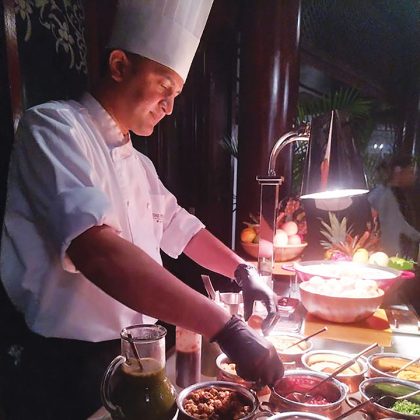
On July 31, Spices, the Southeast and South Asian restaurant at the Peninsula Manila, hosted a dinner to showcase new additions to its Indian menu. The dishes were created by Bal Krishan Sharma, a chef-consultant from Peninsula Clubs and Consultancy Services in Hong Kong, who spent just over a week in the Philippines training the kitchen team on the dishes he grew up with in Delhi before his family relocated to Hong Kong.
The restaurant, located on the ground floor of the Peninsula Manila in Makati — Metro Manila's central business district and a hub for luxury hotel dining — has been operating since the mid-1980s. Its menu spans multiple Southeast Asian cuisines, including those of Vietnam, Singapore, and Thailand.
Katsuma Tokitsu, director of Food and Beverage at the Peninsula, told BusinessWorld that the Indian menu push was driven by a need to restore culinary authenticity following the departure of the restaurant's previous Indian chef during the COVID-19 pandemic. The disruption mirrors a broader challenge faced by hotels across the region, where pandemic-era staffing losses often interrupted specialized culinary programs built around expatriate chefs. "Our menu was quite extensive," he said of the pre-pandemic period. "We kept the recipes, but with the kitchen team, authenticity was fading."
"I really wanted to make sure that every cuisine is authentic," Mr. Tokitsu added. "I don't want to dilute authenticity, just because we don't have an expat chef." Bringing in Mr. Sharma as a short-term consultant rather than hiring a permanent replacement reflects a model some luxury hotel groups use to transfer expertise to in-house kitchen teams while maintaining quality standards across properties.
The dinner opened with Mumbai street food and snacks, including pani puri and samosa chaat, both filled with a mixture of spiced chickpeas and potatoes. The samosa was notably light despite being fried. The pani puri — a round, crispy sphere made of semolina and wheat — is traditionally topped with mint and coriander water, giving it a refreshing quality. Its filling was lightened with fresh ingredients such as pomegranate seeds and mint sauce. Mr. Sharma prepared each piece to order at a serving station.
The tandoori course featured Chicken Malai Tikka: chicken breast marinated in a creamy tandoori sauce of cream, cheese, ginger, and garlic, served with a spicy tomato sauce on the side. While creamy and rich, the dish carried a noticeable kick of heat at the finish.
Next came Kadhai Paneer, an Indian cottage cheese made by setting milk with acid, served in squares within a thick tomato-based sauce. The dish was moderately spicy and quite filling.
The centerpiece of the evening was a Lamb Vindaloo, prepared using methods with origins traced to 15th-century Goa. The lamb was cooked in a marinade of vinegar and spices. Mr. Sharma cautioned that the dish would be quite spicy, though the heat arrived belatedly — warm rather than immediately hot — and spread gradually throughout the palate. The lamb was served with Indian Basmati rice, which Mr. Sharma noted with pride was grown near his hometown.
The meal concluded with Gajar Halwa, a dessert made of grated carrots simmered in milk, ghee (clarified butter), and spices. Presented as a small square topped with nuts, it offered a comforting finish reminiscent of baby food.
Mr. Sharma described his approach to the menu as deliberately straightforward. "I just chose the simple ones, so after I leave, they can follow the recipes," he said of the kitchen staff.
He noted the strong representation of vegetables across the dishes, attributing this to the geography of his native Delhi in northern India. "We don't eat much seafood, because we don't have seafood there. We're very far from the ocean," he said, adding that dietary habits shift as one moves further south. "The geography allows us to eat more vegetables."
Reiterating the restaurant's commitment to authenticity, Mr. Sharma insisted on maintaining traditional spice levels. "If you don't do that, then the consistency will go down."
— Joseph L. Garcia
