PBOC Expected to Set USD/CNY Reference Rate at 6.7219, Reuters Estimate Shows
Key Takeaways
- •The People’s Bank of China is expected to announce its daily USD/CNY reference rate at around 0115 GMT, with Reuters estimating 6.7219.
- •China’s onshore yuan is allowed to trade within 2% above or below the daily midpoint set by the central bank.
- •The PBOC sets the midpoint using the previous close, major currency moves, a broader currency basket and domestic economic factors.
- •A counter-cyclical factor gives policymakers additional flexibility to adjust the fixing away from purely market-driven levels.
- •Market participants treat the fixing as a policy signal that can indicate efforts to curb yuan weakness or tolerate a softer currency.
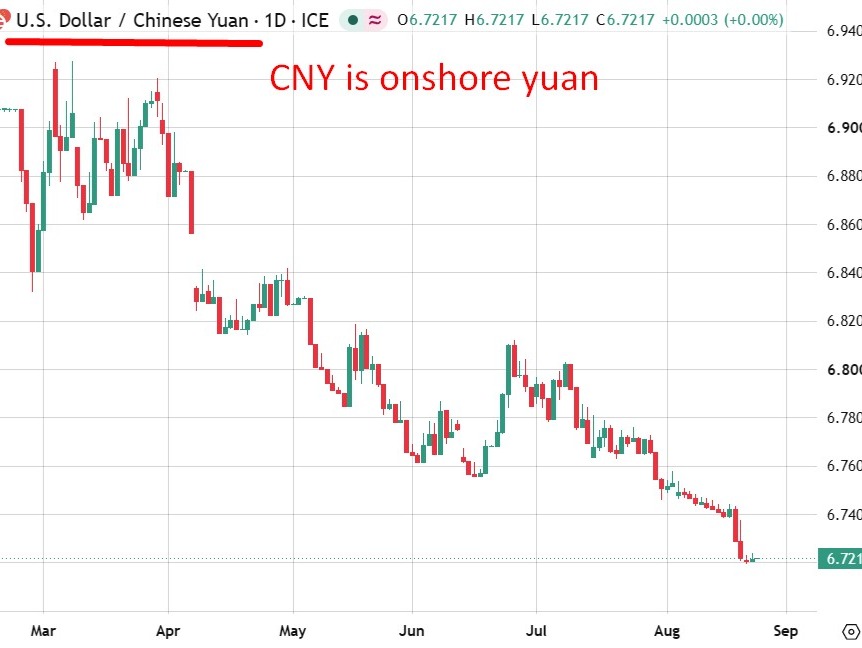
The People's Bank of China is due to publish its daily USD/CNY reference rate at around 0115 GMT (2115 US Eastern time), with a Reuters estimate pointing to a fixing of 6.7219. The announcement remains one of the most closely watched signals in Asian foreign exchange markets.
China operates a managed floating exchange rate system under which the renminbi (yuan) is allowed to trade within a prescribed band around a central reference rate, or midpoint, set each trading day by the PBOC. The current trading band permits the currency to move plus or minus 2% from the official midpoint during onshore trading hours, a range that has applied since it was widened from 1% in March 2014. The band constrains the onshore yuan (CNY) traded in mainland China; the offshore yuan (CNH), traded mainly in Hong Kong, floats more freely, and the gap between the two is itself monitored as a gauge of currency pressure.
Each morning, the PBOC determines the midpoint based on a range of inputs. These include the previous day's closing price, movements in major currencies — particularly the US dollar, alongside a broader basket of trading-partner currencies tracked by the China Foreign Exchange Trade System — and domestic economic considerations such as capital flows, growth momentum and financial stability objectives. A "counter-cyclical factor" introduced into the quote-setting mechanism in 2017 gives authorities additional room to set the fixing away from what purely market-driven inputs would imply. The midpoint is not a purely mechanical calculation, allowing policymakers discretion to guide market expectations.
Once the midpoint is announced, onshore USD/CNY is free to trade within the allowable band. If market pressures push the yuan toward either edge of that range, the central bank may step in to smooth volatility. Intervention can take the form of direct buying or selling of yuan, adjustments to liquidity conditions, or guidance through state-owned banks.
As a result, the daily fixing is often interpreted as a policy signal rather than just a technical reference point. Traders routinely compare the published midpoint against model-based estimates such as Reuters' to see whether the central bank is setting the rate stronger or weaker than market-implied levels. A stronger-than-expected CNY midpoint is typically read as a sign that the PBOC is leaning against depreciation pressure, while a weaker fixing for the CNY can indicate tolerance for a softer currency, often in response to dollar strength or domestic economic headwinds. The fixing's outsized market influence was underscored in August 2015, when a shift in methodology that tied the midpoint more closely to the previous day's close came alongside a devaluation of nearly 2% that rippled through global financial markets.
In periods of heightened global volatility — such as shifts in US rate expectations, trade tensions or capital flow pressures — the fixing takes on added significance. For investors, it provides insight into Beijing's currency priorities as the authorities balance competitiveness, capital stability and financial market confidence.
Source: ForexLive

