PayPal Stock Under Pressure as PYUSD Stablecoin Loses Momentum
Key Takeaways
- •Stripe and Advent International walked away from their takeover bid for PayPal, reportedly over price, ending a catalyst that had supported the stock.
- •PayPal's stablecoin PYUSD has a market capitalization of $2.89 billion, down from a year-to-date high above $4.2 billion, and its 30-day transfer volume fell 76% to $319 million.
- •PayPal's second-quarter revenue rose 5%, while active accounts stayed flat at 439 million and monthly active users grew just 1% to 228 million.
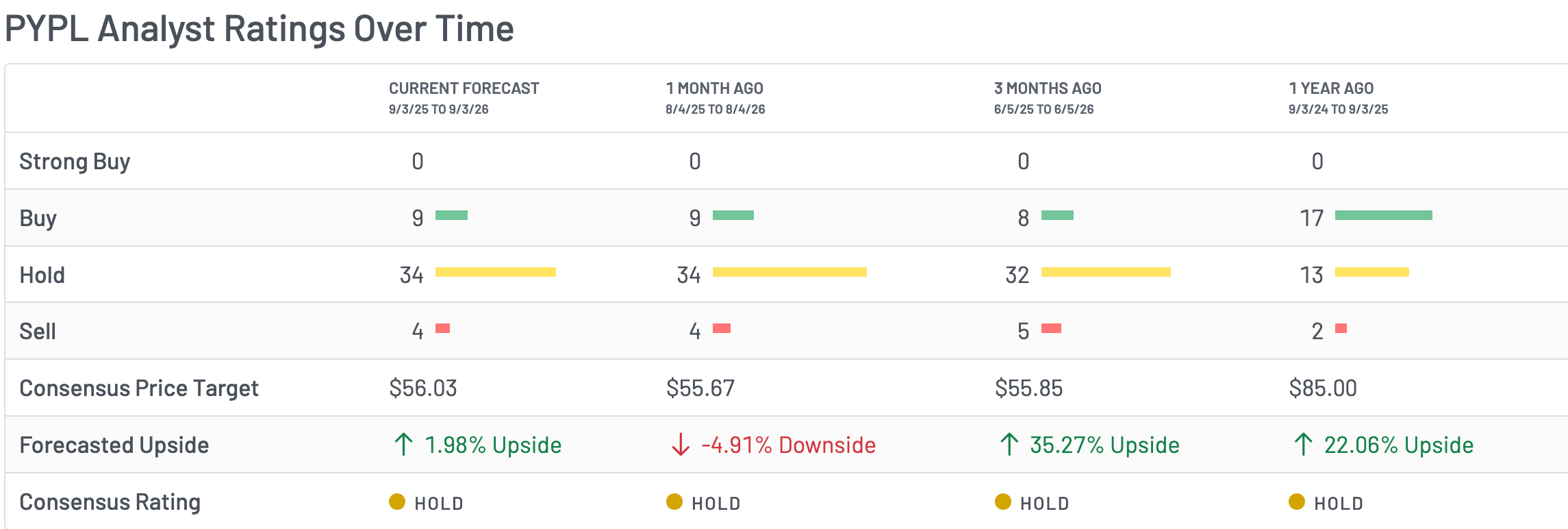
- •Analyst price targets have been cut, with the average target falling to $56 from $85 twelve months ago.
- •With no major catalyst ahead, technical analysis suggests PYPL could retest the $38 support level, with further downside risk toward $35.
Key Insights
PayPal stock has sold off significantly in recent months.
Advent International and Stripe ended their acquisition bid.
PYUSD has lost momentum, with both supply and transaction volume declining.
PayPal stock remains under pressure following the decision by Stripe and Advent International to abandon their takeover pursuit, which removes a catalyst that had supported the shares through the summer.
PYPL closed at $56.82 on September 3, up 3.93%, recovering part of the selloff that followed the collapsed deal. Even so, the stock remains well below its 2025 highs and its 2021 all-time peak.
The company is also contending with slower account growth and intense competition across digital payments. At the same time, current stablecoin data do not support the stronger claim that PYUSD demand is deteriorating across every single metric.
PYUSD Supply Remains Below 2026 Peak
PayPal faces numerous challenges, including within its stablecoin business. Data shows that PayPal USD (PYUSD), the company's stablecoin, is no longer growing, even as other major stablecoins gain momentum. PYUSD launched in August 2023, making PayPal one of the first major traditional finance companies to issue its own stablecoin, but the token's stall comes at a time when the broader stablecoin market has been expanding and when the U.S. regulatory environment has grown clearer, following the signing of the GENIUS Act in July 2025, which established a federal framework for payment stablecoins.
According to DeFi Llama, PYUSD has a market capitalization of $2.89 billion, down sharply from its year-to-date high of more than $4.2 billion. By contrast, Ripple USD (RLUSD) has accumulated over $2.39 billion in assets and its growth is accelerating. It began the year with $1.4 billion in assets.
Similar growth is visible across other stablecoins: the USDC market cap has risen from last month's low of $71 billion to the current $73.8 billion, while Tether holds a market capitalization of over $183 billion.
Several other PYUSD metrics have also deteriorated in recent months. The stablecoin's transfer volume fell by 76% over the last 30 days to just $319 million, making it one of the worst performers in the stablecoin industry. PYUSD has only about 5,500 daily active users.
RLUSD Gains Faster Than PYUSD
PYUSD is not the only part of PayPal's business that is slowing. The company's wallet faces substantial competition from Google Pay, Apple Pay, and Amazon Pay, all of which have become highly popular with users.
PayPal's business payment solution is also under considerable pressure this year. In its recent earnings report, the company said second-quarter revenue rose by just 5%. While that growth exceeded expectations, it was further evidence that PayPal's business is a shadow of what it was a few years ago, when it ranked among the fastest-growing companies in the fintech industry.
The earnings report also showed active accounts were unchanged at 439 million, while monthly active users rose just 1% to 228 million.
Those figures likely explain why many analysts covering the company have cut their expectations. Truist's Matthew Coad lowered his price target from $62 to $53, and Loop Capital's Dominick Gabriele cut his from $62 to $50. The average analyst target now stands at $56, down from $85 twelve months ago.
PayPal stock has also struggled since Stripe and Advent ended their pursuit. Rumors of a deal first surfaced in January and were confirmed a few months ago. The two companies ultimately decided to walk away, potentially over price; PayPal may also have requested a higher offer.
PayPal Stock Price Technical Analysis
The weekly chart shows PYPL has been under pressure for the past several years as its growth trajectory has stalled. The stock was trading at $54.65, far below its all-time high of $300. It has fallen below all major moving averages and the Supertrend indicator.
The stock also remains beneath the descending trendline connecting the highest swing points of April 2022, January, and November 2025.
With no major catalyst on the horizon, the PYPL share price could continue to fall in the near term. If that happens, it may drop and retest the $38 support level. A break below that level would point to further downside, potentially toward $35.
This article is for informational purposes only and does not constitute financial advice. Equity and cryptocurrency markets can experience sharp price movements.
