PayPal Stock Falls as Stripe and Advent Abandon Buyout Offer
Key Takeaways
- •PayPal stock dropped more than 13% in premarket trading to $53 after Stripe and Advent abandoned their buyout effort.
- •The proposed acquisition would have been valued at more than $50 billion and was expected to rank among the largest take-private deals in the United States.
- •PayPal’s latest results showed flat active accounts at 439 million, 1% growth in monthly active accounts, and revenue up 5% while earnings per share slipped 1% to $1.38.
- •The company faces heavy competition across its branded and unbranded businesses from rivals including Google, Apple, Amazon, and Stripe.
- •Technical indicators suggest additional downside risk, with the stock potentially moving toward support around $48.
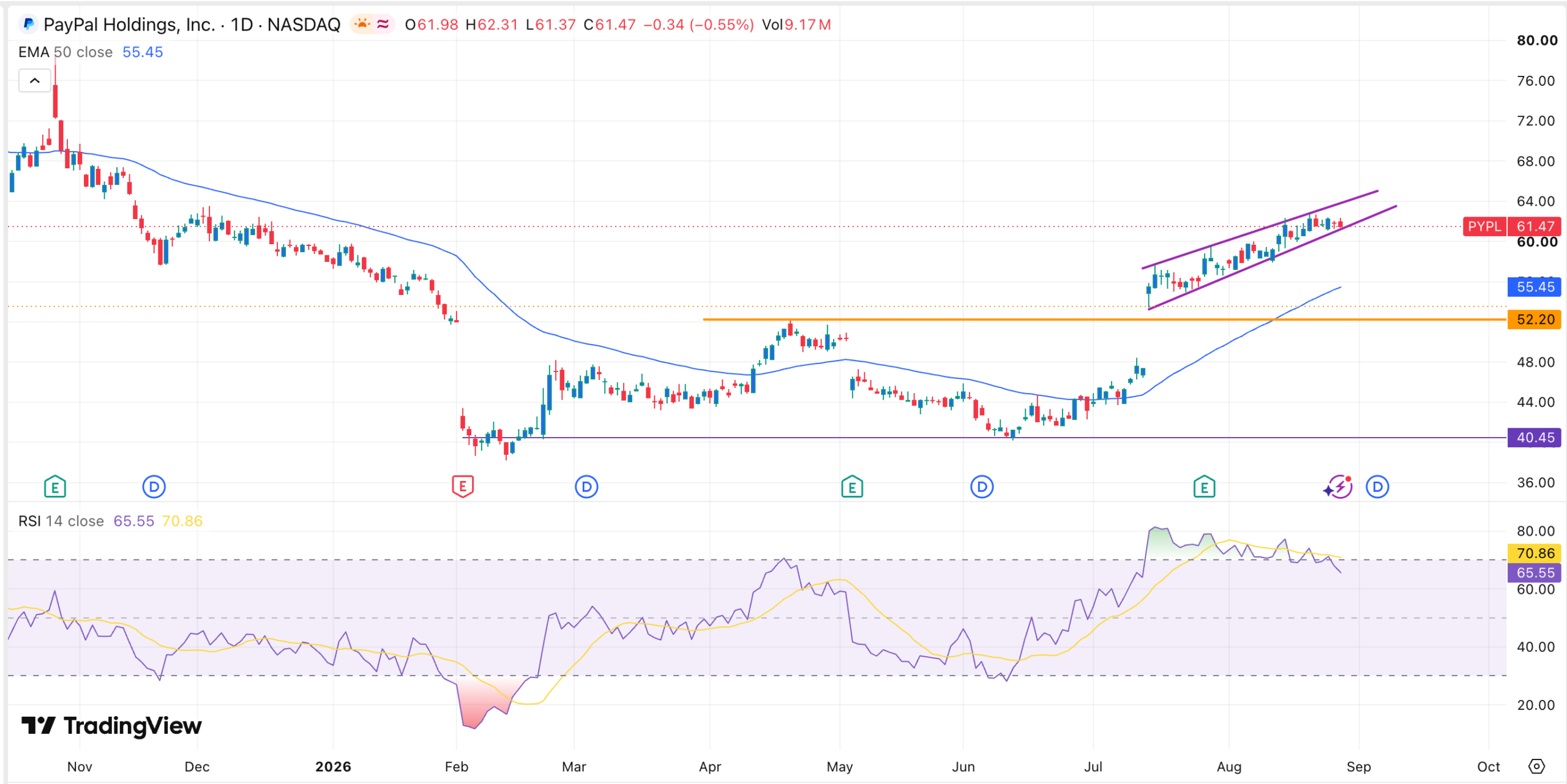
PayPal (PYPL) stock suffered a big reversal in premarket trading, erasing some of the gains recorded over the past few weeks. The shares plunged by more than 13% to $53, down sharply from this month's high of $62.37. The retreat will be in focus in the coming days as investors assess the implications of the new developments — above all, the decision by Stripe and Advent to abandon their buyout pursuit.
PayPal Stock Drops as Buyout Offer Fails
PYPL stock bottomed at $40.45 in June and then made a parabolic move higher after reports emerged that Advent and Stripe were eyeing an acquisition bid. The buyout, worth over $50 billion, would have been one of the biggest take-private deals in the United States.
Such a deal would also have underscored PayPal's fall from grace. While $50 billion is a big number, it remains far below the company's all-time high valuation of more than $300 billion, reached a few years ago.
It is not clear why the two companies decided to abandon the deal. One possible reason is that they disagreed with management on the right price. PayPal's management likely believes the company has more room to grow, a view also held by its new CEO, Enrique Lores.
The collapse of the bid creates a challenge for the shareholder base: many recent PayPal investors bought the stock in the hope that it would be acquired. Most notably, there had been expectations of a bidding war for the company, which would have boosted the shares.
PayPal Faces Major Challenges as a Standalone Company
The end of the acquisition bid presents major challenges for a company struggling to grow as competition rises. That competition is playing out across PayPal's branded and unbranded businesses and comes from companies including Google, Apple, Amazon, and Stripe.
PayPal's growth has stalled, and management has focused on financial engineering to support the stock. That engineering, through share buybacks, has significantly reduced the number of outstanding shares over the past few years, from more than 1.156 billion in 2022 to 862 million today. The buybacks have not been enough to lift the company's performance.
The most recent quarterly results underscore the slowdown. Active accounts were unchanged at 439 million, monthly active accounts rose by just 1%, and the number of transactions per active account increased by just 3%. Revenue rose by 5%, while earnings per share fell 1% to $1.38 — significantly slow growth compared with the blended earnings growth of 50.4% recorded by companies in the S&P 500 Index.
The main challenge is that PayPal has no clear way to reignite revenue growth because it lacks a clear competitive advantage.
On the positive side, the company could decide to spin off Venmo, its peer-to-peer business. Venmo's revenue is still growing by double digits, and PayPal expects it to reach $2 billion in revenue this year. The business has more than 100 million users and could fetch a valuation of $10 billion to $15 billion.
PayPal Stock at Risk of Further Declines
The daily chart shows PayPal stock at risk of further downside. Before the current crash, the shares were forming a rising wedge pattern, made up of two ascending and converging trendlines — price action that often leads to a bearish reversal over time. The Relative Strength Index (RSI) was also forming a bearish divergence pattern, in which the RSI makes a series of lower lows while the asset is in an uptrend.
Against that backdrop, the chart points to the risk of a continued slide in the coming days, potentially toward the key support level at $48.

