How a diverted tuition fee inspired a $450 million remittance platform
Key Takeaways
- •Amegbor’s idea for PayAngel was triggered by a family tuition payment that did not reach its intended university recipient.
- •PayAngel’s direct-to-merchant remittance product allows senders to pay institutions such as schools and hospitals directly instead of sending money through an intermediary.
- •The company launched its direct-to-merchant MVP in 2022 after years of building infrastructure and overcoming early bank resistance.
- •PayAngel says it has processed more than $450 million, has over 100,000 active remitters, and serves customers across 22 countries.
- •The company holds regulatory approval in the United Kingdom, the United States, Canada, Australia and Ghana, and has partnered with Visa.
When a diverted tuition payment cost a family member their university place, Jones Amegbor realised that sending money home was only half the problem. Determined to remove the middleman, he set out to build a system that pays schools, hospitals and insurers directly. A decade later, that system, PayAngel, has processed more than $450 million by helping ensure remittance money reaches the intended destination. OPEYEMI KAREEM reports.
Jones Amegbor learned the hard way that, in cross-border remittances, a successful transfer does not always mean a successful outcome.
In 2010, he was at his desk at the bank where he worked, watching the clock as the deadline for a family member’s university tuition drew closer. Unable to leave the office in time to reach an agent location, he sent the payment later than he should have and braced for the consequences. The family member was expelled anyway.
For months, Amegbor carried the guilt of that delay until he learned the truth: the payment delay was not what caused the expulsion. The tuition he had sent the previous semester had never reached the university. A family member had diverted it, promising to put things right later.
“Why can’t we send the money directly?” Amegbor recalled asking himself. He said he began digging deeper and realised how many people in the diaspora had their own version of the same story, with money diverted away from its intended purpose.
That question, he told TechCabal in a June interview, set him on the path to building PayAngel, a cross-border payments company that helps Africans in the diaspora send money with a guarantee of where it lands.
In 2023, Africa received $100 billion in remittances, equal to nearly 6% of the continent’s Gross Domestic Product (GDP). While many founders in the remittance industry have focused on making transfers faster and cheaper, Amegbor said what happens after the money arrives has received less attention. He founded PayAngel in 2013 on that premise.
Instead of simply helping users send money home, the company allows them to pay verified schools, hospitals, insurers, contractors and other institutions directly. So rather than sending money to a family member to pay university fees, PayAngel enables users to pay the university directly, betting that the next stage of remittances is ensuring money achieves the outcome for which it was intended.
How PayAngel works
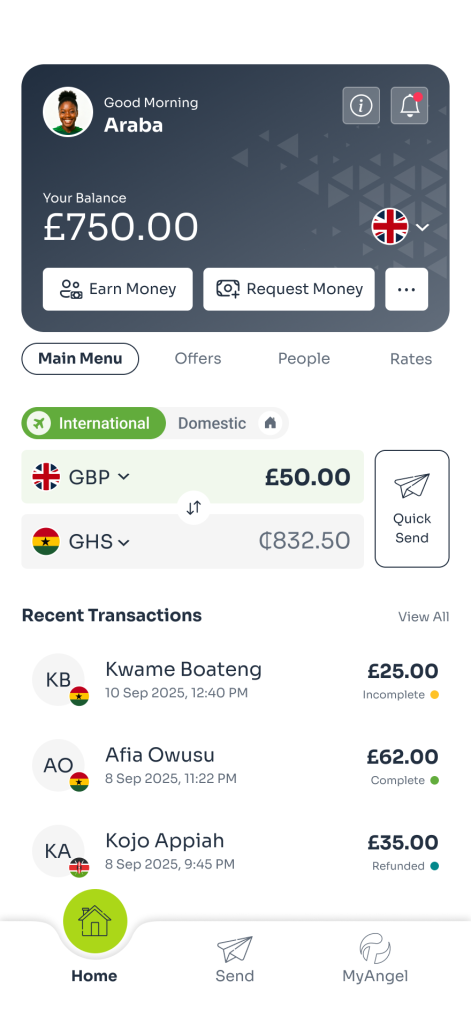
PayAngel’s main product, Direct-to-Merchant Remittances (D2MR), reverses the traditional remittance model. Instead of a user sending money to a person and trusting them to pay a bill on their behalf, the user can pay the bill directly.
Within the app, the sender chooses from a list of onboarded institutions, including hospitals, schools, insurers or retailers. Each organisation uses its own reference system for identifying the recipient of a payment, such as a student ID or hospital ID. According to Amegbor, once the sender makes a payment, the institution receives it without needing a person in the middle to forward the funds.
The company built RemitCare on top of the same rail. According to Amegbor, any sender who transfers at least £100 in a month automatically qualifies their beneficiary for free life and hospitalisation cover that renews on a 30-day basis as long as qualifying transfers continue. Its third product, PayAngel Business, allows African SMEs and large organisations to collect payments from diaspora customers directly, with all transactions reconciled in one place.
Building a cross-border infrastructure
PayAngel’s early infrastructure was Amegbor’s younger brother. When transactions came in, his brother would position himself near a bank, withdraw the money and move from one institution to another paying each one manually.
“I’m not sure how we did it actually, because it sounds almost ridiculous right now,” Amegbor said. “But yes, it was that scrappy.”
It was the workaround that made sense at the time because getting the company off the ground was difficult. Amegbor had a digital remittance idea at a time when banks were still convinced the cash model was what customers wanted. He said that in PayAngel’s early days, banks repeatedly dismissed the concept.
“Most of them just laughed,” he said. “They said, ‘You think you can break what Western Union has been doing for so long? People want to hand their cash to someone and know it’s going to be received on the other end; and you’re proposing a digital solution, in 2012? That’s not going to work.'”
He said PayAngel signed its first disbursement agreements and initially operated through tokens because banks would not give the company direct access to their platforms. But that created a new problem: recipients would arrive at an agent to collect their payment only to be told that there was no cash available. The company then went back to the drawing board.
“We needed to quickly find another solution,” Amegbor said. That was when his brother became part of the infrastructure. The manual process helped PayAngel keep operating while it worked out what a more permanent system should look like.
When PayAngel eventually connected with a bank, the money could move, but the data trail still made little sense. Payment references could disappear from bank statements, making it difficult for businesses to know who had paid them and what the payment was for, because each bank formatted transaction data differently. Amegbor came to understand that solving remittances meant building infrastructure on both sides of the transaction.
“We realised that focusing on the send side was the problem,” Amegbor said. “We needed a solution on the receive side as well, to onboard the businesses directly and give them a platform that actually lets them receive the money and know who it belongs to.”
Rather than trying to force an existing remittance system to work for businesses, PayAngel began building a platform that would onboard businesses and allow them to receive money from users in the diaspora.
PayAngel launched its minimum viable product (MVP) for direct-to-merchant remittances in 2022, roughly a decade after the idea first took shape.
The business behind the bet
For all the years it took to prove that PayAngel’s direct-to-merchant remittances model would work, the platform generates revenue from foreign exchange spreads, like many remittance companies. It earns an FX margin on the money moving through its platform and charges fees for collecting payments for businesses through PayAngel Business.
The startup competes with traditional remittance operators including Western Union and MoneyGram, as well as newer digital players such as LemFi, NALA and Sendwave. What Amegbor says distinguishes PayAngel is the layer above the transfer itself.
“We are driving accountability and trust within the ecosystem,” he said, adding that PayAngel sees an opportunity in payments that are too specific for other channels.
“When you think about payments to businesses and recurring small bills, that is where we believe is the blue ocean,” he added.
According to Amegbor, the business has moved far beyond the early experiments involving tokens and his brother carrying cash between banks. PayAngel says it has processed more than $450 million in transactions and has more than 100,000 active remitters. The company says it now serves customers across 22 countries on four continents, with an annualised revenue run rate of about $4 million.
That growth has required building a regulatory footprint across the markets where PayAngel operates. Amegbor said the company holds regulatory approval in the United Kingdom, the United States, Canada, Australia and Ghana. He also said it has partnered with Visa to help connect to new markets and move money more seamlessly across existing ones.
Amegbor said the next stage for the company is to deepen its roots. He wants to consolidate PayAngel’s presence in several African markets, including Nigeria, Kenya, South Africa and Uganda, before expanding further. The African side, he said, is the heavy lifting that must be done properly because building local infrastructure takes time.
Amegbor described PayAngel’s long-term ambition as building a closed-loop system that allows individuals and businesses to move money between the Global North and the Global South as easily as moving it within a country.

