Argentina’s Patagonia Emerges as an AI Compute Frontier as Data Centers Chase Power and Land
Key Takeaways
- •Northern Virginia data center vacancy stands at 0.3%, and PwC projects cumulative global AI infrastructure investment of $31.6 trillion by 2050, with power availability the decisive siting factor.
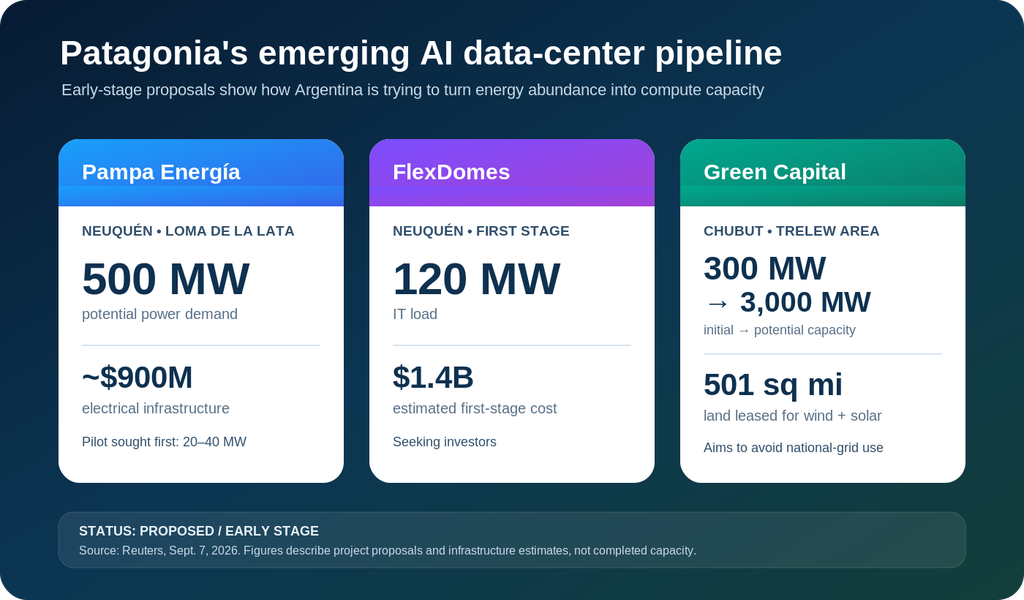
- •Pampa Energía's Neuquén project could deliver roughly 500 MW, FlexDomes seeks $1.4 billion for a 120 MW start in Neuquén, and Green Capital plans a Chubut project scaling from 300 MW to as much as 3,000 MW.
- •OpenAI and Sur Energy signed a letter of intent in October 2025 for Stargate Argentina, which authorities estimate would deliver 500 MW at a $25 billion investment.
- •Argentina's Decree 105/2026 extends the RIGI enrollment window by one year and adds artificial intelligence to the regime's covered technology activities.
- •The Patagonia proposals remain plans rather than delivered capacity, with fiber connectivity far from major submarine cable routes and financing cited as key unresolved risks.
With established data center hubs running into constraints on both energy and land, Argentina's Patagonia is starting to look strategic rather than remote. According to a Reuters investigation published September 7, developers are evaluating sites in the provinces of Neuquén and Chubut for large data centers that could draw on a cold climate, hydroelectric power, wind, solar, and natural gas from the Vaca Muerta formation. The region's consistently low temperatures are a practical draw for data center operators, since cooler ambient air reduces the mechanical cooling burden that makes cooling one of the largest operating costs in conventional facilities, while Vaca Muerta — one of the world's largest shale oil and gas plays — offers a domestic fossil fuel supply alongside renewables.
The open question is whether AI workloads will migrate to energy-abundant regions or remain concentrated in established hubs. The pattern is already visible elsewhere: northern Scandinavia and Iceland attracted hyperscale facilities for similar reasons of cheap renewable power and cool climates, showing that compute can move when the economics justify it. If Patagonia can convert proposals into operating assets, Argentina may capture part of an infrastructure boom that is increasingly shaped by electricity availability and geography.
Why the map is being redrawn
The strain on established markets is becoming measurable. CBRE's Global Data Center Trends 2026 puts vacancy in Northern Virginia at just 0.3%, and the firm expects power availability, grid constraints, and local opposition to construction to reshape site selection across major hubs in North America and Europe.
Meanwhile, PwC's Global Data Centre Outlook projects cumulative capital expenditure on global AI infrastructure of $31.6 trillion by 2050, with annual data center spending rising from $800 billion in 2026 to $1.8 trillion by mid-century. PwC emphasizes that power availability will have the greatest influence on where that investment lands, which places Patagonia squarely in the conversation.
McKinsey offers a complementary lens, distinguishing supply-advantaged markets from demand-driven markets with mature digital ecosystems. Patagonia belongs to the first category. Its task is not to displace Northern Virginia, London, or Singapore, but to attract customers with power-intensive workloads who are able and willing to locate compute farther from end users — provided energy, connectivity, and financing conditions are met.
What Patagonia is actually offering
In Neuquén, Pampa Energía is developing a project at the site of its Loma de la Lata thermal power plant with the capacity to deliver roughly 500 MW of electricity. Investors are weighing an initial pilot plant of 20–40 MW, while building out the electrical infrastructure for the full 500 MW would cost close to $900 million.
FlexDomes is seeking investors for a $1.4 billion project in Neuquén that would start at 120 MW. Farther south, Green Capital plans a Chubut project beginning at 300 MW with room to scale to 3,000 MW over time. The company is leasing 501 square miles of land south of Trelew for wind and solar generation to reduce reliance on the national grid. For scale, the individual Patagonia proposals are already comparable in capacity to large single-campus facilities in mature markets, and Green Capital's 3,000 MW build-out ceiling would place it among the largest data center clusters anywhere if fully realized.
These figures remain plans rather than delivered capacity. Their value ultimately depends on financing, fiber connectivity, transmission infrastructure, and firm customer commitments. Connectivity is a particular watch item: Patagonia sits far from the transatlantic and Brazilian submarine cable routes that serve São Paulo and Buenos Aires, so any large-scale compute campus would require substantial new fiber investment to reach global networks at competitive latency.
Milei's incentives and the Stargate anchor
Policy is central to Patagonia's energy pitch. Argentina's RIGI framework provides incentives and legal stability for large projects, and Decree 105/2026 has extended the enrollment window by one year from July 8, 2026. The decree also adds artificial intelligence to the list of technology activities covered by the regime. The RIGI regime was created under President Javier Milei's government to reassure investors long wary of Argentina's history of macroeconomic volatility, currency controls, and contract renegotiation — precisely the country-risk concerns that any multi-billion-dollar data center investment would have to price in.
The most significant project currently under discussion is Stargate Argentina. OpenAI and Sur Energy signed a letter of intent in October 2025 to begin work on what would be the first Stargate project in Latin America. Argentine authorities estimate the installation would deliver 500 MW of electricity at an investment of $25 billion. Cryptopolitan reported on the proposal when it first emerged, when it was regarded as the country's only landmark AI-related investment. The landscape looks different today, with major data-center projects from Pampa Energía, FlexDomes, and Green Capital adding to Patagonia's potential pipeline.
"The Stargate Argentina project represents a historic opportunity for the country," said Sur Energy partner Emiliano Kargieman, arguing that Argentina could combine its renewable-energy potential with AI infrastructure at global scale.
OpenAI CEO Sam Altman said the effort could help Argentina build toward becoming "an AI hub for all of Latin America."
The gap between announcements and steel
Execution remains the hardest part. The Inter-American Development Bank identifies reliable, affordable energy, strong connectivity, and a stable regulatory environment as the core requirements for attracting data center investment to Latin America. Patagonia has abundant energy and a favorable regulatory regime, but its prospects hinge largely on connectivity and financing.
The outcome of these projects could set a precedent well beyond Argentina. If any part of the pipeline succeeds, it will demonstrate that energy-rich regions outside traditional data center markets can compete for large-scale compute. If the projects stall, the lesson will be equally instructive: cheap energy alone does not produce a successful compute hub.
