PanStar Acro Enters Arctic Waters on First South Korean Government-Backed Container Ship Trial
Key Takeaways
- •The PanStar Acro is the first South Korean container ship to complete a government-backed trial voyage through the Northern Sea Route.
- •The ship departed Busan New Port on Aug. 22 and reached Arctic waters about nine days later with 737 TEUs on board.
- •Its planned route includes Felixstowe and Rotterdam, with the round trip expected to take about 45 days.
- •The Northern Sea Route is about 13,000 kilometers from Busan to Rotterdam, roughly 35% shorter than the route via the Indian Ocean and Suez Canal.
- •South Korea will use operational, cost and navigation data from the voyage to assess whether commercial Arctic shipping could become viable by 2030.
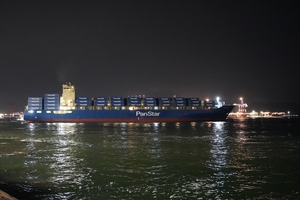
The PanStar Acro entered Arctic waters on Monday, marking the first time a South Korean container ship has undertaken a government-backed trial voyage through the Northern Sea Route.
The Ministry of Oceans and Fisheries said the vessel reached the Arctic region around 8 a.m. Korea time, nine days after departing Busan New Port on Aug. 22. It is carrying 737 twenty-foot-equivalent units, or TEUs, of cargo.
The PanStar Acro is expected to leave the Arctic Ocean around Sept. 7–8. It will then call at Felixstowe in Britain before sailing to Rotterdam in the Netherlands, its main destination, where it is expected to arrive around Sept. 12–14. The ship will return to South Korea via the Arctic route, with the round trip expected to take about 45 days.
The Northern Sea Route runs along Russia’s northern coast and connects Asia and Europe through Arctic waters. The route from Busan to Rotterdam is approximately 13,000 kilometers, about 35 percent shorter than the roughly 20,000-kilometer passage through the Indian Ocean and the Suez Canal. It could cut sailing time by about 10 days.
However, the shorter distance does not guarantee lower costs. Icebreaker escorts, insurance, specialized crews, and the need to operate in difficult weather and sea-ice conditions could offset potential fuel savings. Ships also require clearance from Russian authorities and may depend on Russian navigation and icebreaker services, making the route operationally more complex than standard Asia-Europe sailings.
Cargo volume is another challenge. An initial survey identified potential demand for about 1,300 TEUs, but the PanStar Acro departed with 737 TEUs. The government said the shortfall was partly due to the limited time available to secure cargo and uncertainty surrounding the first trial voyage.
South Korean companies conducted Arctic shipping trials in 2013, 2015 and 2016, but none resulted in regular services. That history underscores why the latest voyage is being treated as a test of both logistics and commercial readiness, not just navigation. The government plans to use operational, cost and navigation data from the latest voyage to assess whether commercial Arctic shipping can become viable and whether regular services can be established by 2030.
The ministry said the sailing schedule remains subject to change because of unstable Arctic weather and changing sea-ice conditions. It added that the voyage is intended to build practical experience and identify viable cargo and business models for future expansion through the Arctic route.
