Pamt Corp. Posts Another Net Loss, 110.6% Adjusted Truckload Operating Ratio
Key Takeaways
- •Pamt reported a second-quarter net loss of $7.4 million, or 36 cents per share, and it was the company’s seventh consecutive quarterly loss.
- •Excluding a one-time accrual tied to prior auto liability claims, second-quarter earnings were 25 cents per share.
- •Consolidated revenue increased 9% year over year to $165 million, while revenue excluding fuel surcharges rose 2%.
- •The truckload unit’s revenue excluding fuel fell 7% from a year earlier, but the company said rate per total mile improved sequentially for the first time in more than three years.
- •Daniel Kleine was appointed chief financial officer, and Pamt ended the quarter with $117 million in liquidity and $333 million in outstanding debt.
Truckload carrier Pamt Corp. continues to reduce its fleet in an effort to restore profitability.
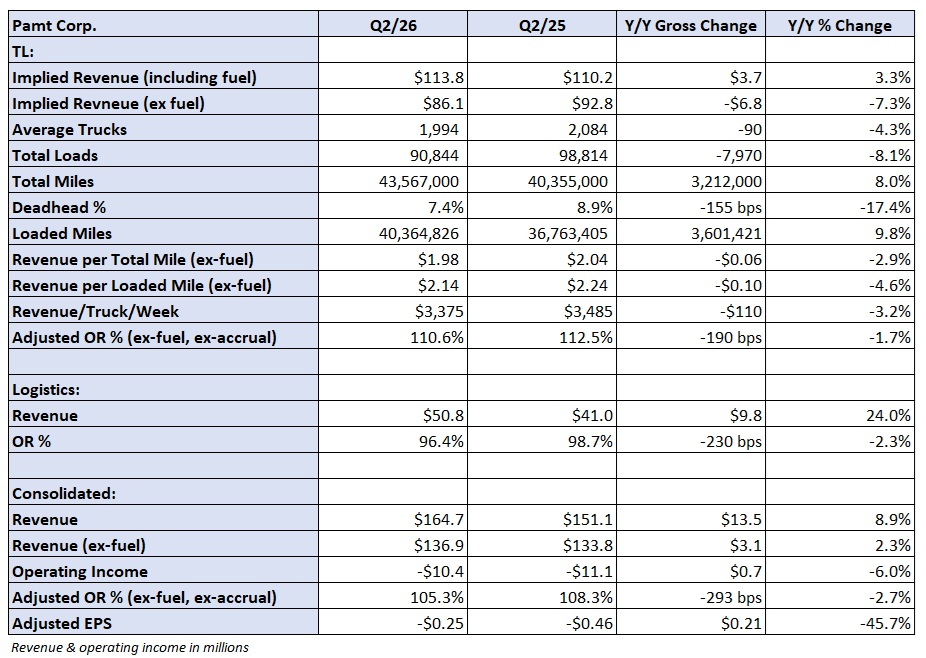
Pamt (NASDAQ: PAMT) reported a second-quarter net loss of $7.4 million, or 36 cents per share, on Tuesday evening. Excluding the impact of a one-time accrual tied to prior auto liability claims, earnings were 25 cents per share. In the year-ago period, Pamt posted a net loss of 46 cents per share.
The second quarter was Pamt’s seventh consecutive quarterly net loss.
The company said it faced roughly 6 cents per share in headwinds that were not excluded from the earnings figure. Compared with the 2025 second quarter, lower gains on equipment sales created a 14-cent-per-share headwind and higher interest expense added another 2-cent drag. Higher non-operating income, which largely reflects changes in the value of its stock portfolio, provided a 10-cent tailwind.
Consolidated revenue rose 9% year over year to $165 million. Excluding fuel surcharges, revenue increased 2%.
In the truckload unit, revenue excluding fuel fell 7% year over year as average trucks in service declined 4% and revenue per truck per week dropped 3%. Loaded miles per truck increased 15% year over year during the quarter. Revenue per loaded mile excluding fuel declined 5% from a year earlier, but improved 4% from the first quarter.
“For the first time in more than three years, market conditions enabled a meaningful sequential increase in rate per total mile,” Pamt President Lance Stewart said. “This marks an important step toward addressing rates that have been pressured lower while inflationary cost pressures have persisted.”
The company’s fleet count was just under 2,000 units in the period, down from more than 2,400 tractors three years ago. That smaller fleet helps explain why Pamt is emphasizing rate improvement and equipment utilization rather than volume growth as the truckload market remains pressured.
The truckload unit reported a 114.2% operating ratio, or OR, which is the inverse of operating margin. Excluding the one-time insurance accrual, the adjusted OR was 110.6%, an improvement of 190 basis points year over year.
The quarter marked 11 consecutive operating losses for the truckload unit.
“As industry dynamics continue to constrain driver supply, we believe opportunities for further rate correction remain, and we have achieved additional progress through the date of this release,” Stewart said.
The logistics unit reported revenue of $51 million, up 24% year over year. The segment improved its margin by 230 basis points and posted a 96.4% OR.
Pamt does not disclose gross profit margins for the unit or operating metrics such as load counts and revenue per load.
For the first half of the year, Pamt used $16.7 million in operating cash flow. Liquidity, including cash, equity holdings and availability under its line of credit, stood at $117 million, down $24 million from the first quarter. Outstanding debt rose $12 million to $333 million.
The company also said Thursday that Daniel Kleine was appointed chief financial officer. Kleine joined Pamt three years ago as vice president of tax. Most recently, he served as senior vice president of finance and treasurer.
Pamt’s results illustrate how some carriers are reducing fleet size in an effort to return to or improve profitability, while still contending with weak operating leverage in truckload and a need to preserve liquidity.

