Palantir Q2 2026 Earnings: Revenue Jumps 93% as AI Demand Reshapes the PLTR Stock Story
Key Takeaways
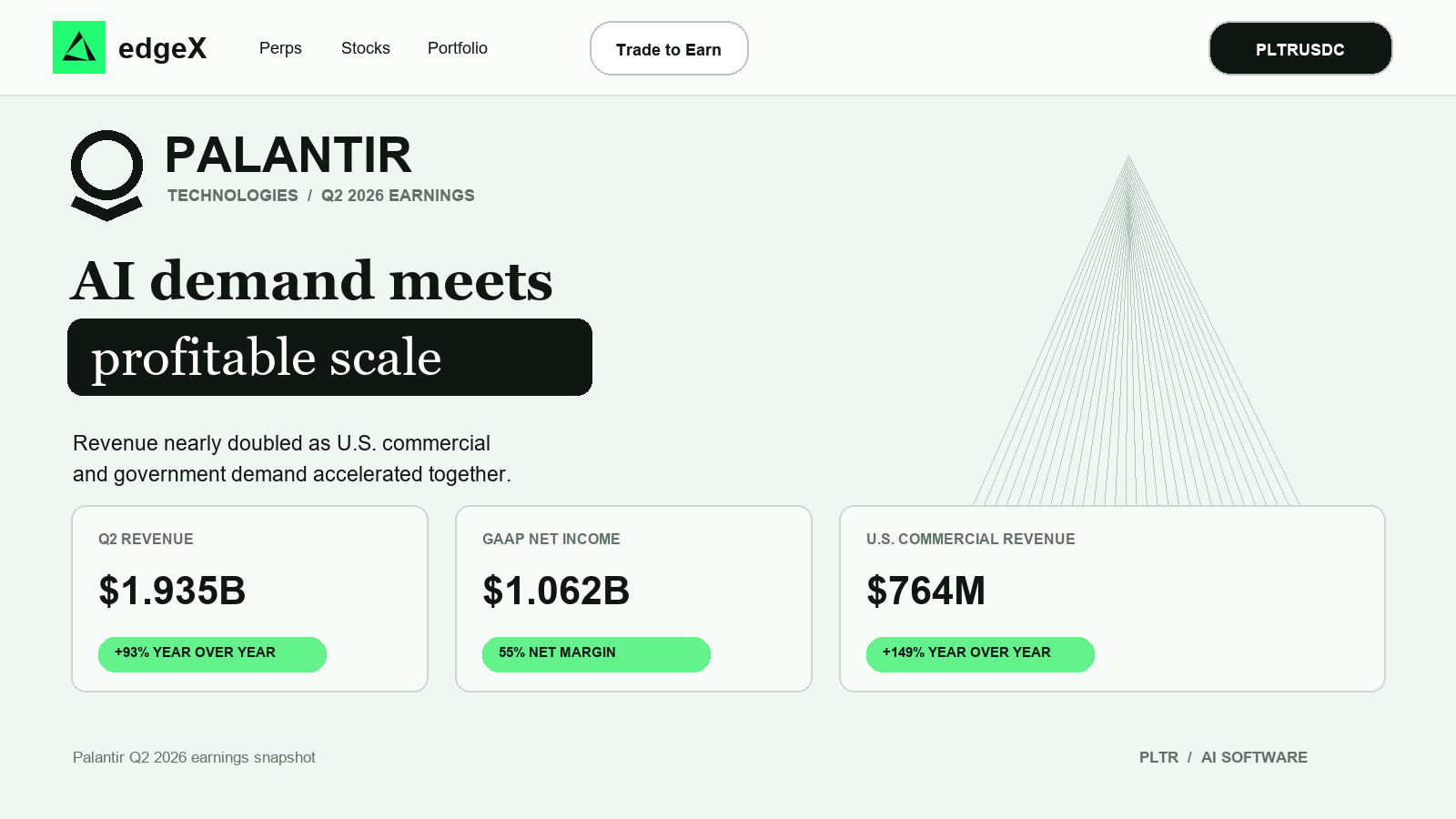
- •Palantir's Q2 2026 revenue reached $1.935 billion, nearly doubling year over year while the company posted a 47% GAAP operating margin and $1.062 billion in net income.
- •U.S. commercial revenue surged 149% to $764 million, making it the fastest-growing segment and signaling that AIP adoption is converting into substantial enterprise spending.
- •Management raised full-year 2026 revenue guidance to a range of $8.150 billion to $8.158 billion and projected Q3 revenue of approximately $2.16 billion, above the analyst consensus of roughly $2 billion.
- •U.S. revenue accounted for more than four-fifths of total company revenue, highlighting significant geographic concentration risk as international expansion remains limited.
- •Palantir ended the quarter with $9.2 billion in cash and short-term Treasury securities, providing capacity for investment without reliance on external capital.
Palantir's Q2 Report Reset the Growth Baseline
Palantir's second-quarter report was not simply another artificial intelligence company beating expectations. The company nearly doubled revenue while producing a 55% GAAP net-income margin, a combination that is unusual even among high-growth software businesses.
Revenue rose 93% year over year and 19% sequentially to $1.935 billion. GAAP income from operations reached $912 million, equal to a 47% margin, while GAAP net income attributable to common stockholders was $1.062 billion. Cash from operations totaled $1.216 billion, and adjusted free cash flow reached $1.220 billion.
Those figures change the quality of the PLTR debate. In earlier phases of the company's public-market story, investors often had to weigh long-term platform potential against stock-based compensation, uneven profitability, and uncertain enterprise adoption. Q2 offered something more concrete: rapid expansion, substantial current earnings, and strong cash generation in the same quarter.
The earnings beat reached beyond the headline revenue number
Palantir's adjusted earnings per share came to $0.41, above the $0.35 analyst estimate cited by Reuters. Revenue of about $1.94 billion also exceeded the $1.80 billion consensus estimate in that report. The company closed 220 deals worth at least $1 million, including 73 deals worth at least $10 million, while total contract value reached $3.373 billion.
The deal statistics matter because they provide context for the revenue acceleration. Palantir is not relying only on a handful of small AI trials. Large contracts, expanding remaining deal value, and strong cash conversion suggest that customers are committing meaningful budgets to the platform.
The market reaction reflected a higher forward path
Reuters reported that Palantir shares rose 14% in extended trading after the company released its results and raised guidance. That reaction should not be read as a live PLTR price; market prices change continuously, and readers should verify current quotes through Nasdaq, their broker, or another real-time market-data provider.
The important signal was what the move represented. Investors were responding not only to a backward-looking beat but also to management's claim that the acceleration can continue. When a richly valued growth stock rallies after earnings, the next question is whether future results can keep lifting the earnings path faster than expectations rise.
U.S. Commercial AI Became the Main Growth Engine
The quarter's clearest operating signal came from the U.S. commercial business. Revenue in that segment increased 149% year over year and 28% sequentially to $764 million. U.S. commercial total contract value reached a record $2.132 billion, up 153%, while remaining deal value rose 124% to $6.238 billion.
| Q2 2026 metric | Reported result | Why it matters for PLTR investors |
|---|---|---|
| Total revenue | $1.935 billion, up 93% YoY | Growth accelerated at a large quarterly base |
| GAAP operating income | $912 million, 47% margin | Shows substantial operating leverage |
| GAAP net income | $1.062 billion, 55% margin | Profitability became central to the thesis |
| U.S. commercial revenue | $764 million, up 149% YoY | AIP adoption is translating into enterprise spending |
| U.S. government revenue | $809 million, up 90% YoY | Government demand remains a second major engine |
| Total contract value | $3.373 billion, up 49% YoY | Large commitments support future revenue visibility |
| Cash from operations | $1.216 billion, 63% margin | Earnings were supported by strong cash generation |
| Adjusted free cash flow | $1.220 billion, 63% margin | Provides capacity to invest without sacrificing liquidity |
AIP is moving from demonstrations into operating workflows
Palantir's Artificial Intelligence Platform is designed to connect models with an organization's data, permissions, software tools, and operating decisions. That is different from selling access to a general-purpose chatbot. The platform becomes economically important when it is used in production for manufacturing, logistics, healthcare, defense, financial operations, or supply-chain decisions.
The U.S. commercial growth rate suggests that more customers are crossing the gap between testing AI and paying for deployed systems. Palantir's approach emphasizes fast implementation and expansion from specific operating outcomes. When an initial deployment saves time, raises production, reduces downtime, or improves a decision process, the company can seek a broader commitment across teams and locations.
Investors should still be careful about attributing every dollar of growth to a single product motion. Contract timing, customer expansions, new clients, and large agreements can all affect a quarter. The more durable evidence will come from repeated growth in revenue, remaining deal value, cash flow, and large-customer commitments across several reporting periods.
Government demand remains powerful, but concentration matters
U.S. government revenue increased 90% to $809 million, reinforcing Palantir's position in defense and public-sector data systems. Government work gives the company long experience with sensitive information, complex permissions, and mission-critical deployments. Those capabilities can strengthen its credibility with regulated commercial customers.
The same strength creates concentration risk. U.S. revenue totaled $1.573 billion, or more than four-fifths of companywide revenue. Palantir's domestic momentum is exceptional, but a more balanced geographic mix would reduce reliance on one market and demonstrate that the platform can navigate different procurement systems, data-sovereignty rules, and political environments.
Raised Guidance Made the Quarter More Than a One-Off Beat
Management increased its 2026 revenue forecast to $8.150 billion-$8.158 billion, up from its previous range of $7.650 billion-$7.662 billion. The company also expects U.S. commercial revenue to exceed $3.424 billion, representing growth of at least 134%, and raised adjusted free-cash-flow guidance to $4.5 billion-$4.7 billion.
For Q3, Palantir projected revenue of $2.160 billion-$2.164 billion. Reuters reported that this was above the approximately $2 billion analyst consensus compiled by LSEG. The guidance implies that management expects the step-up in demand to carry into the next reporting period rather than reverse immediately after a strong quarter.
Guidance raises the execution standard as well as the opportunity
Higher guidance can support a stock when estimates move faster than the valuation investors assign to those earnings. It can also raise the cost of disappointment. After 93% total revenue growth and 149% U.S. commercial growth, even healthy deceleration could appear weak against a newly elevated benchmark.
Investors should therefore avoid treating Q2's growth rates as a permanent run rate. The more useful test is whether Palantir can preserve strong incremental margins as revenue expands, continue converting contracts into cash, and sustain customer demand after the easiest comparisons have passed.
Profit and cash flow give Palantir strategic room
Palantir ended the quarter with $9.2 billion in cash, cash equivalents, and short-term U.S. Treasury securities. Strong liquidity and cash generation give the company room to invest in product development, deployment capacity, partnerships, and international expansion without depending on external capital.
That financial position also changes the risk profile. Palantir remains exposed to customer concentration, procurement cycles, competition, regulation, and valuation compression, but it is no longer asking investors to fund growth while waiting for the business model to prove it can generate profit. Q2 showed that the model can produce substantial earnings today.
What Q2 Still Does Not Resolve for PLTR Stock
The report supplied powerful evidence, but it did not eliminate the difference between a strong company and an attractive stock at every price. Palantir's valuation depends on years of future growth, and a high-expectation stock can fall even when the underlying business continues to expand.
Competition is another unresolved issue. Cloud providers, enterprise software companies, consultants, model developers, and internal engineering teams all compete for AI budgets. Palantir must keep proving that its combination of governance, data integration, deployment speed, and operational tooling produces results that customers cannot easily reproduce elsewhere.
International expansion also remains a test. U.S. growth currently dominates the story, while data rules and concerns about dependence on American technology can complicate adoption abroad. A stronger international commercial engine would broaden the opportunity and reduce geographic concentration.
Four signals matter most after the Q2 surge
The first signal is U.S. commercial revenue growth, particularly whether sequential expansion remains strong. The second is conversion of total contract value and remaining deal value into recognized revenue and cash. The third is the balance between government and commercial demand, including evidence that neither engine depends on isolated contract timing. The fourth is international progress in markets with different sovereignty and procurement requirements.
Investors should also watch the relationship between GAAP operating income, cash flow, and stock-based compensation. Q2 demonstrated strong reported profitability, but the durability of the margin structure will be clearer after several quarters of investment and hiring decisions.
The PLTR Investment Takeaway
Palantir's Q2 2026 earnings moved the company beyond a simple AI-potential narrative. Revenue nearly doubled, U.S. commercial and government businesses accelerated together, cash generation remained strong, and management raised its forward outlook. The result supports the view that Palantir is becoming an operating layer for organizations that want to use AI against sensitive data and real workflows.
The risk is that the stock now carries an even higher standard. PLTR investors are buying exposure to exceptional execution, not merely industry growth. The bullish case requires AIP adoption to remain durable, margins to stay strong, and international expansion to become more meaningful. Q2 made that case more credible, but future quarters must keep proving it.
Trade PLTR Perpetual Futures on edgeX
Palantir earnings can move the market outside regular U.S. trading hours. edgeX gives eligible traders self-custodial access to stock, commodity, and crypto perpetual markets through an on-chain trading platform built for high-speed execution.
Access the PLTRUSDC market
The PLTRUSDC perpetual market supports positions with leverage of up to 10x according to the current market page. edgeX states that its order book can process up to 200,000 orders per second with matching latency below 10 milliseconds, while its platform combines self-custody with on-chain settlement. Traders should verify current leverage, order availability, funding, fees, and market status directly on the product page before entering a position.
Trade to Earn without giving up custody
edgeX’s current Trade to Earn program returns trading activity to users through EDGE-denominated rewards subject to the campaign's rules and eligibility requirements. The platform says users retain control through their private keys and authorize fund movements themselves.
Perpetual futures are derivatives, not Palantir common stock. They do not provide ownership, voting rights, dividends, or other shareholder rights. Leverage magnifies gains and losses and can lead to liquidation. Product access may vary by jurisdiction, and traders should review current specifications and terms before participating.
Frequently Asked Questions
When did Palantir release its Q2 2026 earnings?
Palantir released its second-quarter results on August 3, 2026. The quarter ended June 30, 2026.
What was Palantir's Q2 2026 revenue?
Revenue was $1.935 billion, up 93% year over year and 19% quarter over quarter.
How profitable was Palantir in Q2 2026?
GAAP operating income was $912 million, GAAP net income attributable to common stockholders was $1.062 billion, and cash from operations was $1.216 billion.
What drove Palantir's growth?
The largest signals were U.S. commercial revenue growth of 149% and U.S. government revenue growth of 90%. Management attributed the broader momentum to demand for Palantir's AI and data platforms.
What should PLTR investors watch next?
Investors should watch Q3 revenue against guidance, U.S. commercial expansion, government contract conversion, international growth, cash generation, margin durability, and whether future results continue to support the valuation expectations attached to PLTR stock.

