Pacifica Review 2026: A Beginner's Guide to the Solana Perps DEX
Key Takeaways
- •Pacifica launched in June 2025 as a self-funded platform offering perpetuals and spot trading in USDC on Solana, with cross margin by default, isolated margin for perpetuals, and leverage from 3x to 50x depending on the market.
- •Tier 1 trading fees are 0.015% maker and 0.040% taker, meaning a $1 million taker round trip costs roughly $800 before funding and slippage.
- •The Points Program, launched September 4, 2026, allocates 10 million points weekly, but its formula is dynamic and opaque and no token, TGE date or conversion ratio is confirmed.
- •The review's live check on October 18, 2026 encountered a restricted-jurisdiction warning that prevented wallet connection, deposits and order submission, so users must verify regional access before depositing.
- •DefiLlama data captured October 18, 2026 credits Pacifica with $10.375 billion in 30-day perpetual volume and $59.94 million in open interest, substantially smaller than Hyperliquid's $209.533 billion volume and $7.773 billion open interest.
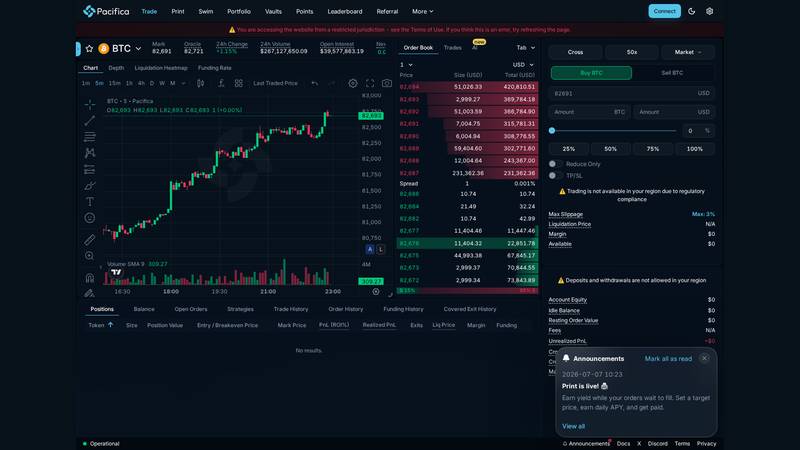
Pacifica is a hybrid perpetuals and spot trading platform built around Solana, combining a fast trading interface with self-custody, cross and isolated margin, a points program and a growing set of automated strategies. This hands-on review draws on the live Pacifica interface and the project's official documentation and was last checked on October 18, 2026.
Pacifica is not a simple perp terminal. Its product surface includes perpetuals, spot markets, Print, Swim, Vaults, points, leaderboards and advanced order strategies such as TWAP, OCO, trailing stop and Atomic.
During the review, the live app loaded the trade interface but displayed a restricted-jurisdiction warning before wallet connection. No wallet, deposit or order was submitted, so this article separates live interface evidence from documented mechanics.
Quick take: Pacifica is compelling for Solana traders who want broad market coverage, a CEX-like order ticket and a serious points program. The main caveats are jurisdictional access, closed-beta limits, dynamic point rules, liquidation complexity and the difference between an interface that looks liquid and liquidity that holds at your size.
What Is Pacifica?
Pacifica describes itself as a high-performance decentralized trading platform launched in June 2025. Its official documentation positions it as a wider trading ecosystem spanning crypto, real-world assets (RWAs) and pre-IPO markets, with perpetuals and spot as core products.
Trading uses a hybrid architecture: the order book is designed for fast execution, while deposits, withdrawals and account settlement run on Solana infrastructure. Pacifica supports cross margin by default, isolated margin for perpetuals and unified spot collateral. Details are in the official trading overview.
The project says its team includes experience from Binance, FTX, Coinbase, Jane Street, OpenAI, DeepMind and MIT, and that Pacifica has been self-funded since inception. That gives the project a different profile from a purely anonymous points farm, but it does not remove smart-contract, oracle, liquidity or liquidation risk.
How Pacifica Looks Across Devices
The desktop terminal places the chart on the left, the order book in the centre and the order ticket on the right, with BTC market metrics, the positions panel, mark and oracle price, 24-hour volume, open interest and funding visible in one view. The tablet layout compresses the same workflow, leaving less room for the chart, book and ticket, while the phone view is better suited to monitoring prices and funding than managing a complex leveraged position; larger screens remain safer for order entry.
The most important live detail observed was the red restricted-jurisdiction banner and the warning inside the ticket that trading is unavailable in the current region. Market data still rendered despite the restriction.
Core Features
Perpetuals and Spot in One Account
Pacifica supports perpetuals and spot quoted in USDC. The trading overview lists more than 35 perpetual markets, while the broader About page claims 65+ pairs across crypto majors, altcoins, RWAs, FX and pre-IPO markets. That documentation mismatch is worth checking before relying on a market-count headline.
Advanced Order Strategies
Beyond Market and Limit orders, Pacifica documents Stop Market, Stop Limit, TWAP, Scale, Chase, Conditional orders, OCO, Trailing Stop, Swarm, Trigger Swarm and Atomic. This is a stronger order toolkit than a basic perp interface offers, particularly for traders who split entries or manage paired exposure.
Print, Swim, Vaults and Neptune
The broader ecosystem includes Print for yield-like structured exposure, Swim for simplified trading experiences, Vaults for managed or automated strategies, and Neptune, an agentic harness intended to turn trading ideas into executable workflows. These products expand the platform's surface area but also add product-specific risks to evaluate.
Markets and Trading Surface
Pacifica's market surface is broader than the live BTC screen alone suggests. The documentation covers crypto, RWAs, FX and pre-IPO markets, but every additional market introduces oracle, liquidity and liquidation questions. The market list should be treated as a starting point, not proof of equal execution quality. Traders should read the contract specifications and market specifications before sizing beyond the most liquid pairs.
Fee Schedule
Pacifica uses volume-based maker and taker fees. Tiers update daily from the account's trailing 30-day volume, and subaccounts share the master account's fee tier. Tier 1 fees are 0.015% maker and 0.040% taker, with lower rates at higher 30-day volume tiers.
For example, a $10,000 Tier 1 taker entry implies about $4.00 in opening trading fees before funding, slippage and network costs. The same notional executed as maker implies about $1.50, though a maker fill is never guaranteed. The current fee schedule should be checked before trading because volume tiers and product-specific costs can change.
Real Cost of Trading: A $1M Notional Example
Trading cost is not just the headline maker/taker rate; documented charges must be separated from variable execution costs so that a points strategy is not mistaken for free volume. For a Tier 1 taker, a $1M round trip already costs about $800 before funding and slippage. That is why points should be evaluated against the full round-trip cost, not against the fee table alone. The deposit and withdrawal rules add further parameters.
Margin, Funding and Liquidation
Pacifica offers cross margin by default and isolated margin for perpetuals. Leverage ranges from 3x to 50x depending on the market, while spot is cross-only. Cross margin can use unified spot collateral, which increases flexibility but also links more account equity to one risk engine.
Funding updates every hour. Pacifica samples the estimate every five seconds, applies a one-hour TWAP and caps the hourly funding rate at plus or minus 4%. The funding calculation uses the premium index, oracle price and impact prices based on a $20,000 impact notional for BTC or $6,000 for other assets.
Liquidation operates in three layers: market liquidation into the order book, backstop liquidation when equity falls below two-thirds of maintenance margin, and auto-deleveraging if equity becomes negative. This structure is more sophisticated than a single liquidation threshold, but it also makes conservative leverage and position monitoring essential. The funding and liquidation documentation covers the mechanics in detail.
Common Margin and Order Mistakes
The practical rule is simple: isolate learning positions, use less leverage than the interface permits and treat every order field as a risk control. Pacifica's margin documentation should be read before using shared collateral.
How to Trade on Pacifica: Step by Step
This walkthrough follows the live terminal. The market screen was available for inspection, but the restricted-jurisdiction warning prevented wallet connection, deposit and order submission. The onboarding details below come from Pacifica's official documentation.
Step 1: Open the App and Check Eligibility
Open the terminal at app.pacifica.fi and verify that your jurisdiction is supported. Check the top banner and the Terms of Use before connecting a wallet. Pacifica documents programmatic restrictions for several jurisdictions, and the warning should not be bypassed.
Step 2: Select a Market and Read the Header
Choose a market and inspect the mark price, oracle price, 24-hour volume, open interest and next funding value. Use the chart, depth and liquidation heatmap views to judge whether the market fits the intended position size.
Step 3: Choose Margin, Leverage and Order Type
Select Cross or Isolated only after understanding how collateral is shared. Choose Market, Limit or an advanced strategy, set a conservative leverage level, then enter the amount and maximum slippage.
Step 4: Review Position and Liquidation Fields
After entry, the Positions panel becomes the control centre for mark price, unrealized PnL, liquidation price, margin and funding. Use Reduce Only when reducing exposure and check funding history before holding a position across multiple hourly settlements.
Step 5: Connect a Solana Wallet, Deposit USDC and Submit Carefully
The live ticket shows the regional restriction before wallet access. Pacifica's documentation supports Solana wallets such as Phantom, Solflare, Backpack and Ledger via browser extension. Deposit USDC, confirm the balance, and review fee, slippage, leverage and liquidation price before submitting. The documented minimum deposit is $10; no transaction was submitted for this review.
Wallet and Network Flow After Connection
Pacifica uses Solana for wallet access, USDC deposits and withdrawals. Supported options include Phantom, Solflare, Backpack, Ledger through a browser extension and WalletConnect-compatible wallets, provided the live app allows access from your jurisdiction.
After connecting, approve the wallet prompt, choose the deposit action and send USDC on Solana to the displayed account route. Pacifica credits the balance after on-chain confirmation; deposits carry a $10 minimum and network gas is the documented charge.
Once the balance is credited, choose Cross or Isolated, select the market and confirm available margin before placing an order. Withdrawals are bounded by available-to-withdraw rules, closed-beta limits and a documented $1 withdrawal fee, so displayed equity should not be assumed to be immediately withdrawable.
This flow differs from a simple wallet swap: the wallet handles the on-chain funding action, while the trading account manages margin, positions, funding and order state. The official wallet and network guidance should be read before moving USDC.
Points, Rewards and Product Programs
Pacifica's Points Program launched on September 4, 2026. The documented weekly allocation is 10,000,000 points, with snapshots every Thursday at 00:00 UTC and distributions within 24 hours.
Points are based on organic trading through the GUI or API. Pacifica states that the formula is dynamic and intentionally opaque, and that self-trading, sybil activity and manipulation do not qualify. The official points documentation confirms no token, TGE date or conversion ratio.
The referral program activates after $10,000 of volume. Referrers receive 10% of the points generated by referred users, while referees receive a 5% points bonus. Print, Swim and Vaults create separate participation paths, but their economics should be read independently of the core trading points.
Points Versus the Cost of $1M Volume
Although Pacifica documents a weekly allocation of 10,000,000 points, it does not publish a fixed points-per-dollar formula. Points earned from $1M of volume therefore cannot be calculated from official data and should not be presented as a guaranteed return. The formula is dynamic and opaque, and no token, conversion ratio or TGE is confirmed. The 10M weekly allocation should be treated as a program fact, not as a price for trading volume. See the official Points Programme and Referral Programme. Third-party airdrop guides may describe potential upside, but they are not confirmation of a token launch.
Funding, Team and Delivery Context
Pacifica's official About page says the platform launched in June 2025 and has been entirely self-funded since inception. The team profile cites backgrounds across traditional finance, crypto, high-frequency trading and AI, including Binance, FTX, Coinbase, Jane Street, OpenAI, DeepMind and MIT.
The product roadmap is visible in the surface area already shipped: perpetuals, spot, Print, Swim, Vaults, points, leaderboards and Neptune. That is a broader delivery footprint than a single perp terminal, but it also means mature trading mechanics should be distinguished from newer strategy products.
Pacifica publishes a BlockSec audit report through its audit page. An audit is evidence of review, not a guarantee against smart-contract, oracle, custody or liquidation failures.
Independent Onchain Data Snapshot
DefiLlama provides an independent protocol-level view of Pacifica. The data referenced here was captured on October 18, 2026; DefiLlama dashboards refresh continuously, so the date is part of the evidence.
These figures place Pacifica above a small experimental venue but below the largest order-book leaders. Volume alone is not enough: open interest, book depth, fees and liquidation behavior should be compared before treating headline activity as executable liquidity. Pacifica's figures come from the dated DefiLlama snapshot; competitor values use the same dashboard family where available and should be refreshed before publication.
Security and Account Controls
Pacifica combines self-custody with a centralised-feeling account interface. Deposits require a Solana-compatible wallet and USDC, while the documentation describes minimum deposit and withdrawal amounts, closed-beta account caps and an exchange-wide withdrawal cap as risk controls.
The most important operational risk is the liquidation design. Market liquidation can cancel orders and send IOC chunks into the book, backstop liquidation can transfer positions and collateral to a backstop liquidator, and auto-deleveraging can close opposing profitable positions if equity becomes negative. The deposit and withdrawal rules, margin documentation and audit page should be reviewed before depositing.
Pacifica vs Competitors
Pacifica is best compared with Solana-native venues and high-volume perp DEXs, though liquidity models differ. Hyperliquid and dYdX are order-book benchmarks; GMX is a pool-based comparison; Jupiter and Drift are closer Solana ecosystem alternatives.
Pacifica's strongest differentiator is breadth within a Solana-native trading account: perps, spot, points, strategies and adjacent products. Its main disadvantage versus the largest venues is that access restrictions and account-state limitations make it harder to validate execution personally from every region.
Execution Depth and Liquidity Risk
The same DefiLlama snapshot gives Pacifica $10.375B in 30-day perp volume and $59.94M in open interest. Hyperliquid sits in a different liquidity class with $209.533B in volume and $7.773B in open interest, while Jupiter reports $5.616B and $39.9M; dYdX reports $1.194B in volume, with open interest not exposed in the snapshot.
Volume is not the same as executable depth. Before trading size, compare the visible spread, order-book levels, expected price impact and liquidation path on the exact pair. Pacifica may be attractive for Solana-native access, but Hyperliquid remains the safer depth benchmark for large notional execution.
Snapshot date: October 18, 2026. DefiLlama metrics are live and can change; see the linked protocol pages for current values and methodology.
Conclusion
Pacifica is a serious Solana trading product with more depth than a simple points-farming interface. The live terminal exposes charting, order-book data, risk fields, portfolio controls and advanced order types, while the documentation covers margin, funding, liquidation and withdrawals in unusual detail.
The trade-off is complexity. Cross margin, hourly funding, dynamic points, advanced strategies and multi-product rewards create more ways to manage risk — and more ways to misunderstand it. The restricted-jurisdiction warning also means access must be verified before any deposit.
For eligible Solana users, Pacifica is worth testing with small size and conservative leverage. The strongest case is broad market access plus a transparent points program; the strongest objection is that a high-volume headline does not guarantee a deep, safe exit at the size a trader plans to use. Future assessments should recheck jurisdictional access, the documented market-count differences, the current points rules and pair-level execution depth rather than relying on a single interface visit or dated volume snapshot.
FAQs
What is Pacifica?
Pacifica is a decentralized perpetuals and spot trading platform built around Solana, with cross and isolated margin, advanced order strategies and self-custody.
What are Pacifica's trading fees?
Tier 1 fees are 0.015% maker and 0.040% taker, with lower rates at higher 30-day volume tiers.
Does Pacifica have an airdrop?
Pacifica has an active points program, but its official documentation does not confirm a token, TGE date or conversion ratio. Points should be treated as speculative.
What wallet and network does Pacifica use?
Pacifica uses Solana and supports wallets such as Phantom, Solflare, Backpack, the Ledger browser extension and WalletConnect-compatible wallets.
Quick Links
App | Homepage | Docs | Points | Fees | Liquidations
This review is educational, not financial advice. Perpetuals and leverage can result in rapid losses.

