Ouster (OUST) Now Listed on edgeX: Physical AI, Digital Lidar, and the OUST Trading Logic
Key Takeaways
- •edgeX has listed OUSTUSDC perpetual contracts, allowing traders to express long or short views on Ouster around the clock through a self-custodial platform without requiring traditional market hours.
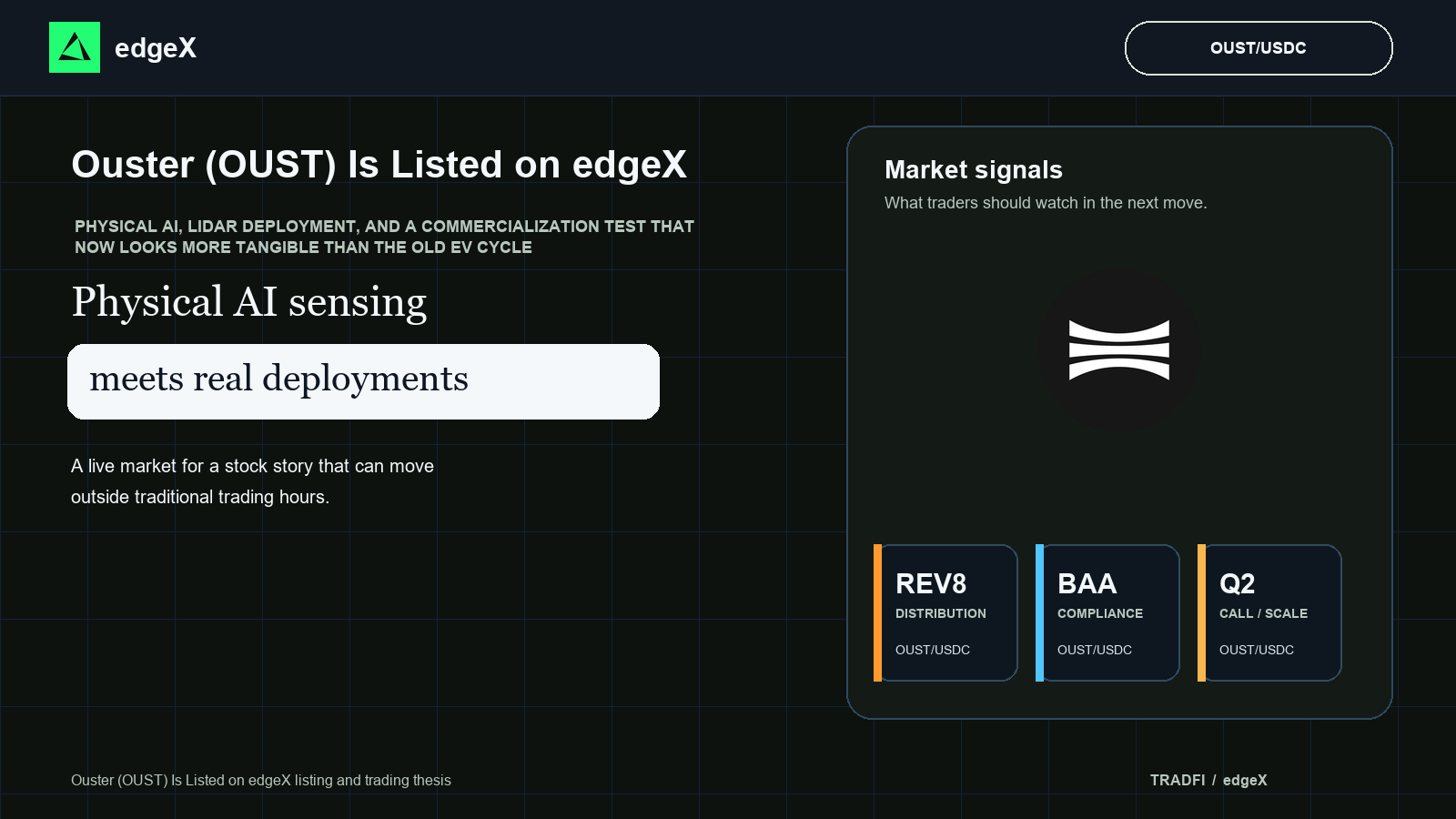
- •Ouster's REV8 OS digital lidar sensor achieved compliance with Build America, Buy America requirements on June 30, potentially opening procurement channels for federal and infrastructure-related projects.
- •The company secured a strategic agreement with AIM Intelligent Machines for heavy earthmoving equipment on June 17 and expanded its manufacturing partnership with Benchmark on June 15 to scale REV8 production.
- •Ouster announced that Q2 2026 earnings will be released on August 6, following a July 2 common stock offering and the July 23 appointment of Shaluinn Fullove as Chief People Officer.
- •The primary risk for traders is that lidar adoption may progress more slowly than expected while capital needs remain elevated, potentially delaying the operating leverage needed to justify a higher valuation.
Quick Answer
Ouster is a sensing and perception company built around digital lidar, cameras, AI compute, sensor fusion, and perception software. edgeX has listed OUSTUSDC, allowing traders to express long or short views on this Physical AI story around the clock. The latest catalyst is not a single piece of robotics news, but rather a series of updates in June and July, including REV8, Build America compliance, new industrial partnerships, and a Q2 earnings call that keeps the commercialization discussion alive.
Trade OUST/USDC perpetuals on edgeX.
https://x.com/edgeX_exchange/status/2088085855961567378
As Physical AI Moves from Demos to Deployment, OUST Lands on edgeX
For years, Ouster has been trying to prove that lidar is more than a futuristic talking point. The company now positions itself as a sensing and perception platform for Physical AI, integrating digital lidar, cameras, AI compute, sensor fusion, perception software, and AI models into a single tech stack. This makes Ouster more attractive than a single-component sensor supplier.
OUSTUSDC perpetuals allow edgeX traders to express their views on this thesis 24/7. If Physical AI scales across warehouses, roads, industrial settings, and automated equipment, Ouster could become one of the purer beneficiaries in the public market. If deployment remains slow or uneven, the stock could remain trapped between technical promise and commercial patience.
What Ouster Actually Sells
At the core of Ouster's business is digital lidar, a sensing technology that generates detailed three-dimensional images of the physical world. Lidar matters because machines can only navigate reliably in the physical world if they know where people, vehicles, buildings, equipment, and obstacles are located.
The Company Is More Than Just One Sensor
One reason Ouster stays relevant is that it no longer tells a single-application story. Its investor materials and recent announcements position the company across industrial automation, robotics, automotive applications, and smart infrastructure. This gives the stock a broader addressable market than the old "autonomous vehicle chip" narrative.
| Driver | Bullish Evidence | What Could Undermine the Thesis |
|---|---|---|
| REV8 Adoption | More deployments, faster certifications, broader customer demand | Slow progress or price competition |
| Industrial Demand | Robotics, warehousing, and heavy equipment expanding use cases | Customers delay deployments or cut capex |
| Public Infrastructure | Build America compliance opens more procurement channels | Funding cycles remain uneven |
| Margins | Gross margin expansion as scale and product mix improve | Revenue growth but persistent operating losses |
| OUST Trading Mechanics | Clear trends and high-liquidity contracts support tactical trading | Volatile price action and funding drag |
Why Physical AI Matters Here
Physical AI is not just a buzzword. It means software now needs to perceive and act in the real world, not just in browsers or data centers. This means robots, road systems, industrial equipment, and automated fleets all need reliable sensing. If Ouster can continue to be the preferred component in this tech stack, the company's market cap could exceed the imagination of traditional automotive lidar.
Why REV8 and Procurement Compliance Matter
Ouster's recent official announcements outline a coherent commercial path. On June 30, the company announced that the REV8 OS digital lidar sensor complies with Build America, Buy America requirements. On June 17, the company announced a strategic agreement with AIM Intelligent Machines for heavy earthmoving equipment. On June 15, the company announced that Benchmark will expand its partnership to scale production of the REV8 sensor.
This combination matters because it moves the stock out of pure concept territory. Procurement compliance can be important for federal or infrastructure-related projects. Manufacturing scale matters equally, because lidar only becomes truly investable when a company can ship with consistent quality and cost structure. Strategic partnerships matter too, because they show sensors are entering real workflows, not just lab demonstrations.
The Real Test Is Whether Lidar Can Become a Repeatable Spend Category
The market has always liked the concept of lidar. The challenge is turning that concept into steady purchase orders, repeat installations, and manageable margins. Ouster's position only strengthens when customers repeatedly buy REV8, and when industrial and smart infrastructure demand goes beyond a few showcase projects.
If the product only intermittently attracts attention, the stock may remain just a thematic trade. If it becomes a standard layer across multiple Physical AI deployments, Ouster becomes more of an infrastructure company.
Latest Operating Signals for OUST
The company's official investor relations page shows that on July 23, it announced the appointment of Shaluinn Fullove as Chief People Officer; on July 14, it announced that Q2 2026 earnings will be released on August 6; and on July 2, it completed a common stock offering. Even without overinterpreting any single event, this sequence says something important: Ouster remains at a stage where capital, execution, and scaling are all equally critical.
The earnings call date is itself a signal. It tells traders that the company is still judged first on execution quality, and second on the broader Physical AI theme. For a lidar company, this means that every update on backlog, gross margin, manufacturing scale, and customer adoption could move the stock more than a broad market rally.
Why Dilution Is Part of the Story
The July offering matters because hardware companies typically need to raise capital to build capacity and support working capital. This is not necessarily a bad thing. But it does mean OUST traders must consider dilution, cash needs, and whether the way growth is funded ultimately produces operating leverage.
The ideal scenario is clear: the company grows revenue, improves product mix, and translates product adoption into better margins. The risk scenario is equally clear: raising more capital while commercialization remains uneven, and the market refuses to pay for vision alone.
What Could Strengthen or Break the OUST Thesis
If Ouster continues to accumulate evidence, the bull case strengthens: more REV8 adoption, more industrial use cases, broader smart infrastructure deployments, and a clearer path from product launches to revenue and gross margin. The company already has the language of a Physical AI market leader, but it still needs to prove that this language can ultimately translate into economic outcomes.
The bear case is not simply that "lidar is hard." It is that adoption may be slower than investors expect, procurement may be lumpy, and the company may need new capital before the market is willing to assign a higher valuation. These risks are all manageable, but in a perpetual structure, they matter significantly more than in a typical thematic trade.
The Key Risk Is Timing, Not Just Demand
Ouster may be right about the long-term direction of Physical AI, but if deployment remains uneven, the coming quarters could still disappoint traders. Hardware stories tend to punish patience. In perpetual markets, funding rates and liquidation mechanics amplify that effect.
The clearest bullish evidence is not another polished presentation deck, but a growing list of named customers, repeat shipments, and margins that improve as capacity expands.
Why Smart Infrastructure May Matter More Than Robotics Demos
Physical AI is often discussed from the perspective of robotics, but Ouster may equally benefit from less flashy deployments. Roads, railways, industrial sites, ports, construction equipment, and public safety systems all need reliable perception of the physical environment. Buyers in these markets are not chasing novelty. They want uptime, durability, and lower operational risk.
This matters for the stock because it changes the quality of the demand story. Robotics demos can generate attention, but smart infrastructure and industrial contracts can bring longer procurement cycles, more defined budgets, and stickier deployments. Once a sensing system becomes part of a traffic management or industrial safety workflow, replacing it is no longer as simple as swapping a consumer electronic device.
Public and Industrial Buyers Value Evidence, Not Narrative
Build America, Buy America compliance is meaningful in this context because it can expand the range of customers willing or able to evaluate the product. It does not guarantee wins, but it moves the conversation from "interesting technology" to "qualified solution." For a hardware company, that position is far more valuable.
For traders, this means the most useful news going forward may be the least visible: procurement qualifications, production capacity, reference deployments, and repeat orders from customers who prioritize reliability over novelty.
OUST Scenario Framework
In the bull case, Ouster continues to expand REV8 adoption across industrial automation, smart infrastructure, and automated systems while gross margins improve. The market would then have reason to view OUST as a genuine Physical AI infrastructure play, rather than a lidar trading vehicle left over from the previous cycle.
In the base case, adoption continues to grow but remains uneven. One use case accelerates while another stays slow, and capital markets remain important because the company needs time for scale to actually improve the income statement. Even so, the stock could still work, but it will likely remain highly event-driven.
In the bear case, deployment cycles remain slow, hardware pricing stays competitive, or customers defer spending decisions. In this environment, Ouster may still have strong technology and a credible roadmap, but the market may conclude that commercialization is arriving too slowly to justify the risk.
This is why traders should pay close attention to the type of customers in future announcements. A pilot project from a respected industrial or infrastructure buyer could matter more than a louder robotics demo, because it means the product is entering a procurement process backed by budget, compliance review, and real operational needs.
Adoption Quality Matters as Much as Win Count
For Ouster, a good customer is not just a well-known one. The best signal is a deployment that is hard to remove once installed, where the lidar system becomes part of the operational process rather than a test project. Traffic management deployments, mining or construction automation projects, or long-term industrial safety deployments that generate repeat orders and greater visibility could matter more than a headline-grabbing robotics story.
This is also why margin improvement matters so much. If adoption rises but every win still must be captured at aggressive pricing, then traders may get the theme without the economics. The more favorable version is adoption accompanied by better product mix, healthier capacity utilization, and a clearer long-term gross margin path.
The evidence investors should want to see is that Ouster is winning business that retains value after the initial installation, not just contracts that look exciting in a press release.
Trading OUST Perpetuals on edgeX
edgeX gives traders access to curated stock perpetuals around the clock through a self-custodial platform. OUSTUSDC perpetuals allow eligible users to express their views on Ouster without waiting for traditional markets to reopen.
What Traders Should Still Verify
OUSTUSDC is a derivative and is not equivalent to holding Ouster stock. Traders should check current leverage, funding rates, liquidity, fees, index methodology, contract specifications, and regional availability directly on the live market page.
Why the Perpetual Format Matters Here
Ouster's stock price may react to product launches, procurement wins, or capital market events outside of regular U.S. trading hours. A perpetual trading venue can allow the market to price these events faster, but it also means that mistimed positioning can quickly become costly.
What to Watch Next
The next catalysts are likely to come from the Q2 earnings call, new REV8 deployment announcements, more industrial partnerships, and any detail that shows the speed at which the company is moving from product validation to repeat shipments.
FAQ
What Does Ouster Do?
Ouster develops digital lidar and sensing systems for Physical AI across industrial, robotics, automotive, and smart infrastructure applications.
Why Is OUST Getting Attention Now?
Recent official updates around REV8, procurement compliance, strategic partnerships, and the Q2 earnings schedule have made the company's story more concrete.
Does OUSTUSDC Represent Ownership of Ouster Equity?
No. It is a perpetual derivative on edgeX and does not confer equity ownership, dividends, or shareholder rights.
What Is the Biggest Risk for OUST Traders?
The biggest risk is that adoption remains slower than expected while capital needs stay elevated before the business achieves better operating leverage.

