Ostium Review 2026: A Guide to Onchain Trading Across Global Markets
Key Takeaways
- •Ostium is a self-custodial perpetual trading platform that allows leveraged long and short positions on traditional and crypto assets using USDC collateral on Arbitrum, without delivering the underlying instruments.
- •The platform lists 75 perpetual instruments across six asset classes with leverage from 5× to 200×, though stocks trade only during market hours while crypto trades around the clock.
- •Live testing showed a well-organized desktop interface but a weak mobile layout, and a restricted-jurisdiction message prevented wallet connection and order submission during the review.
- •Public reporting in July 2026 described an oracle and keeper exploit that drained roughly $18 million to $23.75 million in USDC from Ostium's liquidity vault, halting trading and highlighting that smart-contract audits do not cover oracle keys or keeper permissions.
- •Costs extend beyond headline trading fees to include oracle fees, overnight financing and early-close charges, while liquidation is margin-based with no margin call and begins after a 75% collateral loss at maximum leverage.
Ostium is a self-custodial perpetual trading platform that provides leveraged price exposure to stocks, ETFs, commodities, indices, forex and crypto. CoinWy tested its public trading interface live at three screen sizes and checked fee and market information against Ostium’s documentation.
The platform is aimed at traders seeking exposure to traditional and crypto markets through a wallet, as well as beginners who want to understand the interface before connecting funds. This review describes the product, trading mechanics, fees, ecosystem, security considerations and observed access limitations. It does not constitute financial or investment advice.
What Is Ostium?
Ostium allows users to trade perpetual instruments that track the price movement of assets such as gold, the S\u0026P 500, Tesla and BTC without opening a traditional brokerage account. Users deposit USDC, choose a long or short direction, select leverage and settle positions through an Arbitrum-based onchain system.
Ostium is not a spot exchange. Traders do not receive the underlying stock, barrel of oil or index constituent. Instead, they hold a leveraged price position, making profit and loss, financing and liquidation rules central to the trading experience.
In practical terms, Ostium is a self-custodial onchain venue for leveraged exposure to global markets. It is accessed through a crypto wallet and settles positions in USDC.
Ostium’s official documentation lists 75 perpetual instruments across six asset classes: Stocks, ETFs, Commodities, Indices, Forex and Crypto. Leverage ranges from 5× to 200×, depending on the trading pair. The official trader overview and Markets reference provide the complete list and pair-specific parameters.
Interface and Device Experience
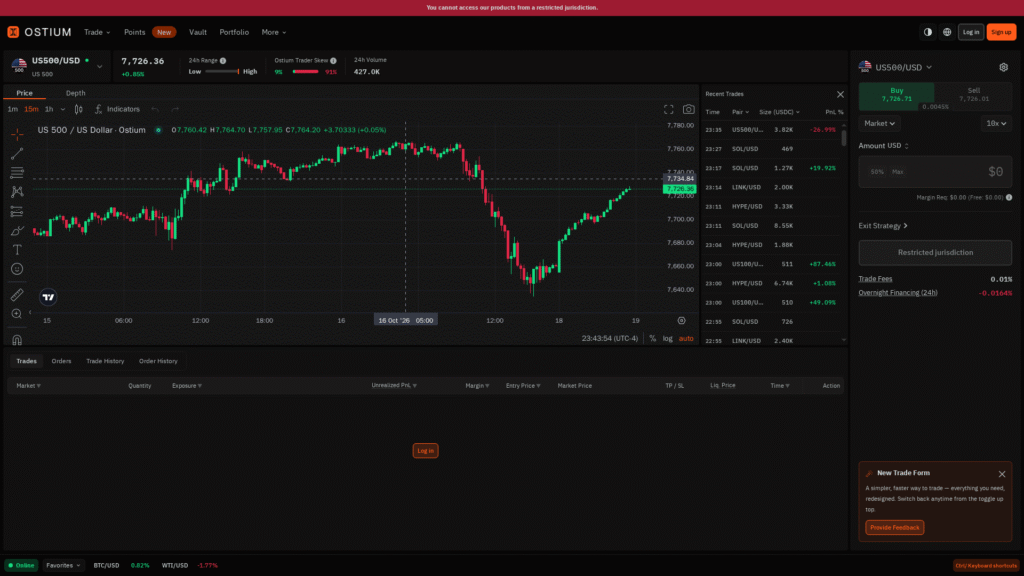
Ostium uses a three-column trading layout rather than a simplified swap form. The left side contains the chart and market-analysis area, the middle column lists recent trades, and the right rail contains the execution panel. This arrangement allows traders to view price information, liquidity context and order parameters without leaving the page.
Desktop: 1440 × 810
The desktop capture showed a restricted-jurisdiction banner, a US500/USD chart, recent trades, an order form, 10× leverage, margin requirements and fee fields.
The market header displayed US500/USD, its status, current price, 24-hour range, trader-skew indicator and volume. The chart toolbar offered 1m, 15m and 1h intervals, Price/Depth tabs, indicators and drawing controls.
The recent-trades panel listed timestamps, pairs, sizes in USDC and PnL percentages. The right-hand panel placed Buy/Sell controls, Market order selection, leverage, Amount USD, 50%/Max shortcuts, Margin Required, Exit Strategy, Restricted jurisdiction, Trade Fees and Overnight Financing in a single vertical sequence.
This layout is suitable for first-time users and active traders who want market data and execution controls visible simultaneously. Its tradeoff is density: users must review substantial information before making their first selection.
Tablet: 1024 × 576
The interface remained usable on a tablet but became horizontally constrained. The chart, recent-trades panel and order form competed for space, making the desktop layout easier to scan.
The tablet view retained the same information architecture, although the chart had less horizontal room and the order rail was narrower. The market summary also compressed, and a horizontal scrollbar appeared in the lower trading area. The layout was acceptable for monitoring but less suitable for comparing several fields before signing a transaction.
Phone: 430 × 242
The phone capture used a 16:9 ratio. At this width, the application collapsed into a compact navigation view containing Trade, Points, Vault, Portfolio and More.
The mobile layout was the clearest weakness observed. Navigation remained available, but the chart and execution details did not form a comfortable mobile trading flow in the capture. A user would need a larger screen to review leverage, financing and liquidation information with greater confidence. The phone view is more appropriate for quick status checks than for a first leveraged trade or rushed wallet confirmation.
The live page displayed the message, “You cannot access our products from a restricted jurisdiction.” No wallet was connected, no funds were deposited and no order was submitted.
Core Features
Exposure to traditional and crypto markets
Ostium’s principal differentiator is the breadth of its market coverage. The same product includes US equities, indices, commodities, forex and crypto, making it relevant to macro traders as well as crypto-native users.
Long and short positions
The live order form showed Buy and Sell controls, Market as the selected order type and 10× leverage. Although the maximum leverage for a particular pair can be substantially higher, the maximum available leverage is not necessarily an appropriate level of leverage.
Onchain USDC settlement
Ostium describes a two-layer system: onchain settlement through smart contracts and offchain hedging through institutional liquidity partners. Its documentation states that collateral remains in segregated contracts and that the interface acts as a frontend for the underlying protocol. The How Ostium Works documentation provides further detail.
Exit-strategy controls
The live form displayed an Exit Strategy control. Ostium documents take-profit, stop-loss and liquidation automation, which are important controls for leveraged positions.
Research and developer resources
The More menu exposed Research, Builder SDK setup, Docs, Stats and Ostiscan, as well as Discord, Telegram and X. These resources are intended for users who want to inspect protocol data or build applications on top of it.
Vault, OLP and Points
Ostium includes more than its trading screen. Its ecosystem contains a Vault settlement layer, an OLP liquidity token and a Points program. Together, these components describe where trader collateral is held, how liquidity providers participate and how platform activity is tracked.
Vault and OLP
Liquidity providers deposit USDC into the Ostium Vault and receive OLP tokens. The official Vault documentation describes OLP as the senior-loss tranche, while a junior buffer funded by affiliates and strategic partners absorbs trader PnL first.
OLP deposits are not insured. An extreme event that depletes the buffer can still affect OLP holders.
The Vault also serves as the instant-settlement layer. When a trader closes a profitable position, the Vault pays USDC onchain while the matching hedge is settled offchain. Consequently, intraday USDC movement is not automatically equivalent to Vault PnL. OLP pricing updates at daily settlement, which is the figure liquidity providers should track.
The live Vault screen displayed OLP Vault TVL, Protocol TVL, APY, supply, settlement number and an OLP price chart. At the time of capture, it showed 2,241,921 USDC in OLP Vault TVL, 4,155,655 USDC in Protocol TVL, 1.63% APY and an OLP price of 0.355209 USDC. These were time-sensitive observations rather than guarantees or promises.
The screen also included a Recovery Portal and separate Deposit USDC and Withdraw controls. Liquidity provision should therefore be evaluated as a risk-bearing position, not as a savings account.
Points
Points are an engagement system rather than a live token. The live Points page described weekly Trading Score and LP Score calculations, with points compiled after each week. It also displayed a Season 2 total and a weekly conversion date.
Trading, referrals and liquidity provision can affect participation scores. However, points should not be treated as ownership, guaranteed rewards or a substitute for trading performance.
The Points page separated weekly Trading Score, Weekly LP Score and Season 2 Points and included a leaderboard. In the restricted, unconnected state observed during the review, both weekly scores were 0, while the page displayed 25.0M total Season 2 points and a weekly conversion date.
This distinction is important because a points dashboard can show program mechanics without demonstrating that points have monetary value. Users should check current program terms and eligibility before changing trading or liquidity-provision activity solely to pursue points.
Funding, Managing and Closing a Position
The user journey consists of four stages: obtaining eligible USDC, funding the trading account, managing an open position and closing it. Risk continues after the initial order, so each stage matters.
Funding
Ostium uses USDC on Arbitrum as trading collateral. Before opening a position, users should confirm the network and token contract and verify that the deposited balance appears in the application. Unsupported assets should not be sent directly to a contract address.
Relevant references include the USDC documentation, Arbitrum documentation and Ostium’s funding guide.
Managing an open trade
From the Positions panel, traders can set or adjust Take-Profit and Stop-Loss levels, add collateral, remove collateral where permitted and monitor PnL, rollover and liquidation distance. Adding collateral reduces effective leverage, while removing collateral can move liquidation closer.
The managing positions guide covers these functions.
Closing
A position can be fully closed, partially closed, closed automatically by TP/SL or closed through liquidation. A successful full close refunds the opening oracle fee, while a partial close carries its own oracle fee. After closing, users should check the resulting USDC and PnL in the wallet and Portfolio history.
Portfolio is the post-trade verification screen. It displays Realized PnL, Total Volume, Gross-versus-Net comparisons and time ranges, with tabs for Positions, Trades, Orders and history. The restricted capture showed an unconnected account with no data, but it indicated where a completed trade should be audited.
Ostium provides separate guides for funding, managing positions and closing a trade.
Supported Markets
Ostium’s market list is broader than that of a typical crypto perpetual venue. Each asset class has its own leverage cap, fee structure and trading schedule.
Representative pairs include US500/USD, EUR/USD, XAU/USD, AAPL/USD, BTC/USD and ETH/USD. The complete list, pair-specific leverage and fees are maintained in the official Markets reference.
Market hours are an important consideration. Crypto trades 24/7, but stocks do not. When a traditional market is closed, market orders may be rejected, while limit and stop orders may queue for the next session.
Order Types
Ostium supports seven order types: three for opening a position and four for closing one. The trigger price and actual execution price are not always identical.
The platform distinguishes among three prices: the bid is where a trader can sell, the ask is where a trader can buy and the mid-price is a reference price used for certain triggers. Trades are not executed at the mid-price. The official Order Types guide provides the platform’s specifications.
Fees
Ostium’s cost structure involves more than a single headline trading fee. Its official Fees page lists the applicable charges and formulas.
In the live US500/USD interface, the observed Trade Fees figure was 0.01%, while Overnight Financing (24h) was −0.0164%. These were values observed for that market at that moment and were not universal platform-wide rates.
Example: a 10,000 USDC position
Assume a trader deposits 1,000 USDC and uses 10× leverage, creating a 10,000 USDC notional position. At a 3-basis-point opening fee, entry costs approximately 3 USDC. Adding the 0.10 USDC oracle fee leaves effective collateral of approximately 996.90 USDC before rollover.
If the position remains open overnight, the applicable financing figure and the pair’s documented rollover formula determine the additional cost. Entry fees, oracle fees, spreads and holding costs all affect the break-even point.
Ostium’s documentation also gives an early-close example. A profitable position closed 10 seconds after opening incurs a 13.33-basis-point early-close rate, capped by the realized profit. The full worked fee example provides the calculation.
Step-by-Step Trading Flow
Step 1: Open Ostium
The trading application is available at app.ostium.com/trade. Before connecting a wallet, users should check whether the product is available in their jurisdiction. The initial screen displays the market chart and trade form before a wallet is connected.
Step 2: Select a market
Choose a pair such as US500/USD and check its leverage cap, opening fee, trading hours and rollover basis in the Markets reference. Pairs do not necessarily follow the same schedule. On a tablet, the chart and market area remain visible, but the order panel becomes tighter.
Step 3: Choose direction, order type and leverage
Choose Buy or Sell, review the behavior of Market, Limit and Stop orders, and select leverage. The live interface showed Buy, Sell, Market and 10× controls.
A Stop order triggers on the mid-price but executes at the bid or ask. A Limit order waits for the actual execution price to reach its specified level. The decision controls visible before an amount was entered included Buy/Sell direction, Market order type and 10× leverage.
Step 4: Review the order panel
Review Amount USD, Margin Required, the fee reserve, Exit Strategy, Trade Fees and Overnight Financing. A position opened in a profitable direction can still lose money if financing, spread and liquidation distance are overlooked.
Step 5: Connect and sign
Connect and sign only after reviewing the wallet prompt. Confirm the chain, spender, amount and transaction fee in the wallet. During this review, the action button was replaced by “Restricted jurisdiction,” so the appropriate response was to stop rather than attempt to bypass the restriction.
At this pre-connection stage, Trade Fees and Overnight Financing remained visible even though the restriction blocked the action.
Security Considerations
Self-custody reduces reliance on a centralized account but does not eliminate risk. Users still rely on smart contracts, oracle pricing, automated execution, liquidity providers and the offchain hedging layer.
Key risks include:
- Leverage risk: Small price movements can materially change collateral.
- Rollover risk: Holding costs accrue over time and vary by market.
- Oracle risk: The protocol uses an in-house consensus oracle for price discovery.
- Market-hours risk: Stocks and other traditional assets are not always available 24/7.
- Eligibility risk: Users in restricted jurisdictions may be unable to access the product.
Users should read Ostium’s Terms of Use before depositing. This review does not independently audit Ostium’s contracts or legal status.
Audits and transparency
Ostium publishes mainnet contract addresses and links to smart-contract reviews by Zellic, ThreeSigma and Pashov. It also documents economic-risk research with Chaos Labs, including work on imbalance monitoring and parameter risk.
These materials are transparency signals, not guarantees that funds are safe. Audits are point-in-time reviews, while contracts, parameters, oracles, keeper infrastructure and market conditions can change. Current reports should be checked through the Smart Contract Audits page and Economic Audit page.
Security incident disclosure
Public reporting in July 2026 described an oracle/keeper exploit affecting the Ostium liquidity vault. CoinDesk reported that approximately $18 million in USDC had been drained, while Galaxy estimated the amount at $23.75 million. Galaxy’s report is available at “Ostium Left an Opening for Exploiters, and $24M Went Out the Door”.
Reporting described manipulated, future-dated oracle messages and the use of a registered PriceUpKeep/forwarder path to manufacture profitable trades and trigger payouts. Halborn’s technical summary described compromised signing infrastructure and fake price reports, after which trading was halted. Its report is available at “Explained: The Ostium Hack July 2026”.
The incident does not by itself establish that the current deployment is unsafe, but it materially changes the risk assessment. Smart-contract audits do not automatically cover oracle keys, keeper permissions, offchain hedging or every operational boundary.
Before depositing funds, users should verify the platform’s current remediation and reopening status.
SDK and API Access
Ostium offers a TypeScript Builder SDK for applications that require market data, previews and programmatic trading actions. The current SDK documentation describes read-only clients, live price and position streams and order previews.
It also covers liquidation-price calculations, transaction builders and write methods for opening, modifying, closing and cancelling orders. Developers can use these tools to build an order ticket, dashboard, bot or risk monitor instead of relying entirely on the hosted frontend.
The official SDK overview recommends beginning with read-only previews before submitting transactions.
Liquidation
Ostium uses a margin-based liquidation system without a margin call. Its official explanation describes a 25% collateral backstop. At a pair’s maximum leverage, liquidation begins after a 75% collateral loss; at lower leverage, a position can tolerate a larger adverse price movement.
These figures are approximations. Rollover fees reduce effective collateral over time, so the actual liquidation price can move closer to the entry price. Ostium’s liquidation guide describes the mechanism in more detail.
Comparison With Alternatives
This review compares Ostium with three named alternatives: Hyperliquid for crypto-native perpetuals, GMX for onchain crypto trading and a traditional broker for regulated, account-based access to underlying markets. Ostium’s distinction is its combination of self-custody and perpetual exposure to multiple traditional and crypto asset classes.
Conclusion
Ostium provides a single interface for onchain exposure to stocks, commodities, indices, forex and crypto. Its broad market menu, self-custodial model and detailed pre-trade panel are its clearest strengths.
The platform is not a shortcut around the risks of leveraged trading. Leverage, rollover, oracle execution, liquidation and market hours all affect outcomes. The Vault, Points and Portfolio screens provide additional visibility, while the phone experience is limited and regional restrictions can prevent access.
The reported 2026 oracle and vault exploit also means that audits and published metrics should not be interpreted as safety guarantees. Users should check the current remediation status, understand the applicable mechanics and plan an exit before signing any transaction.
FAQ
Can I trade stocks 24/7?
No. Stocks generally trade Monday through Friday from 9:30 a.m. to 4:00 p.m. ET. Crypto trades 24/7 and forex trades 24/5. The schedule for each pair should be checked before using a market order.
Is Ostium a spot exchange?
No. Ostium provides perpetual price exposure. Users do not receive the underlying stock, ETF, commodity or currency.
What is the difference between a Stop and a Stop-Loss?
A Stop opens a new position, while a Stop-Loss closes an existing one. Both can use the mid-price as a trigger, but execution takes place at the bid or ask.
Can I recover collateral after liquidation?
No, according to Ostium’s liquidation documentation. Remaining collateral is retained as part of settlement. Lower leverage, a planned stop-loss and an adequate margin buffer are measures described in the platform’s risk guidance.
Source and Reference Links
- CoinWy source article
- Ostium trading application
- Trader documentation
- Markets
- Fees
- Architecture
- Order types
- Liquidation
This article is for informational purposes only and does not constitute financial or investment advice. Cryptocurrency and digital asset markets carry significant risk. Readers should conduct their own research before making decisions.

