Originality.ai flags 1,272 of 2,034 Amazon religious titles as likely AI-written
Key Takeaways
- •Originality.ai analyzed 2,034 English-language paperbacks across 14 faith and belief categories, each with an average rating of four stars or better, and flagged 1,272 titles (63%) as likely AI-written.
- •Likely AI-written books were about $2 cheaper and 38 pages shorter on average than human-written titles, at $16.84 and 170 pages versus $18.96 and 208 pages.
- •Wicca, Witchcraft, and Paganism had the highest share of likely AI-written titles at 78%, while Satanism was lowest at 22% and three low-rate categories rested on thinner samples.
- •Potentially false claims were widespread, with 53% of fact-checkable statements in witchcraft titles flagged, and Atheism, agnosticism, Satanism, and Buddhism each exceeding the 50% mark.
- •Amazon allows AI writing, limits Kindle Direct Publishing to three books per day, and requires publishers to declare AI-generated content, but these declarations are not shown on product pages.
AI detection firm Originality.ai has found that roughly two-thirds of the religious books it sampled on Amazon were probably written by artificial intelligence, a result with consequences for the millions of readers who buy faith and spirituality titles without being able to inspect them first. The findings appear in the company's study.
According to the report, cheap, machine-made books are pouring into Amazon's store faster than the retailer can review them. Amazon is the largest seller of books in the United States, and its self-publishing arm, Kindle Direct Publishing, lets anyone list a paperback or e-book at no upfront cost — a low barrier that has made the store the natural destination for volume-produced listings.
Findings across 14 categories of faith
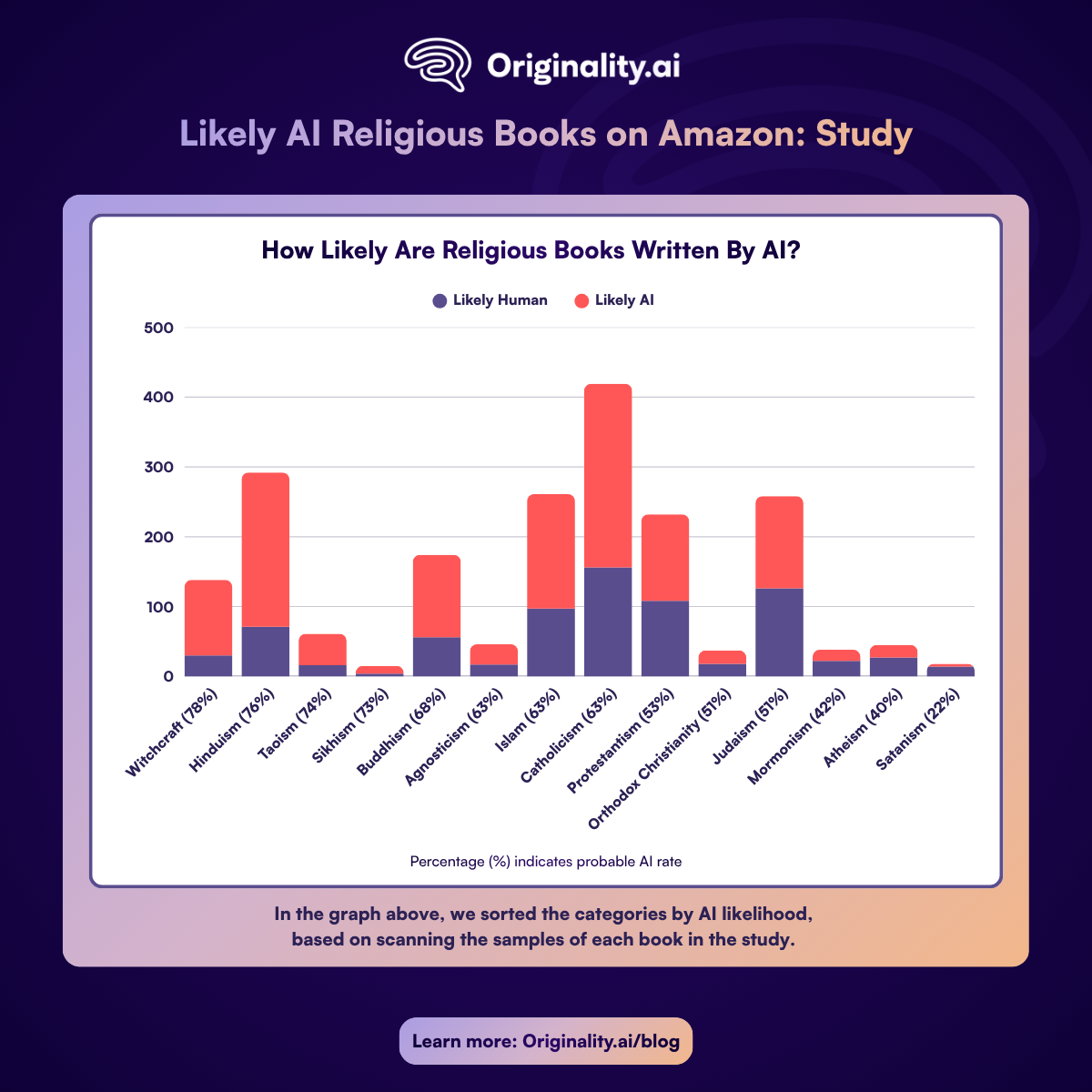
Originality.ai analyzed 2,034 English-language paperbacks across 14 categories of faith and belief. Each had an average four-star rating or better, and most were published in the first six months of 2026. The firm flagged 1,272 of the titles, or 63%, as likely AI-written.
The scan looked at each book's summary, its author bio, and a sample from inside the book, with the interior sample weighted most heavily since it comes from the book itself. Any score of 50 or higher was labeled "Likely AI."
"We don't make claims to certainty about whether books are definitively AI-written," said Michael Fraiman, the report's author. "Our model determines the likelihood that something was AI-written to a degree of certainty."
That hedge mirrors a known limitation of the detection field: OpenAI withdrew its own AI-text classifier in 2023, citing low accuracy, and separate research has documented detectors falsely labeling non-native English writing as machine-generated.
Witchcraft leads at 78%, Satanism lowest at 22%
The Wicca, Witchcraft, and Paganism category posted the highest share of likely AI-written titles at 78%. Hinduism followed at 76% and Taoism at 74%. At the other end, Satanism was lowest at 22%, with Atheism at 40% and Mormonism at 42%. Those three categories had far fewer titles to draw from, so their percentages rest on thinner samples.
Fraiman noted that authors pumping out AI books chase the busiest categories, which may explain why the smaller subgenres show less of it.
Witchcraft titles relied on crystals, herbal remedies, and cleansing "negative energies" — the kind of material that sells without having to clear any scientific bar. "One can picture the ideal customer as someone looking for solutions to heal themselves, improve their mental health, or 'detox' from commonplace chemicals and drugs," Fraiman said.
The study's authors suggested that the high rates across Eastern religions could be explained by non-native English speakers using AI to gain a foothold in the English-language market.
AI books run $2 cheaper and 38 pages shorter
Likely AI books averaged $16.84 and 170 pages, versus $18.96 and 208 pages for those deemed to be human-written. The study portrays the practice as exploitation and contends that AI books "pull at the heart of a religious person's beliefs" while charging them for the trouble.
Accuracy was also a concern. In titles about witchcraft, 53% of the fact-checkable claims were flagged as potentially false. Four other categories passed the halfway mark on false claims: Atheism hit 58%, agnosticism 53%, Satanism 52%, and Buddhism 52%.
Amazon's response
Amazon does not prohibit AI writing. A company spokesperson pointed to its content guidelines, saying the retailer takes "proactive and reactive measures to prevent, detect, and remove content that violates those guidelines, whether AI-generated or not."
Amazon has already limited the number of books an author can publish to three a day in reaction to the deluge of machine-written listings — a cap it placed on Kindle Direct Publishing in 2023. That same year, Amazon began requiring KDP publishers to declare whether uploaded content is AI-generated, but those declarations are not displayed on the product pages customers browse.
For now, a shopper weighing a four-star spirituality paperback has no label telling them whether it came from a person or a model.
AI writing has spread well beyond the online bookstore. According to earlier Cryptopolitan reporting, one study found that up to 22% of computer science papers showed signs of language-model use.

