Attackers Exploited Optimizely Web Experimentation Flaw to Swap Crypto Wallet Addresses on 178 Organisations' Websites
Key Takeaways
- •Attackers exploited a vulnerability in Optimizely's Web Experimentation product to inject malicious JavaScript that reached visitors of 178 organisations, including Zoom, the BBC, HSBC, Ledger, CNN, Salesforce and IKEA, without breaching those websites directly.
- •The injected script replaced legitimate cryptocurrency wallet addresses in displayed text, clipboard copies and outgoing requests, allowing payments to be redirected even from fully up-to-date devices.
- •Report URI estimated the attacker had received roughly $7,040 by 19:25 UTC on November 16, and TechNext24's later on-chain review found an additional Bitcoin deposit of about $150.
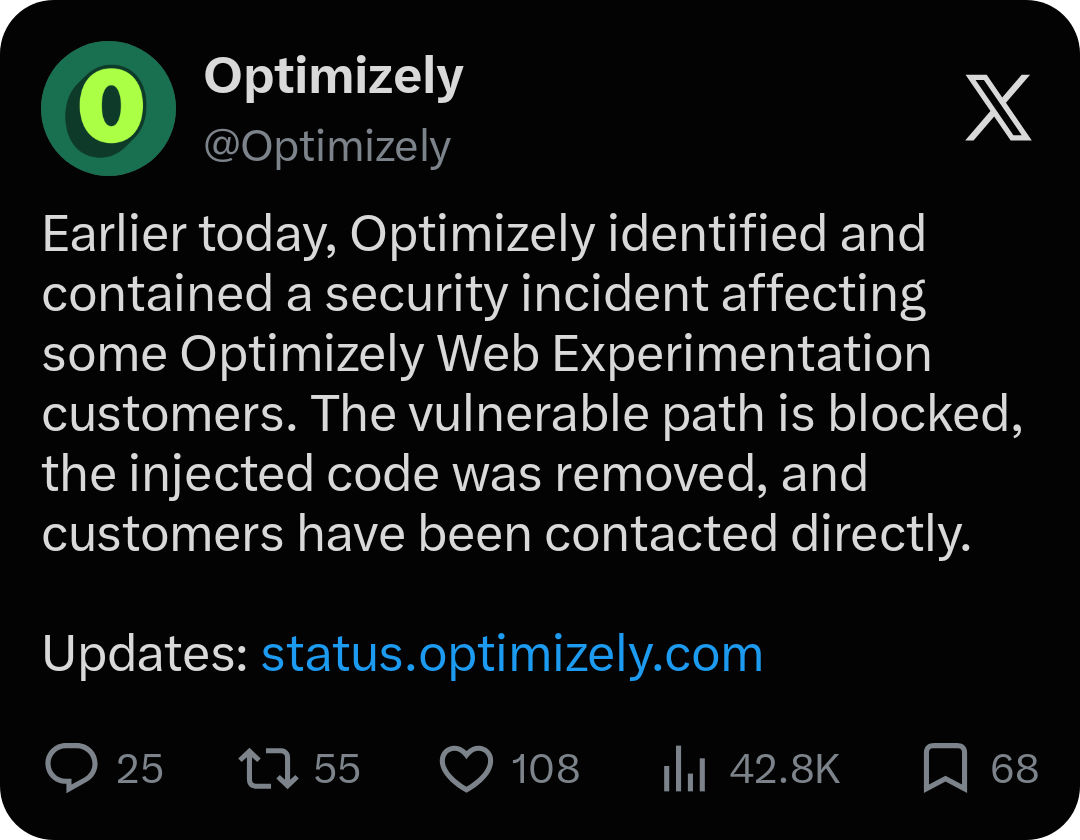
- •Optimizely published a security notice on November 17 stating that it has fixed the flaw, removed the injected code, secured affected accounts and added protections against unauthorised code delivery.
- •Beyond cryptocurrency theft, the campaign included code to capture payment card details, steal cookies and screenshots, and deliver iOS exploit kits, and Report URI cautioned that the number of affected organisations could rise.
A vulnerability in Optimizely's Web Experimentation product exposed visitors to the websites of 178 organisations to malicious code designed to redirect cryptocurrency payments into attackers' wallets. The incident, discovered on November 16, shows how digital assets can be stolen without compromising a blockchain itself.
Among the affected organisations were Zoom, the BBC, HSBC, Ledger, CNN, Salesforce and IKEA. According to cybersecurity monitoring firm Report URI — whose founder Scott Helme documented the campaign in a post on X — the attacker injected malicious JavaScript into customer projects on Optimizely's platform. Because the client websites already loaded these scripts, the code reached visitors even though the sites themselves had never been breached.
The script replaced legitimate wallet addresses with attacker-controlled ones in three places: addresses displayed on webpages, addresses copied to the clipboard, and addresses contained in outgoing requests. Payments could therefore be redirected without users noticing. Because the swap ran inside the pages themselves rather than as malware on a visitor's device, even users with fully up-to-date computers were exposed at the moment they copied an address.
Report URI estimated that the attacker had received about $7,040 by 19:25 UTC on November 16. TechNext24's review of the identified wallets on the morning of November 17, however, uncovered activity the estimate did not capture.
The blockchain was not hacked — the websites using Optimizely were
The attackers did not need a flaw in Bitcoin, Ethereum or any other network. They targeted the software that displays information to website visitors.
Optimizely provides tools that let businesses test versions of their websites and personalise content. Customers add the company's JavaScript snippets to their sites, meaning that code compromised at the Optimizely level can reach visitors even when the websites themselves were never breached. Security teams treat this pattern as a web supply-chain compromise: instead of breaking into 178 sites one by one, the attacker needed to compromise a single vendor whose script was already trusted and loaded across all of them.
Optimizely acknowledged the incident in a security notice published on November 17. The company disclosed that an unauthorised party had exploited a vulnerability in its Experimentation product to add malicious JavaScript to some customer projects. According to the notice, Optimizely has fixed the flaw, removed the injected code, secured affected user accounts and added protections against unauthorised code delivery.
Cryptocurrency theft was only one part of the campaign. Report URI also found code built to capture payment card details, steal cookies and screenshots, and deliver iOS exploit kits to certain iPhones and iPads. The firm examined 1,611 Optimizely snippets and identified 188 infected snippets belonging to 178 organisations, while cautioning that the real number could be higher. Neither figure shows how many visitors were exposed or how much money was lost.
What the on-chain data shows
Public blockchains let researchers watch funds enter and leave identified wallets. Report URI's Bitcoin (BTC) wallet had four deposits totalling 0.08298 BTC, about $5,380 at the time. Its other identified wallets received Litecoin, Tether (USDT), Tron (TRX), Ethereum and Binance Smart Chain assets.
TechNext24 checked the wallets on public explorers:
- Bitcoin: five deposits totalling 0.08528782 BTC, one more than Report URI counted. The extra deposit was 0.00231063 BTC, roughly $150. The entire balance was moved out shortly before the check.
- Tron: the wallet held less than $0.01 but was still showing transactions that morning. Many incoming transfers were tiny, and the wallet held several spam tokens, which cannot be treated as victim payments.
- Ethereum: the balance was close to zero, with outgoing transfers including USDC, the latest minutes before the check.
- Solana, Bitcoin Cash and Dogecoin: the Solana address does not exist on-chain, the Bitcoin Cash address has no transactions, and the Dogecoin address returned no record on Blockchain.
- TON: zero balance, with one incoming transfer about 14 hours earlier from an address labelled traddergift.ton. The amount was not visible.
TechNext24 did not check the Litecoin wallet.
The findings come with caveats. An emptied wallet does not prove that nobody tried to send funds to it, and an active one does not reveal how much was stolen. The extra Bitcoin deposit shows that the first transaction count was not final, but without tying further deposits to the script, calling them a confirmed increase in stolen funds would be premature. The $7,040 figure was Report URI's estimate at a single point in time, not a final tally. The blockchain shows where funds moved; it cannot show who controls each address, how many victims were affected, or whether the money was converted into cash. The picture may still change: Report URI cautioned that its tally of affected organisations could rise, and further deposits to the identified wallets would appear on the public explorers used for this review.
Limited African exposure, broader lessons for users
No Nigerian organisation appears in Report URI's published list, and HSBC Egypt is the only African entity named. For Nigerian users, the lesson is about payment habits rather than exposure to this specific attack. Many people send USDT by copying an address from an exchange, payment page or merchant site and pasting it into a wallet app — a flow that malicious JavaScript can interrupt by swapping the address in between. Confirmed transfers are generally irreversible, and there is no bank to call.
Users can reduce their risk in four ways:
- After pasting, compare the full address with the recipient's original details, not just the first and last characters.
- Check that the network — TRON, Ethereum or another — matches the recipient's instructions.
- For large transfers, send a small test amount first and confirm receipt independently.
- Obtain the recipient's address through a separate channel where possible, such as a direct message, and compare it with the one the website shows.

