Open Source AI Models in 2026: The Numbers on Downloads, Usage and Adoption
Key Takeaways
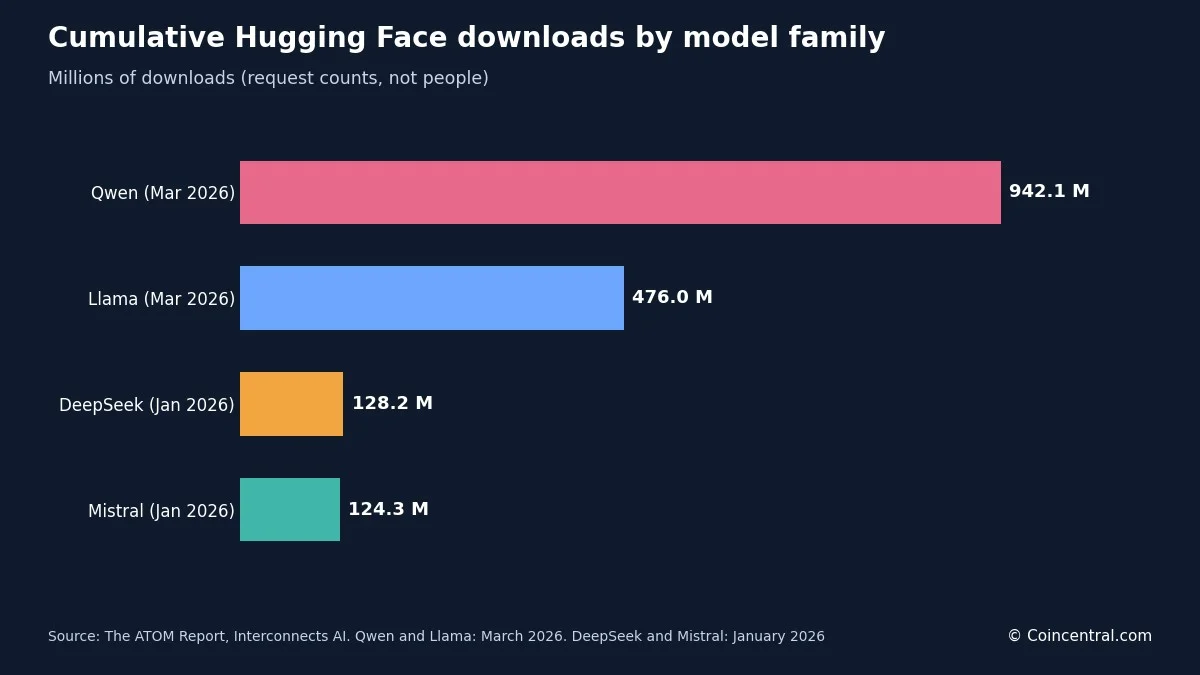
- •Alibaba's Qwen had reached 942.1 million cumulative Hugging Face downloads by March 2026, roughly double Meta's Llama total of 476.0 million.
- •Mozilla estimates that open models handle about 33% of active AI use yet capture only around 4 of global AI revenue.
- •China's open models overtook the United States in cumulative downloads in late July 2025 and led by 428 million as of March 2026.
- •Only 51% of teams working with open models reach production, versus 63% for closed models, a gap attributed mainly to missing infrastructure rather than model quality.
- •Inference costs for GPT-4-class models dropped about 50-fold over 36 months, from roughly $20 to $0.40 per million tokens, a decline the report links to open-weight competition.
Open source AI models are now routine components of software development. Developers download them, build applications on top of them, and run them on their own hardware. Several organizations attempt to measure this activity, and their numbers do not always agree. This report places the main figures side by side, covering downloads, token usage, regional shifts, costs, developer surveys, and company funding. Each figure carries its source, its date, and a note on what it actually counts.
One caveat applies to every metric below. A download is a file request, not a person. A token count measures work performed, not copies made. Most open models are more accurately described as open-weight models: the trained parameters are public, but the training data and code often are not. The figures therefore describe different layers of adoption: distribution, inference, experimentation, and production deployment. They should be read together rather than treated as interchangeable measures of market share.
Key figures at a glance:
- Qwen had reached 942.1 million cumulative Hugging Face downloads by March 2026; Llama had reached 476.0 million.
- DeepSeek served 14.37 trillion tokens on OpenRouter between November 2024 and November 2025.
- Open models handle about 33% of active AI use but earn about 4% of AI revenue, according to Mozilla.
- 79% of developers adding AI features use open models, against 71% for closed models.
- Teams using open models reach production less often: 51%, versus 63% for closed models.
Open Source AI Download Statistics by Model Family
The ATOM Report tracks roughly 1,500 open language models on Hugging Face and defines a download as any HTTP request to a model file endpoint, including automated pulls from tools such as transformers or curl.
Alibaba's Qwen family had accumulated 942.1 million downloads by March 2026, while Meta's Llama family stood at 476.0 million in the same month. Qwen first overtook Llama in September 2025, when the totals were 325.4 million and 323.7 million. Six months later the gap had widened to 466.1 million: Qwen added roughly 617 million downloads over that period, while Llama added about 152 million.
Source: The ATOM Report, Interconnects AI, cumulative Hugging Face downloads.
DeepSeek and Mistral trail the top two by a wide margin. DeepSeek passed Mistral in January 2026, recording 128.2 million downloads against 124.3 million. Mistral had earlier led the field — its share of new derivative models peaked at 57% in December 2023, driven by Mistral 7B and Mixtral. Meta's derivative share peaked at 44% in August 2024 and had fallen to 11% by February 2026.
Newer U.S. labs start from much smaller bases. NVIDIA's Nemotron recorded 30.7 million downloads between August 2025 and March 2026, the Allen Institute for AI's OLMo recorded 14.8 million, and IBM's Granite recorded 8.6 million.
Company announcements follow different rules. Meta said Llama passed 1 billion downloads on 18 March 2025. Google said Gemma passed 1 billion on 20 August 2026, with a Google engineer noting that the count excludes Android and Chrome integrations. Neither company figure has been independently audited, and the ATOM count for Llama covers only tracked text-generation models on Hugging Face, so the two sets of numbers cannot be compared directly.
Qwen's monthly volume underpins its lead. In February 2026, Qwen alone generated 153.6 million downloads, while the next eight open model organizations combined produced 71.2 million.
Open Source AI Download Statistics by Region
ATOM assigns each model to the United States, China, or Europe according to the headquarters of the releasing organization. Total tracked downloads reached 2.04 billion by March 2026, up from 339 million a year earlier.
Source: The ATOM Report, Interconnects AI, cumulative Hugging Face downloads.
No region declined. In March 2025 the United States led China by 80 million downloads; by March 2026 China led by 428 million, with ATOM placing the crossover in late July 2025.
Survey data points in the same direction. Mozilla's developer survey found open-model use at 89% in Greater China and East Asia, the highest of any region, with Western Europe at 70%. OpenRouter traffic shows a parallel shift: Mozilla's analysis found Chinese open-weight models growing from under 2% of weekly traffic in late 2024 to 45% by April 2026.
Hugging Face's summer 2026 report examined model size. In almost every month of 2026, the largest open model released by a Chinese lab was bigger than any model from a U.S. lab. China's monthly ceiling ranged between 754 billion and 2.78 trillion parameters, while U.S. models stayed under 130 billion parameters in five of seven months. AMD and NVIDIA each released more than 200 new model repositories in 2026 — more than any other organization — with LiquidAI third at around 100.
Token Usage Statistics for Open Models
Downloads measure how often weights are copied; tokens measure how much work a model performs. OpenRouter and a16z analyzed more than 100 trillion tokens of real platform traffic from November 2024 to November 2025. DeepSeek served 14.37 trillion tokens, ahead of Qwen at 5.59 trillion and Meta Llama at 3.96 trillion — a different order from the download ranking, where Qwen leads by a wide margin.
Source: OpenRouter and a16z, State of AI, tokens routed on OpenRouter, November 2024 to November 2025.
Open-weight models accounted for roughly one third of OpenRouter use by late 2025. Across the one-year window, Chinese open models averaged 13.0% of weekly token volume, rest-of-world open models averaged 13.7%, and proprietary rest-of-world models 70%.
ATOM's own OpenRouter series shows how quickly shares can move. DeepSeek V3 and R1 together made up as much as 75.6% of open model inference tokens in June 2025, falling to 31.1% by January 2026. Meta's share dropped from a 37.4% peak in January 2025 to zero by August 2025. Leadership on this measure can change within months.
Presenc AI, using a different mix of sources, reports a smaller open share: about 15% of inference tokens in January 2026, up from about 1% a year earlier. Within that estimate, DeepSeek holds about 6%, Qwen about 5%, and Llama about 3%.
Open Source vs Closed AI: Usage, Revenue and Performance
Mozilla published its first State of Open Source AI report in July 2026. It found that open models handle about 33% of active AI use but capture about 4% of global AI revenue; closed models account for the remaining 67% of use and 96% of revenue. The divergence stems from how open models earn money: nobody pays a per-token license fee to run open weights, so revenue flows to whoever hosts the model — often the buyer's own infrastructure.
Other sources report a lower usage share. MIT Sloan, as cited by TechnologyChecker, puts closed models at roughly 80% of model usage and says open models reach about 90% of closed-model performance at release.
The performance gap has shifted over time. Mozilla's Chatbot Arena tracking shows the average gap falling from roughly 8.04% to as low as 0.5% by August 2024. It then widened after closed labs released new reasoning models, standing at 3.3 percentage points in March 2026.
BenchLM uses a different scale. As of 20 October 2026, 12 of its top 50 models (24%) were open-weight, as were 494 of the 972 models it tracks (51%). Its top open model, Xiaomi's MiMo-V2.6-Pro, scored 73.66 out of 100 and ranked 12th — 13.03 points behind the top proprietary model, Claude Opus 5.5. BenchLM lists the Arena Elo gap between the top closed and top open model at 36.8 points on 15 October 2026, versus 29.2 points about a year earlier. The page describes this as narrowing, but the figures as printed show a wider gap, so the trend should be read with care.
The gap also depends on the task. Presenc AI's May 2026 comparison shows near parity on knowledge and coding tests and a wide lead for closed models on hard reasoning tests.
Source: Presenc AI, Open Source vs Closed AI Market Share 2026. Values are approximate.
Individual results can break the pattern. Z.ai's GLM-5.2 scored 81.0 on Terminal-Bench 2.1 against 83.4 for GPT-5.5, and on SWE-bench Pro it scored 62.1 against 58.6 for GPT-5.5. Mozilla's own dataset had the best open model at 67.9 on Terminal-Bench 2.1 before GLM-5.2 arrived — the report's data was already behind the newest release on the day it was published.
Developer Adoption and Production Use Statistics
Mozilla's report draws on a SlashData survey of 1,494 developers, fielded in May 2026, among developers adding AI features to applications.
Source: Mozilla and SlashData 2026 developer survey, fielded May 2026. The first two rows overlap.
Production is where the two groups diverge. Among teams working with open models, 51% reach production, compared with 63% for closed models. Mozilla's report page lists the open figure as 53%, while its blog post gives 51%. SlashData's Alvaro Ruiz Cubero attributes the gap to missing infrastructure rather than model quality.
When asked what blocks open-model projects, developers cited infrastructure cost most often at 27%, followed by security and compliance at 26%, maintenance and updates at 24%, and deployment complexity at 23%. The four answers are close in weight, so no single fix resolves the problem.
Use also depends on the job. Presenc AI estimates that about 94% of edge and on-device work uses an open model, with shares of about 85% for cost-sensitive high-volume work and about 71% for sensitive-data work in fields such as law, finance, and healthcare.
Source: Presenc AI, Open Source vs Closed AI Market Share 2026.
Survey results hinge on how the question is asked. Presenc AI says about 89% of enterprises use at least one open-source model in production, while the Linux Foundation, as cited by TechnologyChecker, found that 63% of organizations use open-source AI and 89% use some open source somewhere in their AI stack.
Visible web deployment is far lower. TechnologyChecker scanned more than 50 million domains in May 2026 and found Botpress, the most common open-source AI framework it could detect, running on 1,558 domains — against 52,682 for the closed OpenAI API and 1,349 for Google's Dialogflow. Of the 899 companies matched to a Botpress deployment, 64% had 10 or fewer employees, 81% had fewer than 50, and about 5% had 1,000 or more. The United States accounted for about 23% of detected deployments, followed by Spain at 6.9% and India at 6%. TechnologyChecker notes that its method cannot see backend tools such as transformers, LangChain, or Ollama; its counts reflect the browser-facing layer only.
Hugging Face Ecosystem Statistics
Hugging Face's spring 2026 report said the platform grew to 13 million users, more than 2 million public models, and over 500,000 public datasets in 2025. Its summer report, covering January to August 2026, recorded public model repositories rising from 2.43 million to 2.96 million, datasets from 711,000 to 1 million, and Spaces from 1.00 million to 1.44 million.
Attention is heavily concentrated. The spring report found that about half of all models had fewer than 200 total downloads, and that the top 200 models — 0.01% of the total — held 49.6% of all downloads. The summer report put the share of models under 200 lifetime downloads at 85.6% and said 1.5% of repositories account for 99.2% of downloads. The two reports count differently and cover different periods, but both show the same shape: a small group of models capturing nearly all the traffic.
The Stanford AI Index 2026 counts about 5.6 million AI-related projects across GitHub and Hugging Face, of which only 206,880 (3.7%) have 10 or more stars. Hugging Face model uploads more than tripled between 2023 and 2025, reaching 332,000 in a single quarter.
Source: Hugging Face, State of Open Source on Hugging Face: Spring 2026, published 17 March 2026.
The mean has grown far faster than the median. Hugging Face credits quantization and mixture-of-experts designs for pulling up the top end while small-model use stays flat. Small models still take most downloads: models under 1 billion parameters account for 83% of all-time downloads and models above 100 billion account for 1%, while for downloads in 2026 alone, 3% went to models above 70 billion parameters.
Likes and downloads measure different things. The top 25 repositories by 2026 downloads and the top 25 by likes shared exactly one entry. The model all-MiniLM-L6-v2 was pulled 1.55 billion times in seven months and has 5,156 likes.
Qwen has become the base that others build on. Qwen-based models account for 151,448 derivatives on the Hub — 2.6 times Meta's total and 4.7 times the Llama repositories alone — with Google next at 82,506. Qwen derivatives grew by roughly 180 to 210 new repositories per day in the first seven months of 2026.
Local running follows the same pattern. Qwen records 39.6 million GGUF downloads a month, against 20.8 million for Gemma and 7.5 million for Llama. GGUF is the file used by local runners such as llama.cpp.
The fastest growth sits in the runtime layer. Repositories using the gguf library rose 464%, lerobot rose 194%, and Apple's mlx rose 148%, while transformers and peft grew 16% and diffusers 21%. All model repositories grew 21.5%.
Agents have emerged as a new class of user. Claude Code made up 44.4% of agent-tagged traffic to the Hub in July 2026, down from 67.8% in April, while Codex rose from 10.4% to 20.8% over the same months.
Cost, Pricing and Funding Statistics
Mozilla reports that GPT-4-class inference fell from about $20 to roughly $0.40 per million tokens over 36 months — a 50-fold drop that the report ties to open-weight competition. A Linux Foundation analysis cited in the report puts closed-model inference at about six times the cost of a comparable open model. Mozilla converts that gap into an estimate of $24.8 billion in unrealized annual savings if buyers moved eligible workloads to open weights. As one example, Stripe cut inference costs by 73% while handling 50 million daily API calls by moving part of its AI work to open models.
Provider price lists illustrate the spread. Presenc AI's May 2026 comparison lists DeepSeek V4 at $0.14 per million input tokens, against $3.00 for GPT-5.5 and Claude 4.7 Opus.
Source: Presenc AI, Open Source vs Closed AI Market Share 2026, May 2026 provider prices.
Smaller closed models sit close to open prices, with GPT-5.5 mini listed at $0.15 and Gemini 3.1 Flash at $0.075 — at the lower tiers, price alone does not separate open from closed.
Companies built on open models are beginning to report revenue. Mozilla's report lists Databricks at a $5.4 billion run-rate and Mistral AI at about $400 million in annual recurring revenue, a 20-fold rise in twelve months. DeepSeek stands at about $220 million and has raised $7.4 billion at a valuation above $50 billion. Mistral announced a €1.7 billion Series C on 9 September 2025 at a post-money valuation of €11.7 billion, led by ASML. Zhipu AI and MiniMax are both pursuing Hong Kong listings in 2026. In May 2026, IBM and Red Hat pledged $5 billion to open-source AI tooling and infrastructure. Market.us projects the open-source AI model market will grow from $19.05 billion in 2025 to $23.08 billion in 2026, about 21%.
Licenses indicate where the return does not come from. Of 178 Chinese releases above 20 billion parameters in 2026, 59% use Apache 2.0 and 22% use MIT. For U.S. releases in the same size band, 29% use Apache or MIT, 41% use custom terms, and 30% declare nothing. Hugging Face notes that some of the largest recent releases, such as Kimi K3 and Qwen 3.8 2.4T, have begun adding non-commercial limits or revenue-share terms — the licensing picture is changing.
Sources
- The ATOM Report (arXiv)
- OpenRouter, State of AI
- Hugging Face, State of Open Source on Hugging Face: Spring 2026
- State of Open Source AI (Mozilla)
- BenchLM, Open Source LLM Statistics (2026)
- Hugging Face, State of Open Models: Summer 2026 Observations
- TechnologyChecker, Open-Source AI Adoption 2026
- Tech Insider, Open-Source AI Powers 33% of Use, Just 4% of Revenue
- Presenc AI, Open Source vs Closed AI Market Share 2026
- Command Linux, Open-Source AI Model Download Statistics 2026
This article was originally published on Blockonomi.

