OPay Threatens Legal Action Over False Account Number Claim
Key Takeaways
- •OPay has rejected a claim circulating on X that it no longer uses phone numbers as wallet account identifiers, confirming phone numbers remain valid account numbers.
- •The company stated customers do not need to visit OPay agents to change or update their accounts.
- •OPay contacted the author of the false post, requested its removal within 30 minutes, and warned it may pursue legal action if the content is not taken down.
- •The dispute follows recent shutdown rumors that led the Nigeria Police Force's National Cybercrime Centre to arrest Hafsat Abubakar over a fake document urging users to withdraw their funds.
- •OPay also took legal action against three social media users over the shutdown rumors and is directing customers to rely on official communication channels for account updates.
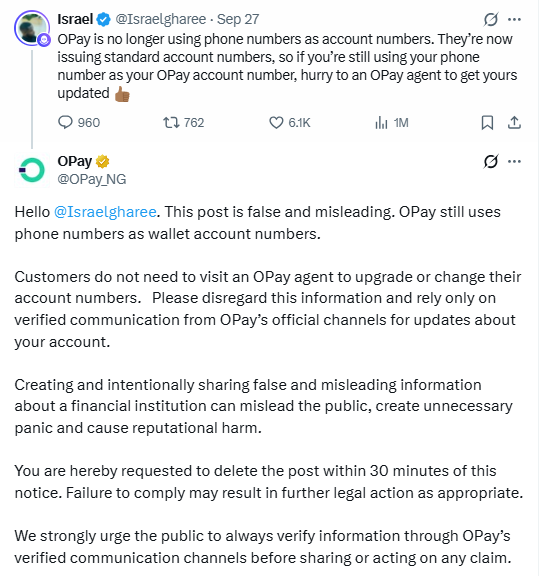
Nigerian fintech company OPay has pushed back against a recent claim circulating on X that it stopped using phone numbers as wallet account identifiers. The rumor, shared in a post on X, suggested that customers would be required to visit OPay agents to receive new account numbers.
The company has firmly rejected the claim. In a response to TechNext24, OPay stated that the information is not true, confirming that phone numbers continue to serve as wallet account numbers and that customers do not need to visit an agent to change or update their accounts. Because wallet identifiers on the platform are tied directly to customers' phone numbers, clarity on this point matters for how users send, receive, and manage funds day to day.
To address the situation, OPay reached out directly to the user who made the post, requesting that the false claim be removed within 30 minutes. The company emphasized the importance of providing accurate information about financial services, warning that sharing misleading content can not only confuse customers but also potentially harm OPay's reputation. It also made clear that it may pursue legal action if the misleading post is not taken down. OPay encouraged customers to rely on official communication channels for updates regarding their accounts and services, rather than trusting unverified posts circulating on social media.
The episode comes shortly after the company faced a separate wave of false information, just weeks after rumors circulated that OPay was shutting down its operations in Nigeria. That earlier episode prompted both a police investigation and legal responses from the company.
In that incident, the Nigeria Police Force's National Cybercrime Centre arrested Hafsat Abubakar after an investigation linked her to the creation and distribution of a fake document claiming that OPay would stop its services. The misleading post spread quickly on social media, garnering more than 572,000 views within minutes and urging people to withdraw their funds from the platform.
In response to the shutdown rumors, OPay took legal action against three individuals on social media, demanding that they remove the posts and apologize for spreading misinformation. The police investigation began after the company filed a formal complaint about the matter.
While the current dispute over account numbers is separate from the shutdown rumor, it again highlights the serious consequences that unverified financial information can have when shared online. Taken together, the back-to-back episodes — an arrest, takedown demands, and threats of legal action — show how rapidly false claims about financial services can escalate beyond social media into real-world legal consequences.
For now, OPay reassures its customers that they can continue using their phone numbers as wallet account numbers. No visit to an agent is required to make any changes, allowing users to access their funds without any hassle. What remains to be seen is whether the flagged post is removed within the 30-minute window OPay requested, and whether the company follows through on the legal action it has signaled.

