ONGold Revives Monument Bay Gold Project With 2 Million Ounce Resource
Key Takeaways
- •ONGold's updated resource for Monument Bay comprises 74.4 million tonnes of measured and indicated material grading 0.84 grams gold per tonne for 2 million ounces, plus 24.5 million inferred tonnes for 491,000 ounces.
- •The new model, prepared by SRK Consulting using a 0.2-gram cut-off and a $3,000-per-ounce gold price, contains more tonnes but lower grades and fewer contained ounces than the 2017 historical estimate prepared for previous owner Yamana.
- •ONGold acquired Monument Bay from Agnico Eagle in December 2024 for $100,000 in cash plus 8.7 million shares and potential milestone payments of up to $21.5 million, after the property passed through Yamana Gold and Precious Metals.
- •SRK has proposed an initial 20-hole, 11,150-metre drill program targeting higher-grade zones in the central and eastern parts of the deposit, which would mark the first drilling at the property since April 2021.
- •The new gold resource excludes tungsten, but ONGold has added about 13,900 tungsten assays from historical samples and is evaluating whether the metal, which sits on Canada's critical minerals list, has sufficient continuity for future resource modelling.
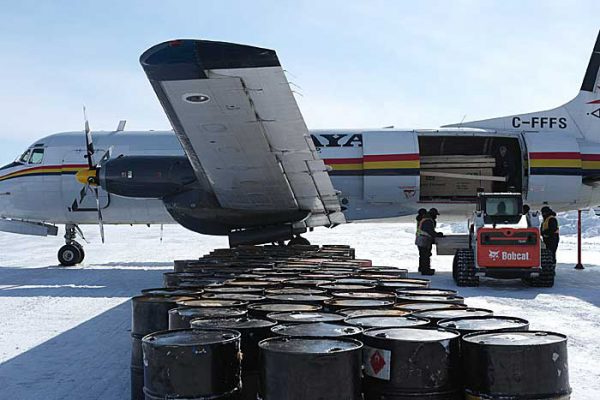
ONGold Resources (TSXV: ONAU; US-OTC: ONGRF) has returned Manitoba's long-dormant Monument Bay gold project to a current-resource footing for the first time in nearly a decade, outlining 2 million and indicated contained ounces of gold.
The project in the province's northeast, near the Ontario border about 340 km southeast of Thompson, hosts measured and indicated resources of 74.4 million tonnes grading 0.84 gram gold per tonne for 2 million oz., ONGold announced Monday in a news release. Inferred resources stand at 24.5 million tonnes at 0.62 gram gold for 491,000 oz. The open-pit estimate uses a 0.2-gram cut-off and a $3,000-per-oz. gold price, and about 80% of the contained gold falls in the measured and indicated categories. Measured and indicated ounces sit in the higher-confidence tiers of Canada's resource classification, while inferred ounces rest on more limited sampling and often change as drilling continues.
Why the currency of an estimate matters: under Canadian reporting practice, resources that fall out of date are reclassified as historical, and a current resource is the baseline a company needs before commissioning the economic studies that weigh whether a project can move toward a development decision.
Compared with a historical resource prepared in 2017 for past owner Yamana, the current model carries substantially more tonnes but at lower grades and with fewer contained ounces.
Shares in ONGold fell 11% on Monday morning in Toronto to 66¢ apiece, valuing the company at about $48.8 million. The stock has traded in a 52-week range of 47¢ to $1.37.
A property that has changed hands
Monument Bay has changed owners several times since The Northern Miner last covered the project in 2015, when Mega Precious Metals was pursuing both gold and tungsten there. Yamana Gold bought Mega later that year, and Agnico Eagle Mines (TSX, NYSE: AEM) took over the property in 2023 along with Yamana's Canadian assets. ONGold purchased it from Agnico in late 2024.
ONGold attributes the new resource to a fresh geological and structural interpretation, core re-logging and additional assays. SRK Consulting rebuilt the mineralization model and constrained the resource inside a new conceptual pit shell.
"The updated geological interpretation has greatly improved our understanding of the structural controls on mineralization and identified priority areas for additional resource drilling as the deposit remains open at depth," CEO Kyle Stanfield said in a statement. "We are encouraged by the opportunity to test mineralization at depth particularly along the eastern portion of the deposit where gold grades from historical drilling are demonstrably higher."
Old estimate versus new model
The previous estimate, now nine years old, put measured and indicated resources at 58 million tonnes grading 1.24 grams gold for 2.32 million oz., plus 24.4 million inferred tonnes at 0.92 gram gold for 720,000 oz. It applied a higher 0.3-gram cut-off and a 2015 pit shell, and excluded the Mid-East and AZ zones. ONGold no longer considers that estimate current.
The new resource draws on 833 historical diamond holes totalling about 237,000 metres of drilling across the 4.2-km Twin Lakes shear zone. SRK identified several structural controls on higher-grade mineralization and modelled a series of higher-grade zones using a 1-gram threshold alongside a broader lower-grade envelope.
Mega had drilled 179 holes at Monument Bay before Yamana completed its $17.5-million takeover in June 2015. Yamana subsequently drilled almost 60,000 metres in 190 holes and generated several resource estimates, shifting some of its attention toward higher-grade shoots beneath the broad open-pit mineralization. The last drilling campaign before ONGold's involvement wrapped up in April 2021.
Agnico's brief stewardship
Agnico inherited Monument Bay when it acquired Yamana's assets in March 2023 as part of the breakup of Yamana between Agnico and Pan American Silver (TSX, NYSE: PAAS). ONGold acquired the project in December 2024 for $100,000 in cash plus 8.7 million shares issued to Agnico, then worth about $4.2 million, and Agnico can also receive as much as $21.5 million in milestone payments. The share consideration initially gave the senior miner about 15% of ONGold.
Field work resumed after Red Sucker Lake First Nation, whose traditional territory includes Monument Bay, formally invited the company to restart exploration in early 2025 under a community consultation framework — a reflection of how central formal community support has become to advancing Canadian exploration projects.
Tungsten stays on the agenda
The new resource excludes tungsten, even though the metal was an important part of Monument Bay's earlier exploration story. When The Northern Miner covered Mega's work in 2015, the then-current resource carried 248,000 tonnes of tungsten trioxide alongside the gold. At the time, Mega was re-assaying old core for tungsten and had found that some of the better tungsten mineralization overlapped higher-grade gold zones.
ONGold has revived that approach. Its 2025-26 re-logging, infill sampling and pulp re-analysis program added about 13,900 tungsten assays to the database, drawn largely from historical samples that had been tested for gold but never systematically for tungsten. Higher-grade tungsten has again been found alongside higher-grade gold in parts of the deposit.
The company says the new gold block model will allow it to identify gaps in the tungsten database and determine whether the metal has sufficient continuity for eventual resource modelling. Tungsten, which occurs primarily as scheelite at Monument Bay, is on Canada's critical minerals list — a designation that ties the project to federal critical-minerals priorities, including funding programs and permitting initiatives introduced since Mega's 2015-era tungsten work.
Deeper targets
SRK has proposed an initial 20-hole, 11,150-metre drill program focused on higher-grade zones in the central and eastern parts of the deposit, including mineralization beneath and outside the current pit shell. Much of Monument Bay remains lightly tested below about 300 metres of vertical depth.
One is the eastern Lake Shoot, where historical hole TL16-575 returned 132 metres at 6.15 grams gold, including 2.75 metres grading 163.92 grams gold. True widths have not been determined. SRK proposes directing roughly half of the initial drilling toward the eastern portion of the deposit.
Confirming that higher grades persist at depth, and deciding whether tungsten is continuous enough to model, now stand as the project's most immediate tests — and the proposed program would be the first drilling on the property since April 2021.

