Ondo Stocks Expands to Solana Through LI.FI Native Intent-Based Execution
Key Takeaways
- •Ondo Finance is expanding its tokenized equities product, Ondo Stocks, to the Solana network.
- •LI.FI is launching native, intent-based execution to power the integration, letting users state desired outcomes instead of manually selecting bridges or swap routes.
- •Launch timing, the supported asset list, fee structures, and on-chain settlement details have not yet been confirmed by either team.
- •Ondo has previously extended tokenized stocks and ETFs to Uniswap and has tokenized U.S. Treasuries, BlackRock's IVV ETF, and Micron shares on Ethereum.
- •Key open questions include which Ondo Stocks products will be available on Solana, whether access is permissioned or open, and how cross-chain settlement will handle regulated tokenized equities.
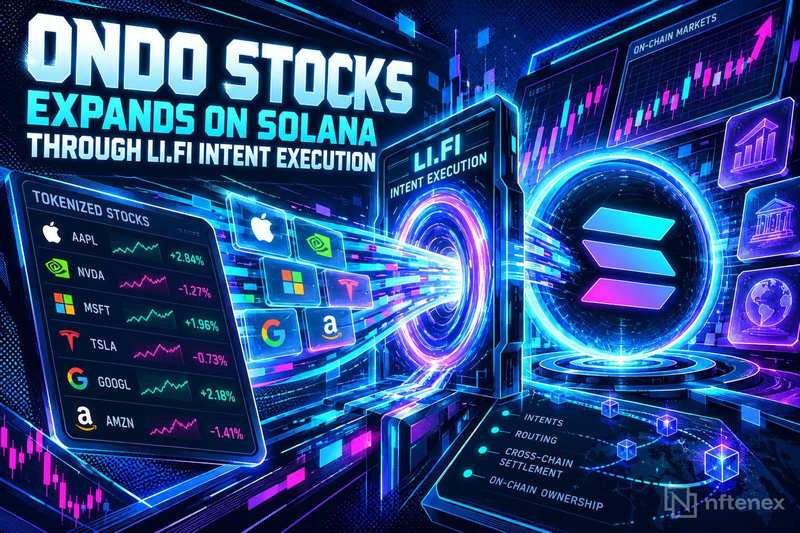
Ondo Stocks, the tokenized equities product from Ondo Finance, is expanding its footprint to Solana, and the move comes alongside a notable infrastructure development: LI.FI is launching native, intent-based execution to power the integration. The pairing signals a meaningful step toward bringing tokenized real-world equity products deeper into Solana's DeFi ecosystem through a cross-chain execution layer built around user intent rather than manual routing. For tokenized products, availability is largely bounded by the networks where they are deployed, which makes multi-chain distribution one of the more concrete indicators of how far an onchain asset can extend beyond its original venue.
Scope of the Solana Expansion
The announcement places Ondo Stocks directly on Solana. Ondo has been steadily broadening where its tokenized assets can be accessed, and this expansion continues that pattern. Earlier moves included Ondo tokenized stocks and ETFs being added to Uniswap, which extended access through Ethereum-native liquidity venues.
Tokenized equities sit within the broader real-world tokenization trend, which has evolved from a niche experiment into a focus area for crypto-native issuers and traditional financial institutions alike. Within that trend, multi-chain availability has become an increasingly visible differentiator, because an asset's usable audience is bounded by the chains, wallets, and liquidity venues where it can actually be held and traded.
Several specifics sit beyond what the announcement confirms. Which equities or ETF products are included, which wallets or interfaces will support them, and what compliance gates apply to end users have not been confirmed in the available materials. The announcement names Solana as the destination network; further implementation details are expected to follow directly from the Ondo and LI.FI teams.
Confirmed and Unconfirmed Details
What is confirmed is the directional intent: Ondo Stocks on Solana, facilitated through LI.FI. What remains unconfirmed includes launch timing, the supported asset list, fee structures, and the on-chain settlement flow. Readers should verify current availability and eligibility requirements directly with Ondo Finance and LI.FI before drawing conclusions about access or product scope.
Ondo's prior tokenization work has covered assets ranging from U.S. Treasuries to equity products. Its decision to tokenize BlackRock's IVV ETF and Micron shares on Ethereum demonstrated the team's willingness to bring recognizable institutional equity products onchain. The Solana expansion appears to extend that same approach to a network with different throughput and cost characteristics, and it reflects a pattern among RWA issuers of treating chain selection as a distribution decision rather than a purely technical one.
How LI.FI's Intent-Based Execution Fits the Integration
Intent-based execution is an approach to onchain transactions in which users express the outcome they want rather than specifying the exact routing steps to get there. Instead of manually selecting a bridge, swap path, or liquidity pool, the user states an intent, and solvers or relayers compete to fulfill it at the best available terms. The model abstracts away chain-level complexity while preserving the user's desired result. Intent-based designs have become an increasingly common pattern across cross-chain infrastructure, reflecting a broader shift of execution complexity away from end users and toward specialized actors who compete on fulfillment quality.
LI.FI has positioned itself as a cross-chain liquidity aggregation and bridging protocol. Its move into native, intent-based execution on Solana suggests the protocol is extending its solver infrastructure beyond simple route aggregation toward a model in which execution quality, not just route availability, becomes the differentiator for users accessing assets like Ondo Stocks across chains.
If implemented as described, the combination of Ondo's tokenized equity products and LI.FI's intent execution layer could allow users to acquire or interact with Ondo Stocks on Solana without manually managing bridging or liquidity routing. For Solana-native users, that would mean onchain equity exposure without leaving the network's tooling; for Ondo, it extends distribution into a network with an established DeFi ecosystem. The degree to which this simplifies the actual user flow depends on implementation specifics that have not yet been publicly confirmed.
The approach has precedent. The 1inch integration with Ondo Finance for tokenized asset access established that DEX aggregators and routing layers are viable distribution channels for tokenized equities. LI.FI's intent model could represent a further evolution of that distribution logic, shifting from aggregation toward outcome optimization.
Solana's network architecture, characterized by high transaction throughput and low fees, makes it a plausible venue for intent-based systems in which solvers need to execute rapidly and cost-efficiently. A similar rationale has drawn other tokenized asset projects to explore Solana deployments, including security token offerings structured natively on Solana.
What to Watch as Details Emerge
The key open questions for this integration are access and scope: which Ondo Stocks products will be available on Solana, whether access is permissioned or open, and how LI.FI's solver network will handle cross-chain settlement for regulated tokenized equities. These are not trivial implementation gaps; tokenized equity products carry regulatory requirements that shape who can hold them and how they can transfer.
Solana's DeFi ecosystem has grown considerably in total value locked and protocol diversity. The addition of tokenized real-world asset products through an intent-based execution layer, if fully realized, would represent a new category of onchain financial primitive for Solana users rather than another liquidity pool or yield source. Whether that translates into meaningful creator and developer infrastructure for onchain equity access will depend on how Ondo and LI.FI handle compliance, discoverability, and the broader Solana wallet and dApp ecosystem's support for RWA token standards.
As Solana-linked financial products gain visibility, including the attention drawn by the Solana ETF launch, tokenized stock access through LI.FI's execution layer could attract both DeFi-native users and institutional participants looking for a lower-friction entry into onchain equities. Announcements covering the supported asset list, wallet integrations, and eligibility mechanics would be the natural next data points for readers tracking the rollout. Official confirmations from both teams on product specifics and launch timelines will be the clearest signal of how quickly this integration moves from announcement to active availability.
Source: NFTENEX
Disclaimer: This article is for informational purposes only and does not constitute financial or investment advice. Cryptocurrency and digital asset markets carry significant risk. Always do your own research before making decisions.

