What Are Onchain AI Agents? Capabilities, Wallets, and Limits in 2026
Key Takeaways
- •An onchain AI agent becomes autonomous only when it can sign and submit blockchain actions within limits the user authorized in advance; merely preparing unsigned transactions counts as assistance rather than execution.
- •Fetch.ai Agentverse, Olas, Coinbase AgentKit, Safe, and x402 serve distinct functions covering agent discovery, persistent autonomous services, wallet transaction tooling, smart account permissions, and machine payments rather than forming one interchangeable product category.
- •A builder connecting Coinbase AgentKit to x402 reported silent library failures caused by smart-account mismatches and a retry that paid twice before the first transaction confirmed.
- •An operator removed x402 from an MCP server after six weeks of production use, citing payment retries, wallet rate limits, silent webhook failures, refunds for failed jobs, and customers requiring dollar payments instead of USDC.
- •The article identifies stale or manipulated input, prompt injection, simulation drift, excessive session authority, duplicate paid retries, and settlement without delivery as the main security risks, and recommends starting with read-only permissions and negative-path testing before granting bounded authority.
Onchain AI agents are software systems that turn an instruction into a blockchain action by combining offchain reasoning with onchain accounts, contracts, payments, and receipts. In most designs, the model itself runs offchain. What makes the agent "onchain" is its ability to read verifiable state, or request a state change, through a wallet operating under defined rules.
The useful version is not a chatbot holding an unrestricted private key. Data is timestamped, the proposed transaction is simulated, policy decides whether it may proceed, and the receipt is checked against the original instruction. That distinction matters more than whether an AI agent coin appears anywhere in the stack, because the practical question is always which layer can observe, authorize, and verify the action.
What are onchain AI agents?
An onchain-connected AI agent can read blockchain state, compare options, or prepare an unsigned transaction. It becomes autonomous only when it can sign and submit a specific action inside limits the user authorized in advance. Both designs combine reasoning, tools, an account, and result monitoring — but preparing calldata is assistance, while exercising delegated signing power is autonomous execution.
An onchain agent should not be confused with every project in the wider AI infrastructure crypto sector. Compute networks sell processing capacity, agent platforms coordinate software, and smart accounts enforce authority. These layers can be combined, yet none becomes autonomous simply because a token or contract is present. A rule-based bot repeats preset conditions and may submit transactions, but it does not interpret a broader objective; an autonomous onchain AI agent chooses tools and actions from context, then signs only within delegated limits. A smart account makes no decisions of its own — it enforces owners, limits, modules, approvals, and recovery rules. An x402 payment rail carries and settles a signed machine-payment authorization without deciding whether the purchase is useful.
Identity is separate from a wallet balance or an agent name. A production system should bind the agent, operator, software version, wallet, service endpoints, and revocation owner. Ethereum's overview of agent identity and validation shows how registries support discovery and reputation, but registration does not prove an output is correct. That boundary matters in DeFAI systems, where a recommendation can become a swap, deposit, bridge, or rebalance, so users need to see which layer proposed the action and which layer allowed funds to move.
How onchain AI agents work
Consider an instruction to buy 50 USDC of ETH on Base only when price impact stays below 0.5%. A WebSocket triggers the workflow when the pool changes, and the agent reads balance, quote, liquidity, gas, and block time. Stale or incomplete input stops execution before a transaction is built.
The model compares routes without receiving final authority. Simulation estimates balance changes; policy checks the chain, tokens, contract, spend, slippage, deadline, and method. The wallet reserves the next nonce through one queue before signing. After settlement, monitoring confirms the spend, the minimum ETH output, the contract called, and remaining approvals. A changed route, reverted call, or poor output produces an alert rather than a silent retry.
The complete sequence is visible to the user rather than hidden behind one confirmation message:
- Read: Capture the WebSocket trigger, quote, balance, liquidity, and block timestamp. Missing or stale input stops the request.
- Decide: Select a pool and minimum ETH output. Expected price impact above 0.5% rejects the route.
- Simulate: Decode the call and project balance changes. A revert, hidden approval, or changed route blocks signing.
- Enforce policy: Check Base, the approved contract, the 50 USDC cap, and the deadline against the original mandate.
- Sign and settle: Reserve the nonce and use a bounded signature. A conflict, expired session, or signer denial stops submission.
- Verify: Compare the receipt with the request. The wrong asset, contract, amount, or output raises an alert.
What onchain AI agents can do today
In DeFi, an agent can watch a lending position, compare net returns after costs, and rebalance across approved markets. Users should see the source block, contracts, expected balance change, policy decision, and receipt.
For machine payments, an agent can request an API or compute job, receive x402 terms, authorize capped USDC, and retry with proof of payment. One authorization must produce one delivered result or a traceable refund — never a duplicate charge. Agents can also discover a provider, verify its identity, purchase a task, and record the returned result. Identity and payment make the exchange traceable, but completion evidence and a recovery owner are still required.
Five systems that give onchain agents real capabilities
These five examples are not five interchangeable agents. They cover discovery, autonomous services, transaction tooling, account control, and machine payments. Read together, they show why agent platforms must be evaluated as stacks rather than by a single demo screen.
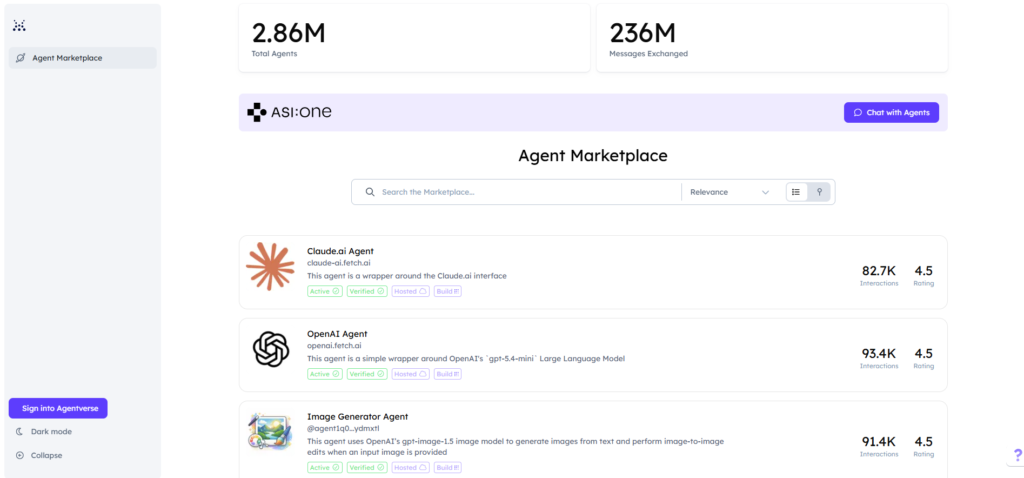
Fetch.ai Agentverse: agent discovery
Fetch.ai's Agentverse helps users and agents discover services, send structured requests, and receive responses. Registration or payment may touch a chain while service logic and data remain offchain. A review should record which agent answered, its source, response time, and completion evidence.
A July 2024 DeltaV beta tester spent one to two hours across five prompts and did not receive nearby EV-charger results despite reporting roughly 15 chargers. That specific DeltaV test is old and anecdotal, not a 2026 reliability measure. It still identifies useful checks: response time, task completion, source dependency, and whether the service solved the request.
Olas: autonomous service coordination
Olas coordinates persistent autonomous services through registered components, operators, and Safe accounts. Reviewers should connect each service ID and operator with its Agent Safe and with the owner, or Master Safe, able to recover control.
A reviewer who used a Pearl wallet followed its contract interactions on GnosisScan rather than relying only on the app dashboard. That Pearl wallet walkthrough, accessed August 19, 2026, is a limited publication test, not an uptime or support benchmark. Even so, it gives an operator a reproducible ownership check: copy the Agent Safe address from Pearl, match each registry and service transaction in the explorer, and identify the Master Safe that can recover control before depositing more funds. This matters because Olas's June 2026 registry remediation specifically tightened the binding between a service and its multisig.
Coinbase AgentKit: wallet actions
Coinbase AgentKit provides balance queries, transfers, and contract calls for wallet-connected software. It connects tool calls to transactions but does not decide whether a route is sensible. Applications must constrain tools, account scope, chain, asset, amount, method, and session lifetime.
One builder connecting AgentKit to x402 found that libraries assuming an externally owned account could fail silently because AgentKit used a smart account. A retry also paid twice before the first transaction confirmed. This two-week integration report is not a platform-wide benchmark, but it produces two release checks: detect the account type and make paid retries idempotent.
Safe: smart account permissions
Safe separates model proposals from asset authority through owners, thresholds, modules, and guards. Every owner, module, spending rule, upgrade path, and recovery mechanism should be reviewed, because an overpowered module or an unreadable interface can weaken a strong threshold.
A Safe community participant testing cross-device verification found that hashes and decoded details needed comparison on separate surfaces. Later tests showed that a disappearing timeout interface could create false urgency. These Safe approval experiments are individual observations, but they support decoding and confirming high-value actions on a device that did not create the proposal.
x402: machine payments
x402 lets software request a resource, receive payment terms, sign an authorization, retry, and obtain the resource after settlement. It covers only the payment layer of the broader AI agent payment protocol landscape.
After six weeks using x402 to monetize an MCP server, one operator removed it despite finding the payment handshake elegant. The first-hand production account describes payment retries, per-tool pricing, wallet rate limits, refunds after failed jobs, silent webhook failures, and a separate requirement for customers paying in dollars rather than USDC. One deployment cannot establish protocol-wide reliability, but it shows what a release test must cover: repeat a request after settlement, deliberately fail the paid job, and verify that one authorization produces either one delivered response or a traceable refund, never a second charge.
Onchain AI agent permission levels
Research capability and financial authority must be scored separately. Moving from read-only access to open-ended signing creates new loss paths and requires a stronger control owner. A 2026 review of 317 relevant studies similarly separated read-only analytics, intent generation, delegated execution, autonomous signing, and multi-agent workflows while comparing custody, policy, observability, and recovery.
The safest production target is usually bounded execution. It keeps asset, destination, amount, method, and expiry enforceable outside the model. A prompt can be misunderstood; account policy can prevent the invalid call from being signed.
Onchain AI agent security risks
Failures often occur at handoffs: data becomes stale before signing, calldata changes after simulation, or payment settles while the API response is lost. A wallet can enforce a cap yet still call an allowlisted method with unintended parameters.
- Stale or manipulated input can produce a confident recommendation from an old quote. Timestamps, approved sources, and freshness limits should reject it.
- Prompt or tool injection may introduce a new destination or hidden instruction. Tool isolation and contract allowlists keep that change outside the signing path.
- Simulation drift occurs when calldata no longer matches the preview. Signing should remain bound to the simulated calldata and deadline.
- Excessive session authority lets a valid action repeat beyond the user's intent. Amount, frequency, asset, method, and expiry limits contain the damage.
- Duplicate paid retries can charge again after an API timeout. An idempotency key must connect the retry to its original authorization.
- Settlement without delivery leaves a confirmed payment but no useful service output. The receipt needs a delivery check and a named refund or escalation path.
A stronger model may improve routing, but it cannot replace deterministic limits, recovery, idempotency, or a receipt proving what happened.
Transaction receipts and audit trails
The 50 USDC instruction should finish with one record connecting the request to settlement. Neither a chat transcript nor a transaction hash alone shows which quote, limit, and policy produced the result.
- Mandate and inputs: Buy ETH on Base, spend no more than 50 USDC, keep price impact below 0.5%, and record the quote provider, liquidity, block number, and timestamp.
- Proposed action and simulation: Preserve the router, pool, token addresses, amount, minimum output, deadline, calldata hash, projected balances, gas estimate, and approval changes.
- Policy and authorization: Record the rule version, pass or rejection reason, smart account, signer or session, reserved nonce, and permission expiry.
- Settlement and follow-up: Attach the transaction hash, block, actual amounts, requested-versus-actual difference, remaining approvals, alert, and recovery owner.
Before raising the wallet limit, test a stale quote, blocked contract, excessive amount, expired session, changed calldata, conflicting nonce, and post-payment timeout. Each case must stop at its assigned layer and remain visible in the record.
Conclusion
Onchain AI agents connect offchain decisions to blockchain accounts and state changes. Fetch.ai, Olas, AgentKit, Safe, and x402 represent discovery, persistent services, action tooling, account policy, and payment rather than one interchangeable product category. The strongest implementation shows why an action was proposed, why policy allowed it, what the wallet signed, and whether settlement matched the mandate. Begin with observable work, add bounded authority only to repeatable workflows, and keep recovery outside the model.
Frequently asked questions
Do onchain AI agents need a token?
No. An application can combine a model, data APIs, transaction tools, and a smart account without issuing or requiring a dedicated token. A token matters only when it performs a necessary function such as payment, staking, access, governance, or coordination.
What runs offchain in an onchain AI agent?
The model, memory, private context, data processing, and most inference commonly run offchain because computation is expensive and inputs may be sensitive. The blockchain more often records identity, permissions, payments, contract calls, and final state.
Are smart accounts enough for onchain AI agents?
No. A smart account can enforce thresholds, modules, and limits, but the configuration must still be reviewed. Unsafe modules, broad allowlists, long sessions, weak recovery, or unreadable signing interfaces can undermine the account boundary.
Which wallet permissions should an onchain AI agent start with?
Read-only monitoring and unsigned transaction preparation expose the least financial authority. Approval-based execution is the next step. Bounded automation should come only after negative-path tests show that invalid, stale, or changed actions are rejected reliably.
Disclaimer: The information provided on AiCryptoCore.com is for educational and informational purposes only and does not constitute financial, investment, or trading advice. Cryptocurrency investments involve risk and may result in financial loss. Always conduct your own research and consult with a qualified financial advisor before making any investment decisions.

