Inside On's Zurich Tech Lab: Robotics Reshape Footwear Manufacturing with Three-Minute Shoe Production
Key Takeaways
- •Swiss sportswear brand On has developed LightSpray, a robotic system that forms running shoe uppers in about three minutes using molten plastic.
- •The LightSpray process reduces shoe construction to just seven parts, eliminating an estimated 200 to 300 hours of manual labor per production cycle.
- •Unlike traditional manufacturers that add automation to existing assembly lines, On designed its footwear manufacturing process to be executed exclusively by robots.
- •The robotic LightSpray system can seamlessly alternate between different shoe sizes on the fly, offering significantly greater manufacturing flexibility.
- •On has expanded its LightSpray production capabilities to South Korea and is actively working to fully automate the remaining manual step of outsole attachment.
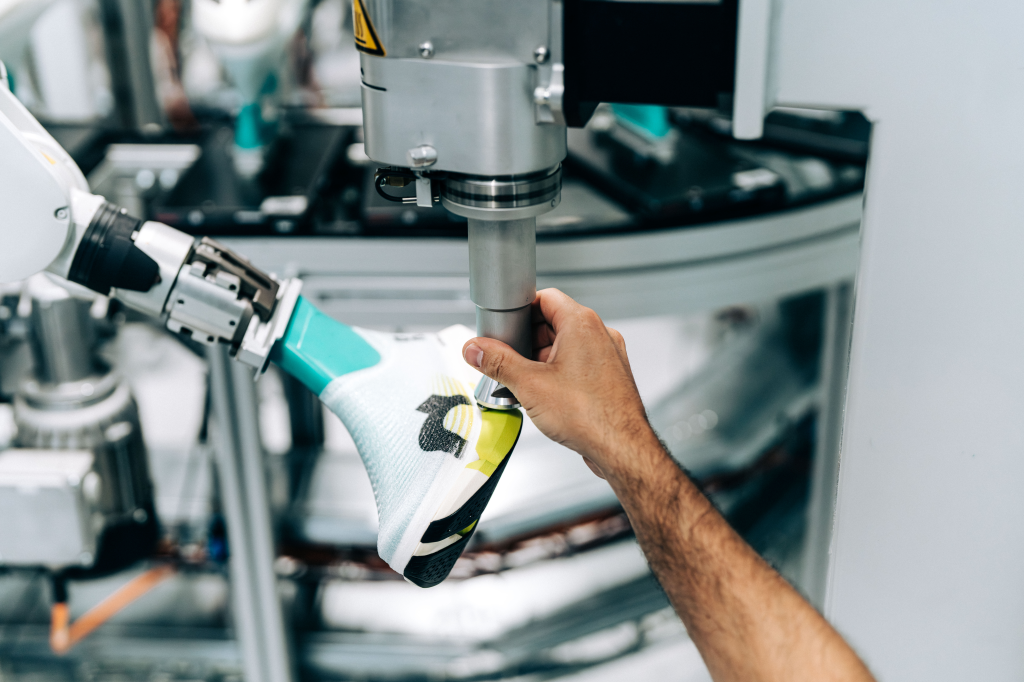
Inside a brightly lit laboratory at On's Zurich headquarters, a robotic arm rotates a plastic model of a human foot while a nozzle sprays 1.5 km (0.93 miles) of thin molten plastic with near-hypnotic precision. Layer by layer, the filament wraps around the mold, gradually forming the upper of a running shoe. The entire process takes approximately three minutes.
The sportswear industry has long relied on labor-intensive assembly — cutting, stitching, gluing, and sewing as many as 200 individual components into a single shoe. This model is concentrated heavily in Vietnam, Indonesia, and China, which together account for the overwhelming majority of global athletic footwear output. On says its LightSpray manufacturing technology reduces construction to just seven parts, eliminating an estimated 200 to 300 hours of human work across the traditional development and production cycle.
While many manufacturers have introduced automation into existing production lines, On says it took a fundamentally different approach, designing a manufacturing process around robotics from the outset.
"We're not trying to rebuild an existing style with robots," cofounder and co-CEO Caspar Coppetti told Fortune during a tour of the company's manufacturing lab. "We designed a technology that can only be done by robots."
LightSpray represents the latest product of an engineering-first philosophy that has defined On since its founding. The company filed roughly 200 patents in the past year alone, covering footwear, apparel, and manufacturing technologies.
Origins in Experimentation
That culture of experimentation traces back to the company's earliest days, says cofounder and co-CEO David Allemann, when prototypes resembled a garage project more than the foundation of one of the world's fastest-growing sportswear brands.
Former professional triathlete Olivier Bernhard, frustrated with running shoes that forced athletes to choose between cushioning and speed, began attaching pieces of garden hose to the outsole of an existing shoe. He presented the prototype to future co-founders Allemann and Coppetti, who immediately recognized its potential.
"It was an incredible feel," Allemann recalled. "We started thinking about other sports innovations throughout history and realized engineering has always changed the feel of sport."
Founded in 2010, On launched its first shoes that same year. More than a decade later, the company has surpassed 3 billion Swiss francs in annual revenue and achieved a market capitalization of approximately $15 billion following its 2021 listing on the New York Stock Exchange.
Footwear remains the core business, generating more than 90% of revenue. The Americas, led by the U.S., account for nearly 58% of net sales, while Asia-Pacific — responsible for 17% of global sales — is the company's fastest-growing market.
On's rise has occurred against a backdrop of continued dominance by Nike and Adidas in global athletic footwear. Still, On's revenue remains a fraction of those legacy giants, which generate $46 billion and $29 billion, respectively.
Along the way, On has attracted high-profile investors including Roger Federer, expanded its retail footprint, collaborated with brands such as Loewe and Post Archive Faction, and enlisted Zendaya for global campaigns.
Engineering by Iteration
Walking through On's shoe archive, Allemann and Coppetti point to shelves lined with prototypes documenting years of experimentation. Each iteration represents a successive attempt to refine cushioning, stability, and energy return.
A few buildings away, On's athlete lab measures what the eye cannot see. Roughly 20 high-speed cameras surround treadmills while force plates embedded in the machines record how runners strike and push off with each stride. Athletes wear oxygen masks to measure energy expenditure at varying speeds and heart rates as motion-capture software generates three-dimensional models of their legs and feet. Together, the systems help engineers evaluate how subtle design changes affect running efficiency.
The company complements controlled lab testing with real-world validation alongside elite athletes. Olympic marathon champion Helen Obiri helped develop the LightSpray racing shoe with the On Athletics Club in Boulder, Colorado. Engineers traveled there twice a month, following her workouts on bicycles, filming her stride, and gathering feedback on shoe performance.
Reinventing the Factory
Developing the LightSpray racing shoe took nearly a decade. Production has since expanded from Zurich to South Korea, where robotic systems now manufacture LightSpray shoes as the company scales the process.
On is not the first sportswear brand to pursue automated production closer to end markets. Adidas opened high-tech "Speedfactory" facilities in Germany and the United States in 2017 and 2018 before ultimately restructuring those operations and shifting some of the underlying technology back into its Asian supply chain. The episode underscored how difficult it has been for the industry to move beyond the cost advantages of traditional Southeast Asian labor at scale.
Coppetti says On's technology shifts manufacturing from labor-intensive production toward robotics — a tradeoff he expects will grow more economical over time while granting On greater geographic flexibility.
"Basically, this is capex versus human labor. The long-term trend is definitely that it will become more economic. It also allows us to do it anywhere in the world, and we're not dependent on a pool of people."
One production station still relies on manual labor: the attachment of the outsole before shoes undergo the LightSpray process. That step remains performed in Asia, though Coppetti says On is actively working to automate it. "There shouldn't be any people involved here," he said.
The technology also transforms factory operations. Traditional production lines manufacture thousands of shoes in a single size before switching over. Allemann says the LightSpray robot can alternate between different shoe sizes on the fly, providing On significantly greater manufacturing flexibility.
Coppetti believes robotics will reshape footwear manufacturing in the coming years. He envisions smaller production facilities located closer to customers, shortening the distance between product development, manufacturing, and the consumer.
Fifteen years after Bernhard attached garden hose pieces to the bottom of a running shoe, On's sportswear technology has evolved dramatically. Yet the co-CEOs say every experiment and product still begins with the same question: Can movement feel better?
This story was originally featured on Fortune.com.

