Blockchain Networks Pivot to Specialist Use Cases to Lead 2026 Growth
Key Takeaways
- •Most major blockchain networks now appear to be centered on one dominant high-liquidity use case.
- •Earlier growth models that relied on token incentives and airdrops are losing influence as chains seek more durable activity.
- •Robinhood currently leads chain activity tied to memes, with more than half of its activity coming from meme issuing and trading.
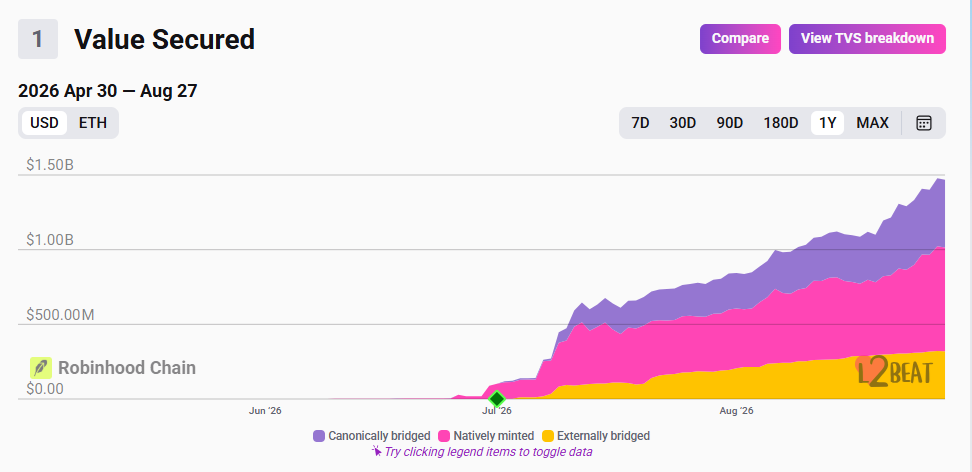
- •Robinhood’s TVL rose from $4 million in June to more than $1.4 billion by August 27.
- •BNB Chain leads in daily active wallets, while Solana has recently reached 5 million daily active addresses.
On-chain activity has become highly specialized in 2026, with most blockchain networks now showing a single high-liquidity use case. Specialized uses also mean fewer artificial incentives and, potentially, a growing base of real users.
Blockchain networks have moved beyond direct competition, with multiple networks adopting high-value use cases and specialization. New chains no longer aim to compete with Ethereum; instead, they seek to attract their own unique user base and excel at one specialized activity. According to Cryptorank, top chains have already established a signature use case, one that has emerged over the past few years — a breakdown the analytics platform also shared on X.
Most of these chains achieved their niche through their most successful apps rather than being specifically engineered to support a given activity. In fact, the busiest networks were originally created for flexible use cases, not specialized ones. The shift matters because earlier growth models leaned heavily on token incentives and airdrop campaigns, which repeatedly drew activity that faded once rewards ended. A signature use case gives a chain a clearer identity and a reason for users to return, though it also ties the network's fortunes to the health of a single activity.
Robinhood leads all chains with a meme gold rush
Despite Solana's reputation as a meme token powerhouse, Robinhood is currently the hottest meme venue, with more than 50% of Robinhood activity tied to issuing and trading memes.
Based on recent Cryptorank research, Solana and BNB Chain are more suited to meme tokens and DeFi than to ongoing meme launches. Solana also expects even higher stablecoin activity, as Circle printed more USDC and sent the biggest share to the Solana chain; over $5B in USDC were printed in the past week, per Solscan. Stablecoin flows have become a key front in chain competition, and the sector gained firmer footing in the US after the GENIUS Act established a regulatory framework for payment stablecoins in July 2025.
As for Ethereum, it has emerged as infrastructure to consolidate all other chains and tokens. Most alternative chains still issue their token on Ethereum, drawn by compatibility and the largest available liquidity. As a result, Ethereum supports its own DeFi and stablecoin activity, but its main role is serving as a base layer for other networks. Even Robinhood chose to become an Ethereum L2 chain, using well-established technology to support its activity. Robinhood Chain is built with Arbitrum's Orbit stack, joining a wave of exchanges and fintechs launching dedicated chains after Coinbase's Base showed that a trading platform's user base can translate into sustained on-chain activity.
Robinhood expanded its value locked from $4M in June to over $1.4B as of August 27, per L2Beat, showing that new chains remain in demand when they provide viable narratives and manage to attract liquidity.
Activity quickly returns to chains with bullish signals
On-chain activity and value locked showed chains to be highly responsive to bullish signals. Over the past month, following the recovery of blue-chip tokens and BTC, most chains dramatically increased their value locked, according to DefiLlama.
Robinhood remained the leader, posting 93% TVL growth for the past month, while most chains added more than 20% to their value. Robinhood also saw over $125M in net inflows over the past month, based on Artemis data, making it the leader in netflows for the period. As Cryptopolitan reported, Robinhood also expanded with its own brand of tokenized real-world assets, a sector that has pulled traditional asset managers and exchanges into issuing tokenized funds and equities on public chains.
Arbitrum was the leader in inflows on a quarterly basis, adding a net $1.9B, per Artemis, mostly linked to tokenized real-world assets. Data on inflows and outflows shows bridge infrastructure remains key, and liquidity moves quickly to new chains whenever there is an active narrative or use case.
As of 2026, the larger Web3 narrative is not as active, but specific chains continue to get a boost from their own niche performance.
When it comes to daily active users, chains tell a different story. BNB Chain remains the most widely used network, with over 3.5M daily active wallets, on par with TRON, per Token Terminal. Solana has seen spikes of activity, recently breaking out to 5M daily active addresses, as Solana reported on X. For specialized chains, the open question is whether a single signature use case can keep users and capital anchored once a fresher narrative pulls liquidity elsewhere.
