OKX Files With SEC for Tokenized U.S. Stock Trading
Key Takeaways
- •OKX, one of the world's largest cryptocurrency exchanges, has submitted an SEC filing seeking to launch trading of tokenized U.S. stocks.
- •The proposed product would provide users with exposure to publicly traded American equities through blockchain-based tokens held on the OKX platform.
- •The SEC filing represents only a proposal, and approval, launch timing, eligible users, and the specific equities to be tokenized remain unconfirmed.
- •Coinbase has separately filed with the CFTC for U.S. single-stock and ETF perpetual futures, reflecting a broader push by major crypto exchanges into regulated equity products.
- •Tokenized stocks could enable around-the-clock trading and programmable settlement, while raising regulatory questions about custody, issuer liability, and investor protections under U.S. securities law.
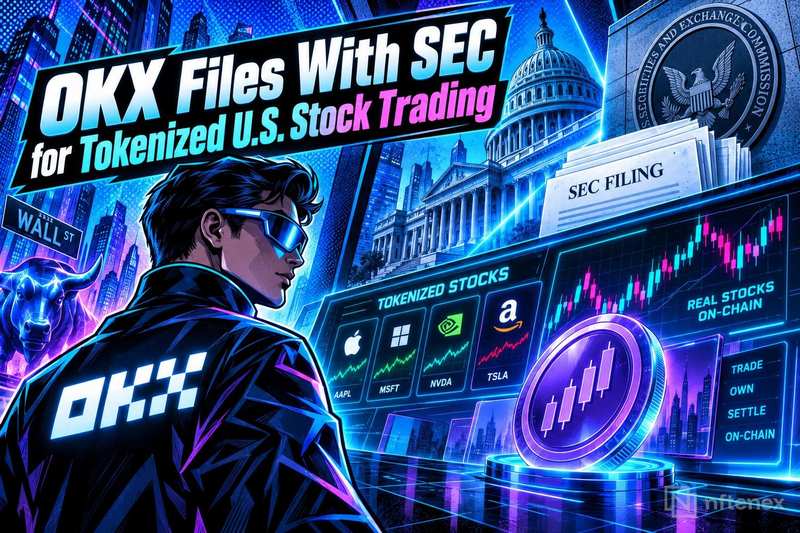
OKX, one of the world's largest cryptocurrency exchanges, has filed with the U.S. Securities and Exchange Commission (SEC) to launch tokenized U.S. stock trading, according to a report from market intelligence account WatcherGuru. The filing represents a formal regulatory step toward connecting crypto-exchange infrastructure with direct U.S. equity exposure through blockchain-based tokenization.
Key Points
- OKX has filed with the SEC to offer tokenized U.S. stock trading.
- The proposed product would allow users to gain U.S. equity exposure through blockchain-based tokens on the OKX platform.
- The filing constitutes a proposed launch, not a regulatory approval or a live product offering.
What the SEC Filing Proposes
The filing signals OKX's intent to offer tokenized representations of U.S. stocks. Under the proposal, users could hold blockchain-based instruments that track the value of publicly traded American equities directly on the exchange. A filing, however, only opens a regulatory dialogue. It does not confirm product approval, launch timing, eligible users, or the specific equities that would be tokenized.
The move follows a broader pattern among crypto-native platforms pursuing regulated equity products. Coinbase, for example, has filed a bid with the Commodity Futures Trading Commission (CFTC) for U.S. single-stock and ETF perpetual futures, indicating that several major exchanges are independently working to bring traditional equity exposure onto crypto rails. As one of the world's largest exchanges OKX's pursuit of SEC authorization adds a prominent data point to this ongoing conversation between crypto platforms and U.S. regulators.
Tokenized Stocks: How They Work
Tokenized stocks are blockchain-based tokens designed to mirror the price of a real-world equity. Tokenization, in this sense, means representing rights to an asset as a digital token recorded on a blockchain. On a crypto exchange, users would trade these tokens rather than purchasing shares through a traditional brokerage. Because the infrastructure runs on-chain, it can enable around-the-clock trading and programmable settlement — a notable departure from the fixed weekday sessions that govern traditional U.S. stock exchanges. The structure also raises distinct regulatory questions concerning custody, issuer liability, and investor protections under U.S. securities law.
For OKX specifically, adding tokenized equities would extend the exchange's product surface beyond crypto assets into regulated securities territory, which is precisely why an SEC filing is the necessary first step.
Filing Is Not Approval
The distinction between a filing and an approval matters. The SEC reviews submissions and may request amendments, impose conditions, or decline to authorize an offering in its proposed form. After an initial filing, the review process typically involves a comment period during which the SEC may issue comments or deficiency letters requesting clarification or structural changes. OKX would need to respond to any SEC feedback before the product could receive authorization.
The Bitwise filing of a Chainlink ETF prospectus with the SEC earlier this year demonstrated that crypto-asset firms are increasingly willing to engage directly with U.S. securities regulators on novel product structures, rather than routing around them.
Regulatory Milestones to Watch
Timing, approval status, and the final scope of any tokenized equity product are not confirmed by the available information. Observers should monitor for SEC acknowledgment letters, public comment filings on the SEC's EDGAR system — the agency's free public database where filings and related correspondence are published — and any official OKX announcements about product timelines.
A related development worth tracking is Coinbase's separate CFTC filing for single-stock and ETF perpetual futures, which suggests U.S. regulators are being asked to define rules for multiple competing structural approaches to equity-crypto hybrid products simultaneously. The outcome of OKX's filing, alongside parallel submissions from other exchanges, could shape how tokenized real-world assets are regulated in the United States going forward.
Until the SEC completes its review, OKX's tokenized stock product remains a proposal, not a service.
Disclaimer: This article is for informational purposes only and does not constitute financial or investment advice. Cryptocurrency and digital asset markets carry significant risk. Always do your own research before making decisions.

