OKX Exchange Review 2026: Safety, Features, Fees, and Supported Regions
Key Takeaways
- •OKX is a Seychelles-based cryptocurrency exchange founded in 2017 that supports trading in over 100 countries but is not available to users in the United States and several other restricted jurisdictions.
- •The platform holds 95% of user assets in offline cold storage and maintains a risk shield fund exceeding $700 million to protect against potential security breaches.
- •OKX published its December 2024 Proof of Reserves showing over $30.8 billion in assets, with reserve ratios of 105% for Bitcoin, 102% for Ethereum, 106% for USDT, and 100% for USDC.
- •Standard spot trading fees start at 0.10% for takers and 0.08% for makers, with discounts available based on 30-day trading volume and OKB token holdings.
- •OKX operates its own X-layer blockchain and native OKB token, placing it alongside Binance and Coinbase in building proprietary blockchain infrastructure to expand ecosystem offerings.
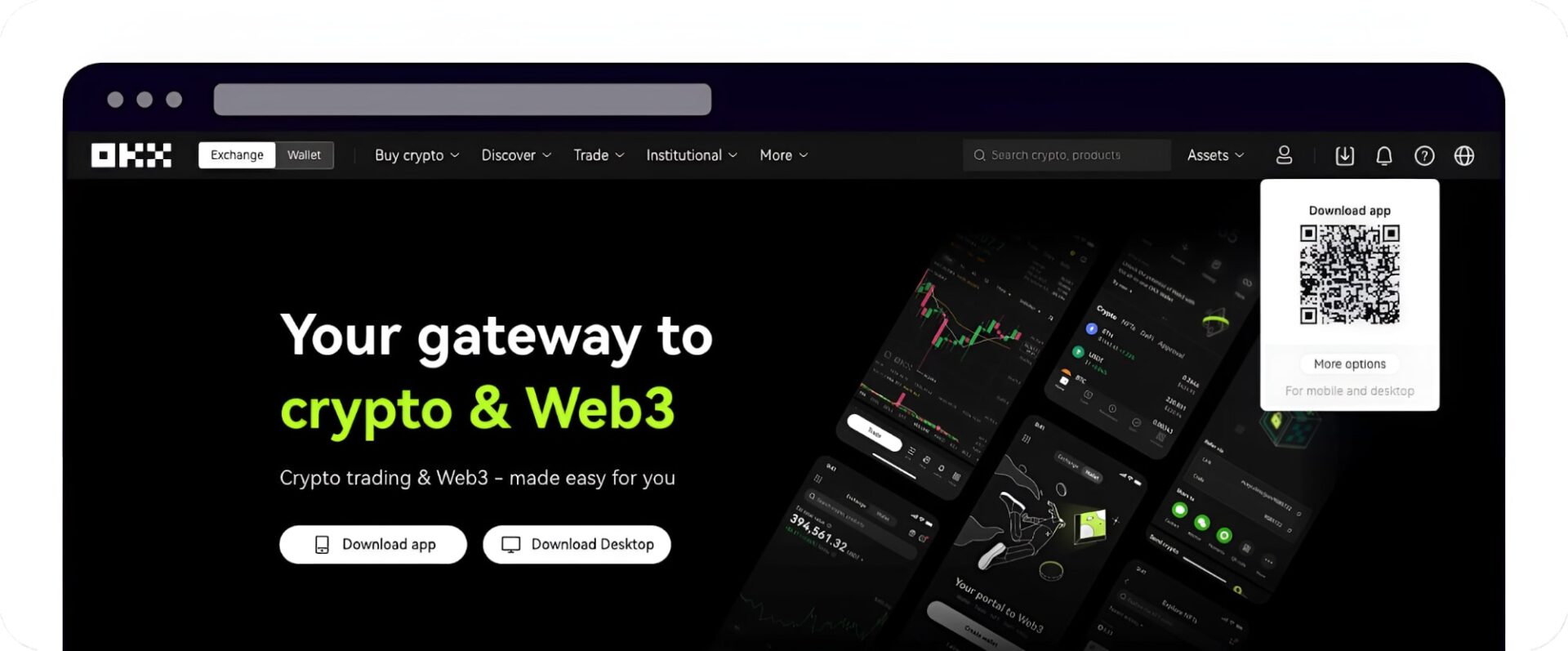
OKX, a leading cryptocurrency exchange formerly known as OKex, was founded in 2017 to provide crypto investors with a user-friendly platform for buying, selling, and trading digital assets. The exchange features a clean interface, automated trading tools, and opportunities for earning passive income through various crypto products, positioning it as a popular choice among both experienced and new traders.
OKX is considered safe for buying and selling cryptocurrency in 2026. The platform implements multiple security measures, including cold storage, anti-phishing codes, and a risk shield designed to protect users and their digital assets. Following the collapse of FTX in late 2022, which exposed critical transparency gaps across the centralized exchange industry, OKX was among the major exchanges that reinforced its Proof of Reserves program and security disclosures to restore user confidence.
What is OKX?
OKX is a cryptocurrency exchange offering user-friendly trading interfaces and options such as spot, margin, and futures contracts. The platform also provides advanced tools including crypto trading bots, block trading, and a portal to the Web3 ecosystem.
OKX operates its own blockchain, the X-layer network, and a native token called OKB. This token is used to pay trading fees, reward investors for holding OKB through OKX Earn programs, and grant users access to voting and governance on the platform. The launch of X-layer places OKX alongside other major exchanges — such as Binance with BNB Chain and Coinbase with Base — that have built proprietary blockchain infrastructure to deepen their ecosystem offerings.
Key features and services offered by OKX include:
- Derivatives (margin, futures, perpetual, and options)
- Automated trading tools (bots and copy trading)
- OKX Earn (staking, lending, etc.)
- NFT marketplace
- Crypto borrowing
Where is OKX Based?
OKX is headquartered in Seychelles, with global offices in Hong Kong, Singapore, the UAE, Silicon Valley, and the Bahamas, providing support for users worldwide.
Supported Countries
OKX supports cryptocurrency trading in over 100 countries, including South Africa, Singapore, Kenya, Australia, the Netherlands, Argentina, and Seychelles.
The OKX exchange itself is not available in the United States, though the company does offer Web3 services to US users.
Restricted Countries
OKX has varying levels of restrictions across different jurisdictions:
- Belgium, Japan, Malaysia, and Cuba: Users in these locations are restricted from using margin and derivatives-related services, including futures, perpetual, and options trading.
- Canada: Existing users can access OKX, but new account registrations are not permitted at the time of this review.
- Hong Kong: Derivatives services are unavailable.
- The United Kingdom, the Bahamas, and the Netherlands: These countries are prohibited from using the platform's derivatives-related services.
Note: Potential users from most of these countries cannot currently register on OKX. Only existing traders can use the permitted products and services.
Completely Restricted Countries
OKX is unavailable to traders in the United States and its territories, Belgium, France, Iran, Cuba, Bangladesh, North Korea, Bolivia, Malta, Crimea, Syria, the Donetsk and Luhansk regions, and Ireland. The company may update this list as regulations evolve. The restricted-country landscape has shifted noticeably since 2023, as regulators in the EU, UK, and parts of Asia tightened licensing requirements and derivatives offerings for crypto platforms.
Trading Fees
OKX employs a maker-taker fee model. Standard trading fees start at 0.10% for takers and 0.08% for makers, with VIP-level traders paying lower rates. These baseline rates are competitive with other tier-1 exchanges such as Binance and Bybit, which also use volume-based tiered discount systems.
A maker creates a limit order that is not filled immediately, adding liquidity to the platform and therefore paying lower fees. A taker fills an existing order from the order book, removing liquidity and paying a higher fee.
For example, if the current ETH lowest ask price is 2,700 USDT and a maker places a bid at 2,570 USDT, the order enters the order book until a taker fills it.
Spot Trading Fees
Regular users are charged 0.10% for takers and 0.08% for makers on USDT pairs. The platform uses a tiered rating system based on 30-day trading volume and OKB token holdings, through which transaction fees can be discounted to as low as 0%. Lower fees apply to crypto, other stablecoin, and fiat pairs depending on 30-day trading volume.
Futures Fees
- Taker Fee: 0.05% for non-VIP users
- Maker Fee: 0.02% for non-VIP users
VIP 1 users pay 0.03% (taker) and 0.01% (maker) for futures.
Options Fees
Options fees start at 0.02% for makers and 0.03% for takers. OKX also charges a forced liquidation fee and an exercise fee, though the exercise fee does not apply to 1-day options that do not expire on Friday.
Spread Trading Fees
A 50% discount applies to the standard fee rate for all users on spread trading. For example, a VIP 1 user opening a BTC/USDT-margined perpetual spread would pay 0.04% for makers and 0.05% for takers.
Key Features
OKX Trading Bot
The platform offers approximately 11 trading bots for automation, including spot and futures grid, futures DCA, smart arbitrage, spot DCA (martingale), recurring buy, signal bot, iceberg, TWAP, smart portfolio, and arbitrage.
Spot Grid: This mode splits starting funds between the two assets of a chosen trading pair, such as BTC/USDT. The bot creates a grid of price points between upper and lower limits, dividing capital equally across the number of grids. It automatically buys when the price drops to a lower grid level and sells when the price rises to an upper grid level. Profit is generated from the difference between buy and sell prices.
Futures Grid: This strategy aims to profit from price fluctuations within a range. OKX offers three types:
- Long Futures Grid: Buys futures at the current price and sells when the price rises, suited for upward-trending but volatile markets.
- Short Futures Grid: Sells futures at the current price and buys back when the price drops, suited for downward-trending but volatile markets.
- Neutral Futures Grid: Trades in both directions, buying low and selling high regardless of market trend.
Smart Arbitrage: This bot uses a delta-neutral strategy by holding equal but opposite positions in two markets — buying a cryptocurrency in the spot market (long) and selling the same cryptocurrency in the perpetual swap market (short). Profits come primarily from funding fees earned during the holding period. Two modes are available:
- Custom Mode: Users choose their strategy and set profit targets.
- Smart Mode: The system recommends the best strategy and automatically manages profit-taking, stop-loss, and adjustments.
For futures and spot bots, users can set parameters based on personal analysis, use bot-recommended parameters, employ AI strategy, or copy lead traders' winning bots.
OKX Copy Trading
OKX copy trading allows new users to replicate strategies from more advanced traders, automatically executing them in spot or futures markets. Copied positions open and close in sync with the lead trader's actions.
Transaction fees for copied trades match the user's regular tier-level fees. However, users share profit with the lead trader, typically 8–13% of results. Users can set a maximum amount per order and a maximum total amount for each copied trader. For instance, with a per-order maximum of 50 USDT and a trader maximum of 500 USDT, after the lead trader opens 10 positions, the invested margin reaches the 500 USDT limit and no further positions are copied.
OKX Wallet
OKX Wallet is a decentralized, non-custodial wallet supporting multiple blockchain networks and providing access to the Web3 ecosystem. Unlike the OKX exchange, the wallet gives users full control of their assets and private keys. The expansion of self-custody wallets by centralized exchanges reflects a broader industry shift toward DeFi integration, as platforms seek to retain users who increasingly interact with on-chain applications.
The OKX Web3 wallet includes a built-in DEX aggregator for multi-chain and cross-chain transactions, allowing users to switch between supported networks without creating separate wallets. Additional features include yield farming, an NFT marketplace, and access to over 1,000 DApp protocols.
Benefits of the OKX Web3 wallet:
- Full control and ownership of assets
- Quick crypto withdrawals without an approval process
- Multi-chain support with automatic network recognition
- Asset management across over 60 chains, including Ethereum, Aptos, Optimism, and BSC
- Available on iOS, Android, and web browsers
The wallet does not store seed phrases, private keys, or passwords — users are solely responsible for these.
OKX Mobile App
The OKX mobile app provides a user-friendly interface for buying, selling, trading, and managing crypto on the go. It offers a simple view for beginners and an advanced mode for experienced traders. The app is available on the Apple App Store and Google Play Store.
The mobile app retains all tools available on the web interface. Users can buy, sell, and convert crypto using fiat or crypto assets, set limit and market orders with TP/SL and trail stops, and access margin trading with leverage up to 10X. For derivatives, futures contracts and perpetual swaps support leverage up to 125X, with customizable alerts for trade notifications.
How to Open an Account and Trade on OKX
Account Registration Steps:
- Select your country or region, agree to the terms and privacy agreement, and click "Next."
- Register using your email and enter the OKX referral code "CNJREVIEW."
- Enter the verification code sent to your email, then verify your phone number via text code.
- Create a secure password (recommended at least 12 characters).
- Complete KYC verification by submitting identification documents. OKX verifies documents within 24 hours.
Trading Steps:
Step 1 — Deposit Funds: Fund your account by depositing cryptocurrency from another wallet or using fiat options such as credit cards (Visa, Mastercard), bank transfers, or peer-to-peer (P2P) transactions. To deposit crypto, navigate to the 'Assets' tab, select 'Deposit,' choose the cryptocurrency and network, then transfer funds to the generated wallet address.
Step 2 — Choose Your Trading Method: Go to the 'Trade' section and select between spot or derivatives (futures, margin, perpetual swaps). Beginners are advised to start with the spot market or the copy trading tool.
Step 3 — Place Your First Trade: Select a trading pair (e.g., PEPE/USDT or BTC/USDT) and use the order window to place buy or sell orders. Available order types include:
- Market Orders: Execute immediately at current prices.
- Limit Orders: Set a specific price for buying or selling.
- Stop Orders: Execute when a specified price condition is met.
Confirm the order for execution according to the selected order type.
KYC Requirements
Yes, OKX requires KYC verification. Users must submit personal identification documents such as a selfie, passport, or driver's license. The information on the ID must match the region or country selected during registration.
Security Features
OKX offers a range of security measures to protect user accounts and assets:
Cold Wallet Storage
95% of assets on OKX are held in offline wallets, which are not susceptible to hacks and security breaches. The company limits each cold wallet address to a maximum of 1,000 BTC, distributing offline assets across multiple wallets to prevent a single point of failure. Once funds in a cold wallet are withdrawn, new deposits are no longer received at that address.
OKX Risk Shield
OKX sets aside a percentage of the platform's assets — over $700 million — to safeguard users from potential breaches. This risk fund is comparable to Binance's Secure Asset Fund for Users (SAFU), protecting against security breaches and market volatility.
Multi-factor Authentication
Users can enhance account security by enabling two-factor authentication (2FA), passkeys, and authenticator apps. Those activating Google Authenticator should safely store the backup code for device recovery purposes.
Anti-phishing Codes
When activated, OKX emails users a code that helps distinguish legitimate communications from suspicious emails.
Proof of Reserves
OKX published its December 2024 Proof of Reserves data, reporting over USD 30.8 billion in reserves. Reserve ratios include Bitcoin (105%), Ethereum (102%), Tether USDT (106%), and USD Coin (100%). The Proof of Reserves is published monthly using advanced cryptographic methods, including zero-knowledge proofs, to ensure transparency while protecting user privacy. Users can independently verify their assets through OKX's dashboard and public wallet addresses. Monthly PoR publications became an industry-wide expectation after November 2022, when the failure of FTX revealed that several exchanges had commingled or misreported customer funds.
Withdrawal Address Whitelisting
Users can specify approved wallet addresses for withdrawals. Any address not on the pre-approved list is automatically blocked, preventing unauthorized fund transfers even in the event of an account compromise.
Source: CryptoNinjas

