Oil Hits Three-Month High as U.S.-Iran Strikes Resume; Diesel Sets Record
Key Takeaways
- •Brent crude settled at $95.85 a barrel, up 8.8% for the week, and WTI at $91.22, up 9.4%, the highest levels in about three months.
- •Iran retaliated with attacks on U.S. military bases in the region, and Kuwait reported intercepting Iranian missiles and drones.
- •The European Union officially joined the U.S. sanctions campaign 'Operation Economic Outcast' targeting Iran's access to the global financial system.
- •The U.S. national average diesel price hit a record $5.85 a gallon, surpassing the previous June 2022 high of $5.82.
- •More than 17 million barrels of oil transited the Strait of Hormuz on Monday under U.S. military protection, a wartime record but below pre-conflict levels of about 20 million barrels per day.
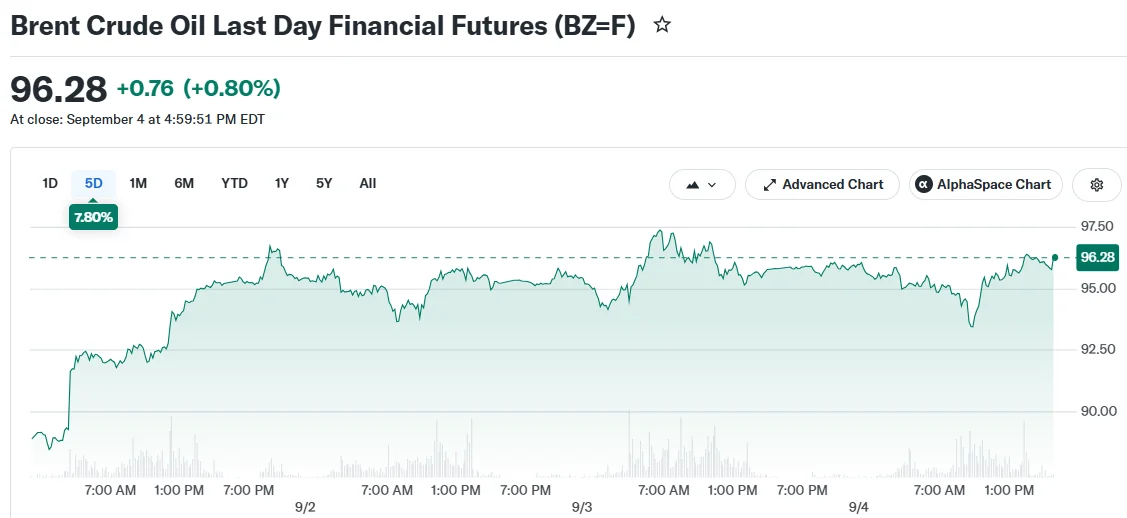
Oil prices climbed to their highest levels in roughly three months this week as renewed military exchanges between the United States and Iran reignited fears over crude supply through the Strait of Hormuz.
Brent crude settled at $95.85 a barrel, up 8.8% for the week, while U.S. West Texas Intermediate settled at $91.22 a barrel, a 9.4% weekly gain.
The spike followed the first exchange of strikes between the U.S. and Iran since July. President Donald Trump said the fighting would not last "too long" and that U.S. strikes targeted infrastructure Iran had been rebuilding around the strait. The waterway, which runs between Iran and Oman, normally carries about a fifth of globally traded petroleum liquids, making it the world's most important oil chokepoint.
BREAKING: New US intelligence warns that Iran can keep the US trapped in this war for months, and may be planning a significant escalation to turn the mounting economic and political costs against Trump, per NYT. The new intelligence states that Iran believes the US military…
— The Hormuz Letter (@HormuzLetter), September 5, 2026 — X post
Iranian state media confirmed that Tehran retaliated with attacks on U.S. military bases in the region. Kuwait also reported intercepting incoming Iranian missiles and drones, with its armed forces describing "ongoing Iranian aggression."
EU Joins Economic Pressure Campaign Against Iran
U.S. Treasury Secretary Scott Bessent said the European Union had "officially joined" Washington's operation to economically squeeze Iran, which he called "Operation Economic Outcast." The EU confirmed it had adopted extensive sanctions to stop Iran from using the global financial system, and Bessent said the goal was to sever every remaining financial lifeline to the Iranian regime.
Energy Secretary Chris Wright told CNBC that more than 17 million barrels of oil transited the Strait of Hormuz on Monday under U.S. military protection — a wartime record, though still below the roughly 20 million barrels per day that passed through before the conflict began in February.
Analysts at ING noted the rally may lose momentum if Hormuz shipments continue moving without major disruption.
Diesel Prices Break 2022 Record
The global oil price surge hit U.S. consumers directly. The national average diesel price reached a new all-time high of $5.85 a gallon, topping the previous record of $5.82 set in June 2022, which was set during the price shock that followed Russia's invasion of Ukraine.
Patrick De Haan of GasBuddy said record diesel prices raise costs across the supply chain, pushing up prices for groceries, deliveries, and household goods. Because diesel powers most trucks, trains, and ships in U.S. freight logistics, it tends to transmit energy costs to consumer prices faster than gasoline. According to AAA, the national average gas price stood at $4.1474 a gallon.
Vice President JD Vance said gas prices were high because Iran had been attacking commercial ships. He added that prices could have been much higher without U.S. intervention, but declined to promise a return to $3 a gallon.
U.S. commercial crude inventories fell to 424.5 million barrels for the week ending August 28, down from 428.9 million barrels the prior week.
OPEC+ is expected to hold its October output policy steady when members meet Sunday. The producer group, which includes Saudi Arabia and Russia, has been unwinding earlier production cuts, and its decision on Sunday will be watched as a signal of whether members are willing or able to add supply to offset Hormuz-related risk.
