Crude Oil Hits Three-Month High as U.S.-Iran Conflict Resumes and U.S. Diesel Prices Set Record
Key Takeaways
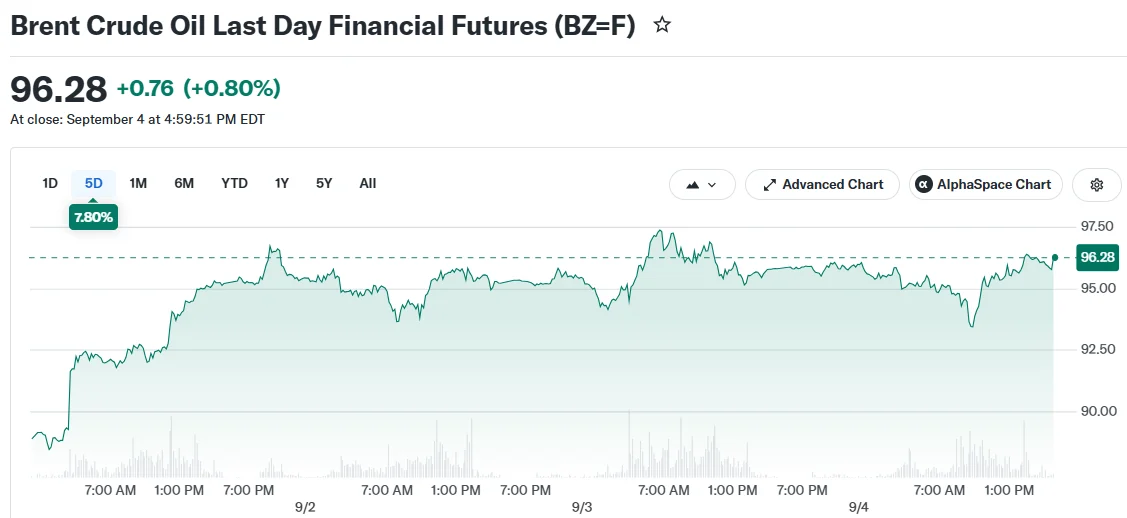
- •Brent crude rose 8.8% for the week to $95.85 per barrel and WTI gained 9.4% to $91.22, reaching three-month highs.
- •The U.S. and Iran resumed direct military confrontation for the first time since July, with American strikes near the Strait of Hormuz and Iranian retaliation against U.S. installations in the region.
- •The European Union formally joined the U.S. sanctions campaign against Iran, aiming to cut Tehran off from international financial networks.
- •U.S. diesel prices reached a record national average of $5.85 per gallon, exceeding the previous June 2022 high and threatening higher costs across freight and consumer goods.
- •More than 17 million barrels moved daily through the Strait of Hormuz under U.S. military escort, still about 3 million barrels below pre-conflict levels, and OPEC+ is expected to hold output steady at its Sunday meeting.
Key Highlights
Brent crude climbed 8.8% weekly to reach $95.85 per barrel, with WTI advancing 9.4% to $91.22
Military confrontation between the U.S. and Iran resumed for the first time since July, focusing on Strait of Hormuz facilities
European Union formally aligned with Washington's sanctions campaign to economically isolate Iran
Diesel costs in the United States reached an unprecedented $5.85 per gallon, surpassing the June 2022 high
OPEC+ members are anticipated to maintain current production levels at Sunday's upcoming meeting
Global oil markets staged a significant rally this week, pushing prices to three-month highs as renewed military confrontation between the United States and Iran raised fears of disruption to critical oil shipping routes through the Strait of Hormuz. The strait is one of the world's most important oil chokepoints, handling roughly a fifth of global petroleum liquids consumption, which is why even the threat of interruption there tends to move prices sharply.
Brent crude futures closed at $95.85 per barrel, an 8.8% weekly advance, while U.S. West Texas Intermediate crude finished at $91.22 per barrel, up 9.4% over the same period.
The surge followed renewed military exchanges between Washington and Tehran — their first direct confrontation since July. President Donald Trump indicated the conflict would be relatively brief and said American forces had struck infrastructure facilities that Iran had been reconstructing near the strategic waterway.
BREAKING: New US intelligence warns that Iran can keep the US trapped in this war for months, and may be planning a significant escalation to turn the mounting economic and political costs against Trump, per NYT. The new intelligence states that Iran believes the US military… — The Hormuz Letter (@HormuzLetter) September 5, 2026
BREAKING: New US intelligence warns that Iran can keep the US trapped in this war for months, and may be planning a significant escalation to turn the mounting economic and political costs against Trump, per NYT.
The new intelligence states that Iran believes the US military…
— The Hormuz Letter (@HormuzLetter) September 5, 2026
Iranian government outlets confirmed that Tehran had launched retaliatory operations against American military installations across the region. Kuwait separately reported successfully intercepting inbound Iranian missiles and unmanned aerial vehicles, with Kuwaiti defense forces describing the situation as "persistent Iranian aggression."
European Union Aligns With U.S. Sanctions Strategy
Treasury Secretary Scott Bessent announced that the European Union had "formally joined" America's economic pressure initiative against Iran, which he called "Operation Economic Outcast." The EU's participation is significant because Iran has historically relied on European trade channels and financial messaging networks as alternatives to U.S.-dominated banking relationships.
The EU confirmed it had implemented comprehensive sanctions designed to cut Iran off from international financial networks. Bessent stressed that the objective is to eliminate every remaining economic connection to the Iranian government.
Energy Secretary Chris Wright told CNBC that more than 17 million barrels of crude oil moved through the Strait of Hormuz on Monday under American military escort — a wartime high, though still below the roughly 20 million barrels that flowed daily through the strait before hostilities began in February. That roughly 3-million-barrel daily gap underscores how much supply remains constrained even with escorts keeping the waterway open.
Market analysts at ING suggested the price rally could weaken if Hormuz shipments continue flowing without significant interruptions.
U.S. Diesel Costs Reach Unprecedented Levels
The international oil price surge dealt a heavy blow to American consumers at home. The nationwide average diesel price climbed to an all-time high of $5.85 per gallon, exceeding the previous record of $5.82 set in June 2022. Diesel is the primary fuel for trucks, trains, and other freight transport in the United States, so its price feeds into the delivered cost of a far broader share of the economy than gasoline alone.
Patrick De Haan of GasBuddy warned that record diesel prices raise costs across distribution networks, lifting expenses for food, shipping, and consumer goods. According to AAA, the national average gasoline price stood at $4.1474 per gallon.
Vice President JD Vance attributed elevated fuel prices to Iranian attacks on merchant vessels, arguing costs could have climbed significantly higher without American military involvement, though he stopped short of guaranteeing a return to $3-per-gallon pricing.
U.S. commercial crude stockpiles fell to 424.5 million barrels in the week ended August 28, down from 428.9 million barrels the previous week.
OPEC+ is widely expected to keep its existing October production strategy when coalition members meet Sunday. With prices already near $96 per barrel, the coalition's decision will be a key signal of whether additional supply could be brought to market to offset Hormuz-related losses, or whether producers will hold output steady amid the conflict.
The post Crude Oil Soars to Three-Month Peak Amid Renewed U.S.-Iran Tensions and Record Diesel Costs appeared first on Blockonomi.
