Crude Prices Recover as Saudi Shipments Resume Amid Strait of Hormuz Uncertainty
Key Takeaways
- •Brent crude for November rose about 1% to $103.64 per barrel and WTI gained 0.9% to $90.21 on Wednesday, reversing Tuesday's declines of 2.6% and 3.5% respectively.
- •Saudi Arabia restored operations on its East-West Pipeline, resuming crude shipments to the Yanbu Red Sea terminal with capacity brought back to roughly 3.5 million barrels per day, about half its maximum throughput.
- •Vessel-tracking data showed nearly 10 million barrels of crude had departed Yanbu and the adjacent Al Muajjiz facility, and Saudi Aramco distributed October loading schedules to customers.
- •The Strait of Hormuz has stayed effectively closed since a joint U.S.-Israeli military strike on Iran in late February, and Qatar-mediated talks between Washington and Tehran have yet to produce an agreement on reopening.
- •Goldman Sachs estimated Persian Gulf crude shipments, including unreported dark-fleet cargoes, at 23.3 million barrels per day last week, in line with the region's average output in 2025.
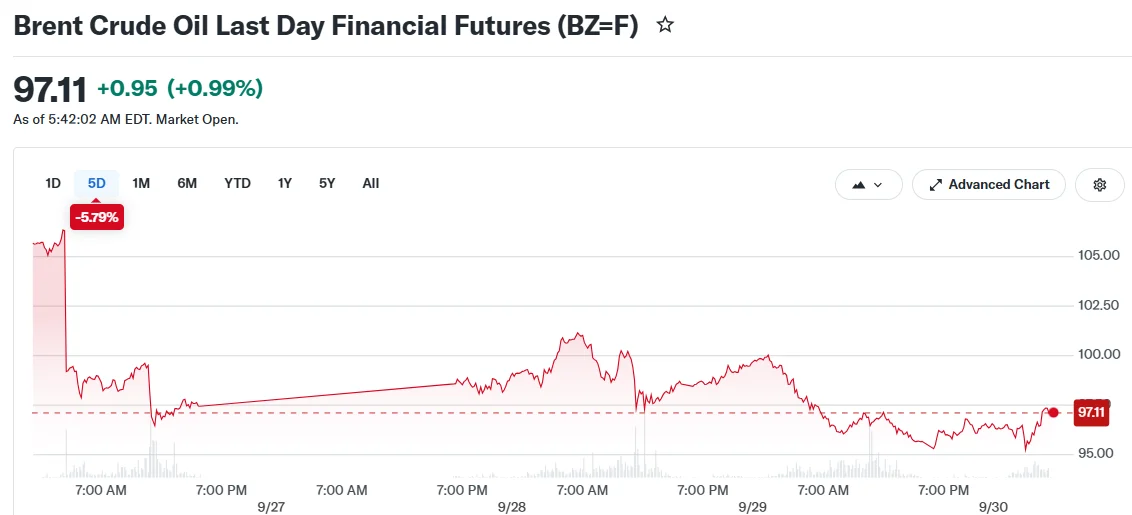
Oil prices recovered during Wednesday trading after recording steep losses in the previous session, as the resumption of Saudi crude shipments offset some concerns about disruptions around the Strait of Hormuz.
Brent crude contracts for November delivery rose approximately 1% to settle at $103.64 per barrel. West Texas Intermediate (WTI) crude advanced 0.9% to finish at $90.21 per barrel. On Tuesday, Brent fell 2.6%, while WTI dropped 3.5%. Brent is the pricing benchmark for much of the world’s crude, while WTI fills the same role U.S. barrels.
Market participants continued to weigh improving Middle Eastern export flows against uncertainty surrounding a key shipping route. The Strait of Hormuz, a chokepoint that carries a substantial share of the world’s seaborne oil, has remained essentially closed since the end of February, following a combined U.S.-Israeli military operation against Iran. The disruption has kept supply risks elevated, although diplomatic efforts could eventually lead to the waterway’s reopening.
Saudi Arabia Restores Yanbu Shipments
The price recovery followed Saudi Arabia’s announcement that it had resumed crude shipments from Yanbu, its Red Sea export terminal. The kingdom restored operations on its East-West Pipeline, allowing crude to reach the Red Sea without passing through the Strait of Hormuz — a rerouting that explains how exports can recover even while the waterway stays shut.
Crude oil flows from the Middle East are almost back to pre-war levels despite continued risks to shipping, according to JPMorgan — Bloomberg (@business) September 30, 2026
Saudi Aramco distributed October loading schedules to customers, while vessel-tracking data showed that nearly 10 million barrels of crude had departed from Yanbu and the adjacent Al Muajjiz facility.
Saudi Arabia has restored the pipeline’s operating capacity to approximately 3.5 million barrels per day, or about half of its maximum throughput — spare capacity that leaves room for additional volumes — according to sources with direct knowledge of the operations. The improvement has reduced some immediate supply concerns linked to the regional conflict.
The Strait of Hormuz, however, remains a source of volatility. The waterway has stayed effectively closed since the joint U.S.-Israeli strike on Iranian targets in late February, and diplomatic attempts to secure its reopening have not produced a concrete agreement.
Deutsche Bank analysts said traders were continuing to account for scenarios involving a prolonged disruption. They added that increased Gulf oil shipments had eased short-term pricing pressure to some extent.
Qatar Mediates as Fuel Costs Rise
Qatar has taken on a mediating role between Washington and Tehran. Negotiations reportedly focus on a possible agreement covering the reopening of the Strait of Hormuz and changes to U.S. sanctions policy toward Iran. No agreement has emerged. Iran has said that specific conditions must be met before it permits the strait to reopen.
President Trump has rejected claims that his administration offered sanctions relief to Iran’s leadership.
Separately, the Financial Times reported that Trump was considering several measures to address rising fuel costs in the United States, including a possible prohibition on diesel exports, a step that would keep more of the fuel within the domestic market. Diesel, the fuel that powers most trucking and freight, reached $6.53 per gallon during the previous week, more than 70% above pre-conflict levels.
Goldman Sachs analysts estimated that Persian Gulf crude shipments, including unreported movements by the so-called dark fleet — tankers that move cargoes outside standard tracking and reporting — totaled 23.3 million barrels per day during the past week. That figure is in line with the region’s average output in 2025.
The key question for the market is whether the higher shipment levels can continue through October. Traders are monitoring signs of stability across crude supply chains while assessing the possibility of further disruption around the strait.
In early Wednesday trading, Brent’s more actively traded December futures contract was down 0.8% at $95.34 per barrel. WTI futures declined 0.6% to $88.87 per barrel during the same period.
Source: Blockonomi

