Crude Oil Surges as Hormuz Closure Persists While US Strategic Reserves Fall to Four-Decade Low
Key Takeaways
- •Brent crude climbed to $89.81 per barrel and WTI rose to $84.08, extending their recent winning streaks.
- •Reports of maritime incidents in the Strait of Hormuz and Bab el-Mandeb lifted concerns over oil transport through key Middle Eastern shipping lanes.
- •A senior Iranian security official said the Strait of Hormuz would remain closed until Washington accepts Tehran’s conditions, while President Donald Trump rejected those demands.
- •American Petroleum Institute data showed US crude inventories increased by about 9.1 million barrels last week, contrary to market expectations for a decline.
- •The US Strategic Petroleum Reserve fell to 298.7 million barrels, its lowest level in four decades.
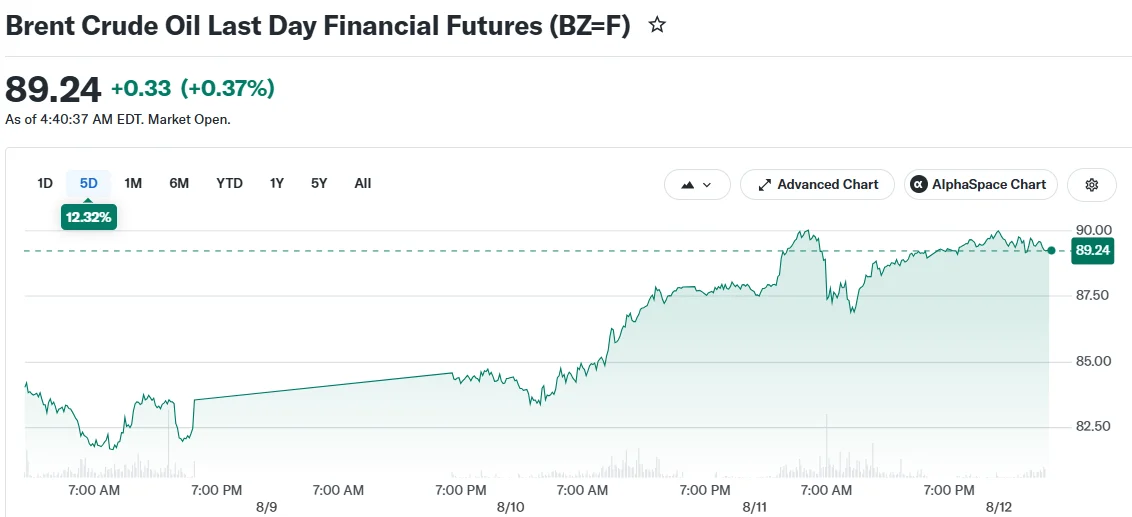
Oil prices continued their multi-day rally on Wednesday amid renewed maritime incidents in two critical Middle Eastern shipping lanes, intensifying concerns over global energy supply chains.
Brent crude futures rose 1% to $89.81 per barrel, notching a sixth consecutive session of gains. West Texas Intermediate (WTI) climbed 1.1% to $84.08, extending its winning streak to five sessions.
The upward momentum followed reports from Washington and Yemen's Houthi movement detailing separate maritime incidents in the Strait of Hormuz and the Bab el-Mandeb Strait during Tuesday's trading. Both passages are essential arteries for transporting petroleum and natural gas from the Middle East, operating in conjunction with the Suez Canal. Hormuz alone typically carries roughly a fifth of global oil consumption, making any sustained disruption a focal point for energy markets worldwide.
A senior Iranian security official stated that the Strait of Hormuz would remain closed until Washington agrees to Tehran's conditions for ending hostilities, which include releasing frozen Iranian financial assets. Maritime tracking data showed that only eight vessels successfully transited Hormuz on Tuesday — a weekly low. Before the conflict, daily traffic had ranged between 125 and 140 ships.
President Donald Trump firmly rejected Tehran's demands, and negotiations have made minimal progress toward a resolution.
PRESIDENT TRUMP JUST NOW: "I don't trust Iran. I'm the last person to trust Iran; they've lied to me constantly. We have total control over the Hormuz Strait right now; they don't have control." pic.twitter.com/TPiPdiXr51 — Bull Theory (@BullTheoryio) August 12, 2026
American Crude Inventories Unexpectedly Surge
Despite the price rally, expanding US crude stockpiles could limit further gains. American Petroleum Institute figures indicated that US crude reserves increased by approximately 9.1 million barrels during the previous week, substantially exceeding market forecasts. A Reuters survey had projected inventory declines, making the unexpected build a notable development for market participants.
Gasoline reserves declined by 1.5 million barrels, while distillate inventories contracted by 596,000 barrels over the same period. Market observers noted that the inventory accumulation could ease some supply tightness concerns, pending confirmation from official Energy Information Administration (EIA) statistics due later on Wednesday. The build suggests domestic production and import patterns remain robust even as export-route risks escalate, though it remains uncertain whether rising stockpiles can fully offset the loss of access to Middle Eastern shipments.
Emergency Petroleum Stockpile Reaches Four-Decade Low
America's Strategic Petroleum Reserve (SPR) fell below the 300 million barrel threshold during the previous week, dropping 6.1 million barrels to 298.7 million barrels. This marks the lowest level in four decades, according to Department of Energy records. For perspective, the reserve held approximately 727 million barrels at its 2010 peak, meaning current levels represent less than half of that capacity.
President Trump authorized the withdrawal of 172 million barrels in March to mitigate supply disruptions stemming from the Iranian situation. The strategic reserve was designed for deployment during supply crises, and its ongoing depletion underscores the severity of current global petroleum supply pressures. A diminished SPR also reduces the buffer available for any future disruption, a consideration that has drawn attention from energy policy analysts and lawmakers tracking reserve replenishment timelines.
In Libya, the National Oil Corporation announced that fires at petroleum storage facilities within the Zawiya oil installation had been completely extinguished.
Looking ahead, the EIA anticipates that Middle Eastern crude supply disruptions will persist through late 2027. The agency projects that 2026 Brent prices will average $86.81 per barrel, while West Texas Intermediate will average $80.88.

