U.S., Israel, and Saudi Arabia Explore Secretive Infrastructure Plans to Bypass Iran's Chokehold on Global Oil Routes
Key Takeaways
- •The Strait of Hormuz carries approximately 20 million barrels of oil per day, equivalent to roughly one-fifth of global oil consumption, while the Bab el-Mandeb Strait handles an additional 6 to 9 million barrels daily.
- •The MERA Oil Consortium is finalizing site selection for a $5 billion, 200,000-barrel-per-day integrated refinery on the Gulf of Oman or Arabian Sea, with Phase One mechanical completion targeted for the end of 2029.
- •U.S. planners estimate that the India–Middle East–Europe Economic Corridor could divert around 60 percent of container traffic that currently transits the Strait of Hormuz, with a 2026 wartime redesign anchoring the eastern leg in Oman.
- •A proposed U.S.-backed pipeline would connect Saudi Arabia's 5-million-bpd East–West Pipeline to Israel's Trans-Israel Pipeline, enabling Europe-bound crude to bypass both Iranian-controlled chokepoints entirely.
- •Houthi attacks on commercial shipping in the Bab el-Mandeb Strait since late 2023 have already forced major carriers to reroute around the Cape of Good Hope, adding weeks of transit time and significantly increasing freight costs.
Regardless of the outcome of ongoing U.S.–Iran negotiations, Tehran has established de facto control over the world's two most critical maritime energy transit routes — the Strait of Hormuz and the Bab el-Mandeb Strait — for as long as the Islamic Republic remains in power. Washington, London, Brussels, Beijing, and Moscow are all aware of this reality. Together, these two chokepoints handle roughly a third of the world's seaborne oil trade, with the Strait of Hormuz alone carrying around 20 million barrels per day — approximately one-fifth of global oil consumption — making any sustained disruption an immediate concern for every major importing economy.
The Strait of Hormuz remains effectively controlled by Iranian forces along its full eastern stretch, blocking oil and liquefied natural gas (LNG) shipments from the Middle East heading east through the Gulf of Oman and the Arabian Sea toward major Asian buyers China and India, or west into the Gulf of Aden. Meanwhile, Iran-backed Houthi forces in Yemen dictate access to the Bab el-Mandeb Strait from the Gulf of Aden, affecting vessels transiting north through the Red Sea, the Gulf of Suez, and into the Mediterranean Sea. The Bab el-Mandeb typically sees around 6–9 million barrels per day of crude and refined products, and Houthi attacks on commercial shipping since late 2023 have already forced major carriers to reroute around the Cape of Good Hope, adding weeks of transit time and significantly increasing freight costs.
Before 'Operation Epic Fury' was launched by the U.S. and Israel on February 28, Iran had signaled it would close both waterways if threatened. Following the attacks — and Tehran's subsequent closure of the Strait of Hormuz and interference in the Bab el-Mandeb Strait — the Islamic Republic has now permanently formalized its future response to any such threats.
MERA Oil Consortium's $5 Billion Refinery Project
A key component of the U.S.–Saudi infrastructure strategy involves the MERA Oil private consortium — a joint venture between the U.S.'s MWG Enterprises, the Patel Family Office, and PWS (an associate of the Saudi-headquartered AHQ Group). The consortium was formally announced at the end of last month after three years of discussions among partners regarding potential sites.
The group has entered the final stage of selecting a host for a planned US$5 billion integrated refinery and energy export corridor located outside the Strait of Hormuz. While the final location has not yet been formally announced, the planned development centers on a 200,000-barrel-per-day (bpd) integrated refinery linked to deepwater port infrastructure, large-scale storage of crude and refined products, and marine export facilities.
According to the consortium, its position outside the Strait of Hormuz is specifically designed to provide a route-resilient export platform with direct access to international shipping routes. Its on-the-ground presence would also establish a long-term industrial base to strengthen manufacturing, logistics, technical capability, and energy security in the region.
Once the site is officially announced, the project is expected to move into final site diligence and engineering design, with mechanical completion of Phase One targeted for the end of 2029, followed by commissioning and commercial operations.
Given these operational parameters — and alignment with broader efforts across the six Gulf Cooperation Council (GCC) states (Bahrain, Kuwait, Oman, Qatar, Saudi Arabia, and the UAE) — only two viable locations would allow circumvention of both the Strait of Hormuz and the Bab el-Mandeb Strait. These would be sites on the Gulf of Oman or the Arabian Sea, such as Fujairah in the UAE or Duqm/Salalah in Oman, both offering unrestricted access to the Indian Ocean. The UAE already operates the 1.5 million bpd Habshan–Fujairah pipeline, which carries crude from interior fields to the Gulf of Oman, bypassing Hormuz — demonstrating the viability of this geographic approach. Oman has similarly invested heavily in Duqm Port and its surrounding special economic zone, positioning it as an Indian Ocean-facing energy and logistics hub.
The India–Middle East–Europe Economic Corridor (IMEC)
This geographic logic dovetails with one of Washington's longstanding strategic priorities — the India–Middle East–Europe Economic Corridor (IMEC). Originally launched at the 2023 G20 Summit but stalled by regional conflict, U.S. planners now estimate that IMEC could eventually divert around 60% of container traffic that currently risks transiting the Strait of Hormuz.
Its architecture is built around two integrated corridors: an eastern maritime leg linking India's western ports to the Arabian Gulf, and a northern overland rail network running through Saudi Arabia and Jordan to Israel's Port of Haifa, where short-sea shipping connects directly to Europe. Crucially, the 2026 wartime redesign anchors the eastern maritime leg in Oman rather than the UAE, allowing ships from India to unload entirely outside the Strait of Hormuz before transferring cargo onto the Arabian Peninsula rail grid.
Additional 'IMEC Plus' nodes through Egypt and Syria are under discussion to create a wider lattice of land-based alternatives. New legal frameworks — including the India–EU free trade agreement and the U.S. Senate's Eastern Mediterranean Gateway Act — have formally designated Greece as Europe's entry hub, according to a senior European Union (E.U.) security source who spoke exclusively to OilPrice.com last week.
IMEC would also give Washington a critical degree of control over oil and LNG flows, rather than China, which has held leverage over the Strait of Hormuz and the Bab el-Mandeb Strait by dint of Beijing's influence over Iran. This influence was established under the Iran-China 25-Year Comprehensive Cooperation Agreement, first revealed in a September 3, 2019 article. China is the world's largest crude oil importer and relies on the Middle East for roughly half of its supply, meaning any disruption to these waterways would have an outsized impact on the Chinese economy.
The Saudi–Israel Pipeline Option
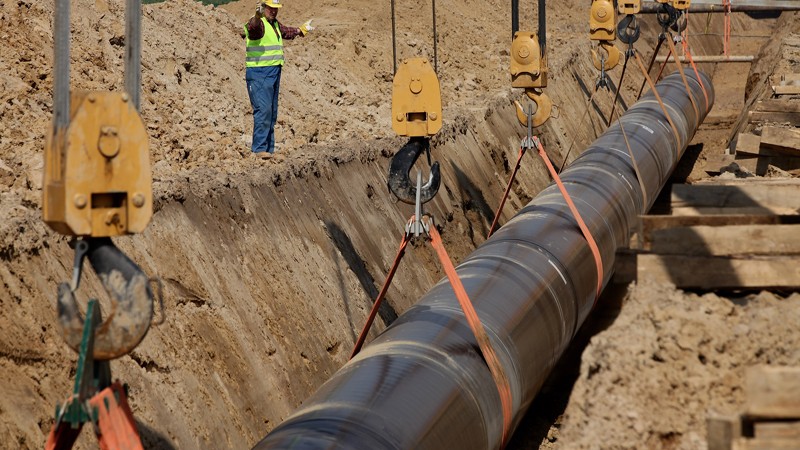
An even more secretive option currently under development toward the same goal of cutting Iran out of the global energy supply chain is a U.S.-originated scheme involving an overland pipeline built across the Saudi desert to the Israeli border. There, a second pipeline — the Trans-Israel Pipeline (the Eilat-Ashkelon pipeline), laid down between 1968 and 1969 — would carry crude north to ports on the Mediterranean.
Saudi Arabia already operates a precedent for such a bypass: the 1,200-kilometer East–West Pipeline (also known as Petroline), built in the 1980s during the Iran–Iraq War, runs from the Abqaiq processing complex to the Red Sea port of Yanbu with a capacity of approximately 5 million bpd, though it has been underutilized for years. Linking this existing infrastructure to Israel's Mediterranean coast would extend that Hormuz-bypass capability to Europe-bound crude.
Ironically, the 42-inch diameter crude oil pipeline was originally developed as a secret joint venture between Israel and Iran (under the Shah) to transport Iranian oil from the Red Sea port of Eilat directly to the Mediterranean port of Ashkelon, bypassing the Suez Canal.
Israel's Energy Minister Eli Cohen recently highlighted the strategic rationale: "The Gulf countries do not want to be dependent on either Iran or the Houthis when it comes to their oil exports, which are their primary source of income, [...] If you create a land route, you bypass both Iran and the Houthis ... The best route is through the State of Israel."
Israeli Prime Minister Benjamin Netanyahu has also expressed support for the concept: "Instead of going through the chokepoints of the Hormuz Strait and the Bab-el-Mandeb Strait, we'd just have oil pipelines, gas pipelines going west through the Arabian Peninsula, right up to Israel, right up to our Mediterranean ports and you've just done away with the chokepoints for forever. That is definitely possible."
The proposal has also gained traction within U.S. President Donald Trump's core team, according to a senior Washington-based source who works closely with the U.S. Treasury. "The infrastructure would stretch across Saudi and Israeli land, which means it would provide a great base for security forces to be stationed to ensure its safety, which in turn would allow for great leverage extension [for Washington] across the region, including for the Abraham Accords, as the president [Trump] wants," the source told OilPrice.com last week.
The Abraham Accords — relationship normalization deals between Israel and Middle Eastern states brokered by the U.S. — have long been Trump's favored foreign policy instrument for gradually re-establishing U.S. influence across the region at the expense of China and Russia.
"And if Iran — or any of its backers — attacked any part of the infrastructure, we [the U.S.] would be fully entitled, along with Israel and our Gulf allies, to hit them [Iran and its allies] harder than ever before, with the definitive goal of regime change," the source concluded.
By Simon Watkins for OilPrice.com

