Oil Prices Rise as Strait of Hormuz Attacks Collide With Forecasts of a 2027 Supply Glut
Key Takeaways
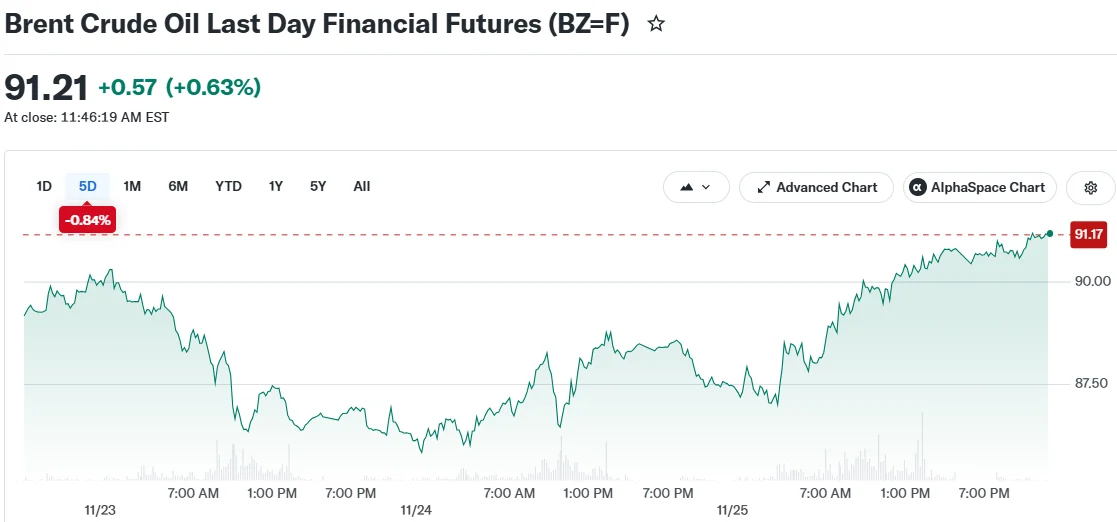
- •Brent crude climbed from a Monday settlement of $89.37 per barrel, its weakest finish since late August, to roughly $92 by Thursday after a new wave of attacks on Gulf shipping and Saudi energy facilities.
- •The International Energy Agency expects global supply to exceed demand by 1.7 million barrels a day this quarter, widening to 3.8 million barrels a day in 2027.
- •ANZ estimates Strait of Hormuz throughput at about 49% of normal while Kpler data show transits roughly 42% below prewar levels, and both flag low inventories and almost no spare production capacity as key market risks.
- •During the 1980s Iran-Iraq Tanker War, abundant Saudi spare capacity contributed to oil prices collapsing in 1986 despite hundreds of ship attacks — a cushion ANZ says is missing today.
- •OPEC+ is set to meet on Sunday, Nov. 29, to determine 2027 output policy as Tehran threatens to tighten its grip on the strait unless Washington lifts its naval blockade, eases sanctions, and releases Iranian assets.
The oil market is trying to price two stories at once. One says the world faces a large supply glut building into next year. The other says the world's most important oil shipping lane is running at roughly half its normal traffic, under attack, with little backup supply available. Brent is one of the benchmarks used to price crude cargoes around the world, which is why the collision of these two narratives matters well beyond the Gulf.
Brent crude traded near $92 a barrel on Thursday after a new wave of attacks on ships and Saudi energy sites. On Monday, the benchmark's January contract had closed at its lowest level since late August.
The market's lead story has flipped quickly. On Monday, Brent's January contract settled at $89.37, its weakest finish since Aug. 28, after three straight weekly losses. By Thursday, Brent was changing hands at $91.86 in Europe, according to Investing.com, following a fresh round of attacks across the Gulf.
The UK Maritime Trade Operations agency, which tracks and reports shipping incidents in the region, said three more ships were struck by projectiles while heading east through the Strait of Hormuz, the Gulf's only outlet to open water. Iran's Fars news agency reported that another tanker had hit a naval mine. Houthi militants aimed four drones at Saudi Arabia's Ras Tanura refinery and two Red Sea ports. Bahrain reported an Iranian attack on a civilian industrial site, while Iran's Revolutionary Guards claimed strikes on U.S. positions in the country.
The case for a glut
The Paris-based International Energy Agency expects supply to exceed demand by 1.7 million barrels a day this quarter, widening to 3.8 million barrels a day in 2027.
U.S. crude stocks rose 1.1 million barrels in the week to Nov. 20, the third consecutive weekly build, according to the Energy Information Administration, the U.S. government's energy statistics agency.
Dennis Kissler of BOK Financial wrote in a note on Monday that the attacks have not stopped oil from moving: “Global crude oil exports remain ample… While attacks are still occurring…oil flows are reaching destinations.”
He called Iranian claims that more than 35 large tankers had hit mines in 20 days “nearly impossible” given current flows.
The case for a squeeze
ANZ analysts estimate Hormuz throughput at 49% of normal and warn that low global inventories and almost no spare production capacity — idle output that can be ramped up when supplies run short — leave the market exposed. UBS analyst Giovanni Staunovo has said prices underestimate the combined risk of depleted inventories, recovering Chinese demand, and ongoing disruptions.
Even the basic numbers do not line up. Preliminary data from Kpler, a firm that tracks global tanker movements, showed Hormuz transits running 42% below prewar levels in the week to Nov. 21 — closer to 58% of normal than ANZ's 49%. The figures cover different periods and may measure different things.
Demand signals are mixed as well. Investing.com linked a drop in U.S. crude exports, which fell to their lowest level since early August, partly to softer Asian demand.
A lesson from the 1980s
This is not the first time a Gulf shipping war has met a glut. During the Iran-Iraq “Tanker War,” which began in 1984, hundreds of merchant ships were attacked — yet oil prices collapsed in 1986.
Spare capacity was a major reason. Saudi Arabia had cut its output deeply earlier in the decade, leaving it with large volumes it could bring back.
ANZ says that cushion is missing now. If that assessment is right, today's glut forecasts depend heavily on a single assumption: that Gulf oil keeps getting through the strait.
What to watch
OPEC+, the alliance of oil producers led by Saudi Arabia and Russia, meets Sunday, Nov. 29, to set 2027 output policy, with Iraq pushing for more room to pump. But most Iraqi crude ships from terminals near Basra, inside the Gulf — meaning safe passage may matter more than higher quotas.
Vice President JD Vance met Qatar's prime minister this week, but U.S. efforts to win nuclear concessions from Iran remain stalled. Tehran has threatened to tighten its control of the strait unless Washington lifts its naval blockade, eases sanctions, and frees Iranian assets.
Thin Thanksgiving trading, with U.S. markets closed for the holiday, could exaggerate price swings this week. After that, the next weekly count of Hormuz traffic may tell traders more than any annual forecast.
Source: Blockonomi

