Oil Prices Stay Above $100 as Gulf Exports Recover but Iran Strike Risk Persists
Key Takeaways
- •Brent crude fell to $114 a barrel and WTI declined to $101.49 in early Thursday trading.
- •Diplomatic contacts involving U.S., Qatari, Saudi, Turkish and Pakistani officials have not yet produced an accepted agreement from Iran.
- •Gulf oil exports rose above prewar levels before falling to at least 15.7 million barrels a day in the week through Oct. 26.
- •Higher shipping costs and threats involving Sinokor vessels are increasing risks around the Strait of Hormuz, which carries about one-fifth of global petroleum liquids consumption.
- •Global oil inventories are near their lowest level since at least 2016, limiting the market’s ability to absorb a disruption in Gulf supplies.
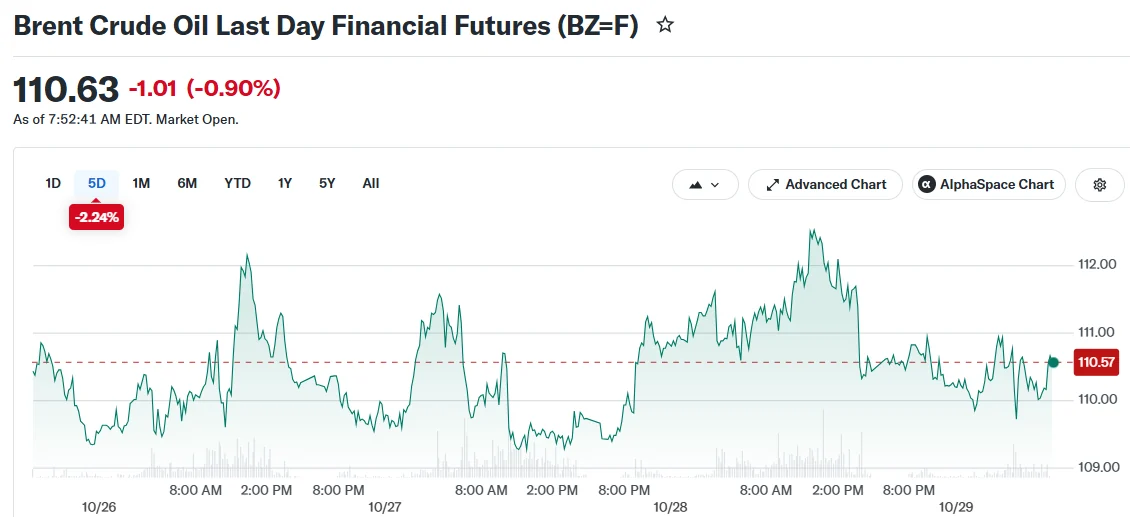
Oil futures slipped on Thursday as traders weighed fresh diplomatic overtures in the Middle East against the possibility of renewed U.S. strikes on Iran, while lingering fears of attacks on Saudi energy infrastructure kept both benchmarks above $100 a barrel.
As of 07:37 ET, Brent crude futures were down 1.1% at $114.00 a barrel, and U.S. West Texas Intermediate fell 1.3% to $101.49. Brent serves as the international benchmark for crude oil, while WTI is the U.S. reference grade. Both contracts had closed higher the previous day. The declines came after Yemen's Houthi rebels said they had attacked Saudi Arabia's largest oil refinery.
Diplomacy and the Threat of Strikes
The Wall Street Journal reported that U.S. Vice President JD Vance reached out to Mohsen Rezaei, secretary of Iran's top security body, in a move that could open a channel for negotiations. President Donald Trump told Axios that talks are underway through mediators, though he said he did not know whether they would produce results.
Qatari mediators have handed Tehran a new draft proposal aimed at ending the conflict, but an Iranian official described the ideas as unacceptable, according to Reuters. Saudi Arabia, Turkey and Pakistan also held talks with Iranian officials this week.
Meanwhile, Trump is reportedly weighing short, intense military action against Iran after the Nov. 3 midterm elections. Washington has warned Gulf allies to prepare for strikes and for possible Iranian attacks on energy sites. For readers tracking the standoff, the near-term markers are concrete: Tehran's response to the Qatari draft, the Nov. 1 start date for Iran's threatened action against Sinokor vessels, and the post-election window in which any U.S. military decision is reportedly being considered.
Goldman Sachs estimates that fear of fresh supply disruptions has added roughly $27 a barrel to Brent. The bank said refiners are purchasing crude while supplies remain available and investors are hedging with futures. JPMorgan, by contrast, puts Brent's fair value at $94 a barrel, well below current trading levels. The divergence between the two banks frames the market's central uncertainty: how much of the current price reflects physical tightness, and how much is the fear premium Goldman describes.
Shipping and Supply
Persian Gulf oil exports topped 24 million barrels a day in the week through Oct. 18, exceeding the prewar level of 23.3 million, according to Kpler. They then fell to at least 15.7 million barrels a day in the week through Oct. 26.
A record number of commercial ship attacks occurred near the Strait of Hormuz this month, and UBS said insurance and freight costs have risen sharply. The strait is the world's most critical oil chokepoint, with roughly one-fifth of global petroleum liquids consumption transiting the waterway, according to the U.S. Energy Information Administration. Shipping crude from the Gulf to Asia cost nearly $36 a barrel in early October, the International Energy Agency said, more than five times prewar levels — a freight burden that stacks on top of the crude price itself for Asian buyers.
Iran's Persian Gulf Strait Authority warned of legal action against Sinokor vessels beginning Nov. 1. Sinokor ships accounted for more than one-fifth of identified tanker traffic through Hormuz over the past three months, according to Kpler.
Global on-land oil inventories are near their lowest levels since at least 2016, the IEA said. U.S. commercial crude stocks fell 1.9 million barrels to 410.6 million in the week ended Oct. 23. Ship-tracking data suggest China's October crude imports rose from September's total. With stockpiles that lean, the market has limited buffer to absorb any interruption in Gulf flows, consistent with the refiner buying behavior Goldman described.
U.S. gasoline averaged $4.25 a gallon on Wednesday, according to AAA. In early trading Thursday, the most actively traded Brent contract was near $111 a barrel, while WTI stood at $101.49.
Source: CoinCentral

