U.S. Treasury Sanctions Iranian Maritime Firms Over Bitcoin Payment Rail in Strait of Hormuz Extortion Scheme
Key Takeaways
- •OFAC designated HormuzSafe Marine Services Authority and Persian Gulf Marine Insurance Company under Executive Order 13902 for their participation in an IRGC-backed extortion scheme targeting vessels in the Strait of Hormuz.
- •The action swept in eight additional shadow-fleet vessels, bringing the total number of such tankers sanctioned since the start of 2026 beyond one hundred.
- •Treasury specifically identified HormuzSafe as accepting Bitcoin and other digital assets as a settlement mechanism to transfer value outside the Western banking system.
- •Existing OFAC guidance classifies Iran-based digital asset exchanges as blocked institutions, meaning any counterparty touching the designated payment flow faces sanctions exposure.
- •A key open compliance question is whether OFAC will append specific cryptocurrency wallet addresses to the SDN List, which would materially sharpen screening obligations for digital asset exchanges.
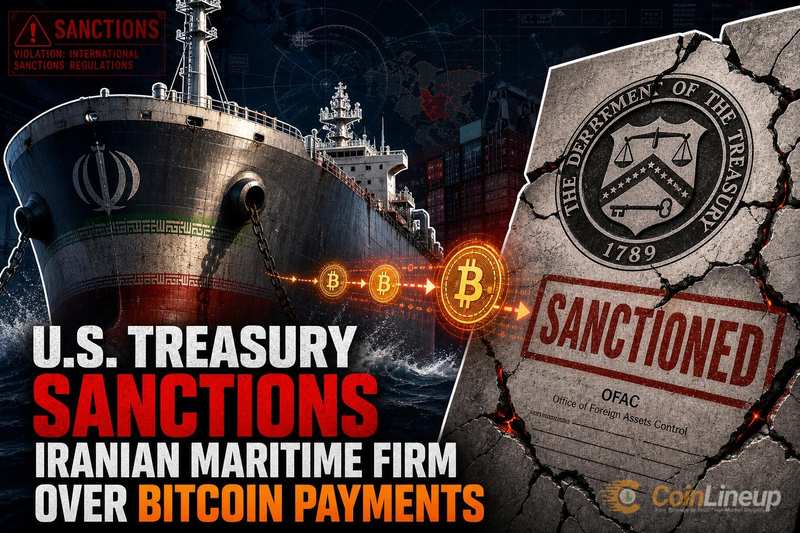
On July 29, 2026, the U.S. Department of the Treasury's Office of Foreign Assets Control (OFAC) designated two firms central to an extortion scheme targeting commercial vessels transiting the Strait of Hormuz—a narrow passage through which roughly a fifth of global seaborne oil flows daily, making any disruption there a direct concern for energy markets worldwide. The action, taken under Executive Order 13902, named HormuzSafe Marine Services Authority and Persian Gulf Marine Insurance Company as participants in an operation backed by Iran's Islamic Revolutionary Guard Corps (IRGC), Treasury announced.
Both entities were added to the Specially Designated Nationals (SDN) List under the IRAN-EO13902 program, per OFAC's recent actions record. The designation also swept in eight additional shadow-fleet vessels—typically aging tankers operating under obscured ownership and flag arrangements to transport sanctioned crude—bringing the total number of such vessels sanctioned since the beginning of 2026 past one hundred.
The Bitcoin Payment Dimension
What distinguishes this designation from routine maritime sanctions is Treasury's specific finding that HormuzSafe accepts payment in Bitcoin and other digital assets. Treasury described this as part of Iran's broader effort to bypass Western sanctions, placing a cryptocurrency payment rail at the center of the enforcement action.
Notably, only HormuzSafe—not the co-designated Persian Gulf Marine Insurance Company—is identified as accepting cryptocurrency payments. The case therefore remains fundamentally a sanctions action, with the cryptocurrency dimension arising through its payment channel rather than any protocol-level concern.
The core issue, according to Treasury, is the use of Bitcoin as a settlement mechanism to transfer value outside the Western banking system. The same conduct would carry identical sanctions exposure regardless of whether it were settled in dollars, euros, or digital assets.
Chainalysis addressed this principle directly in its research on the scheme:
"The fact that these payments would be denominated in cryptocurrency rather than traditional fiat does not change the underlying sanctions implications."
— Chainalysis Team, Chainalysis research
Enforcement Challenges and Treasury's Structural Response
TRM Labs analysts highlighted that cryptocurrency payments can be settled rapidly and processed entirely outside U.S. correspondent banking networks, making real-time interdiction of individual toll payments technically difficult, per TRM Labs research. This speed-of-settlement challenge helps explain why Treasury opted to designate the receiving entity itself—a structural enforcement approach—rather than chase individual transfers in real time.
The case also aligns with earlier reporting that Iran has explored Bitcoin-denominated ship insurance arrangements in the same maritime corridor, suggesting an emerging pattern of cryptocurrency adoption within Iran's sanctions-evasion infrastructure rather than a single isolated incident.
Compliance Implications for Digital Asset Exchanges and Counterparties
The July 29 designations effectively convert existing written guidance into a named-entity enforcement action. OFAC FAQ 1249 establishes that payments to Iran or the IRGC for safe passage through the Strait of Hormuz are not authorized for U.S. persons and create sanctions exposure for non-U.S. persons as well, according to OFAC guidance.
The same guidance page carries FAQ 1250, which classifies Iran-based digital asset exchanges as blocked Iranian financial institutions under Executive Order 13599 and the Iranian Transactions and Sanctions Regulations (ITSR). This classification means that any counterparty touching the designated payment flow—whether a cryptocurrency exchange, a payment processor, or another financial intermediary—faces sanctions exposure that extends well beyond the two named Iranian firms.
Market Context and Open Questions
Bitcoin was trading around $63,956 at the time of the announcement, down slightly on the day. Market reaction to the sanctions action was subdued.
A significant open question for compliance teams is whether OFAC will pair these entity designations with specific cryptocurrency wallet addresses on the SDN List. Such an addition would materially sharpen screening obligations for digital asset exchanges, provide investigators with concrete on-chain targets tied to the Hormuz network, and create clearer compliance parameters for the broader industry. OFAC has previously appended wallet addresses to SDN listings in actions targeting other state-linked illicit finance networks, a step that triggered immediate compliance adjustments across major exchanges and virtual asset service providers.