CPI Upside Surprise: October Inflation Tops Bloomberg Consensus
Key Takeaways
- •Headline CPI rose 0.4% in October, exceeding the 0.3% consensus estimate.
- •Core CPI increased 0.3%, also coming in 0.1 percentage point above expectations.
- •CME futures pricing showed the probability of a 50-basis-point Fed rate increase in December rising to 9.8% from 0%.
- •The November CPI report will be the next test of whether October’s inflation surprise continues.
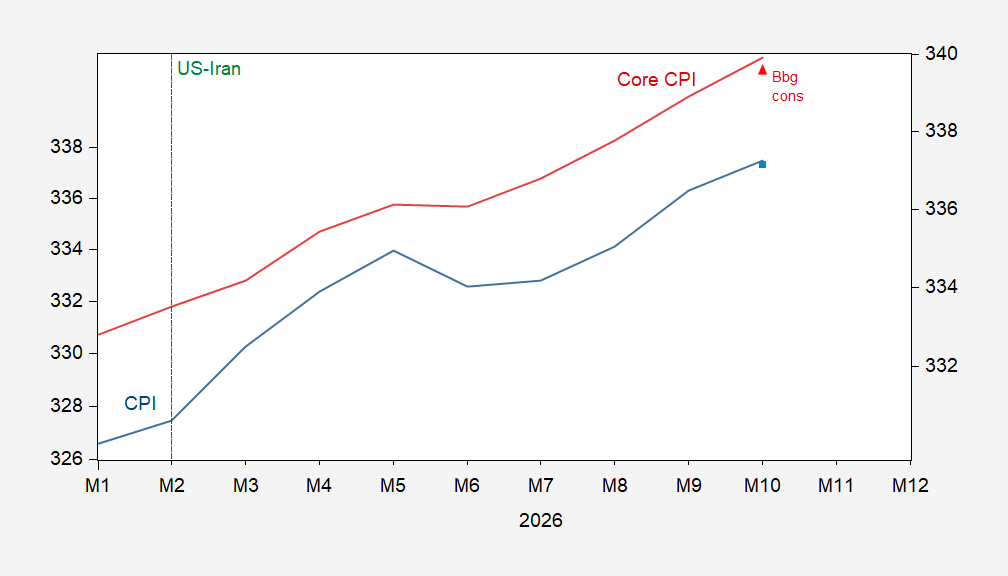
United States consumer prices rose faster than economists anticipated in October, according to the latest Consumer Price Index (CPI) release — an upside surprise relative to the Bloomberg consensus, as highlighted in an analysis published on Econbrowser.
Headline CPI increased 0.4% month over month, compared with the +0.3% consensus, while core CPI rose 0.3% versus the +0.2% forecast — leaving both measures a tenth of a percentage point above expectations.
The post's first figure plots headline CPI (blue, left scale) against the Bloomberg consensus (light blue square), alongside core CPI (red, right scale) and its corresponding consensus estimate (red triangle), with index values shown on logarithmic scales against the 1982–84 base period of 100. Source: Bureau of Labor Statistics (BLS) and Bloomberg.
A second figure places the various price gauges on a common basis, indexing each series to January 2025 = 0 and charting them in logs. The comparison includes headline CPI (bold black), the wage-earner CPI (CPI-W, red), chained CPI on a not-seasonally-adjusted basis (green), CPI excluding shelter (orange), the PCE deflator (purple), the Producer Price Index (PPI, teal), the S&P Global GDP deflator (pink), and the American Institute for Economic Research's Everyday Price Index (AIER EPI, blue). Source: BLS, the Bureau of Economic Analysis (BEA), S&P Global, AIER, and the author's calculations. Read together, the two charts let readers gauge not only the size of the miss versus consensus but also how the month compares across alternative yardsticks for inflation, from measures that strip out housing costs to indexes built around different baskets.
The CPI is produced monthly by the BLS and tracks the average change over time in the prices paid by urban consumers for a basket of goods and services; the core measure strips out volatile food and energy prices. The Bloomberg consensus represents the median pre-release forecast among economists surveyed by Bloomberg. Because price stability is one of the Federal Reserve's statutory policy goals, monthly inflation prints sit among the most closely watched data points on the economic calendar, and departures from consensus can feed quickly into market expectations for interest rates.
Market-implied odds of a larger Federal Reserve policy move also shifted after the release. According to CME futures pricing as of 1 p.m. Central Time, the probability of a 50 basis point rate increase at the Federal Open Market Committee's December meeting rose from 0% to 9.8%. (The post initially cited a 25 basis point move before a correction was issued — h/t Macroduck.) The December meeting is therefore the next scheduled policy checkpoint at which this inflation print will be on the table.
Addendum, data as of 2:46 p.m. Central Time (Bloomberg): “Treasuries Slide as Hot US Inflation Cements December Rate Bets.” The November CPI report, the next installment in the BLS's monthly cycle, will offer the first read on whether October's surprise extends beyond a single month.

