Luke Dashjr Exits OCEAN Mining Pool in Buyout; Hash Power Shift to New CONVOY Venture Remains Unproven
Key Takeaways
- •Luke Dashjr resigned as OCEAN's chairman, CTO, and director, and OCEAN repurchased all of his equity under an Aug. 29 joint statement.
- •The buyout price, remaining ownership structure, and successor appointments were not disclosed, and Dashjr's departure leaves OCEAN without its most prominent technical voice.
- •Dashjr plans a new mining venture called CONVOY, which has published no endpoint, codebase, miners, infrastructure, fees, or block-template policy to verify it functions.
- •Mempool.space data placed OCEAN between roughly 2.45% and 2.88% of Bitcoin network hashrate across recent snapshot windows, well behind leaders like Foundry USA and Antpool.
- •The companies said the separation reflected differing visions after recent protocol developments but did not tie the buyout to any specific proposal such as BIP-110.
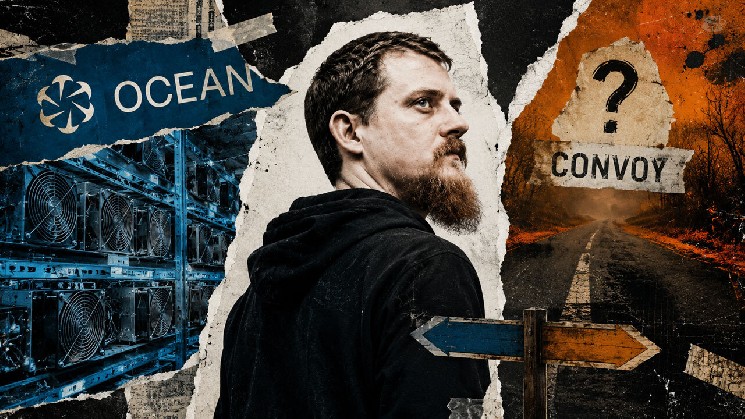
OCEAN Mining has completed a buyout of co-founder Luke Dashjr, a 16-year veteran Bitcoin Core developer, ending both his ownership stake and his three leadership positions at the Bitcoin mining pool.
According to an Aug. 29 joint statement, Dashjr resigned as chairman, chief technology officer, and director, and OCEAN repurchased all of his equity. Those board, technical, and executive roles had placed him at the center of OCEAN's governance as well as its mining-policy decisions.
The privately held company did not disclose the repurchase price, its remaining ownership structure, or any successor appointments. OCEAN said it will continue operating its transparent, non-custodial mining pool, while Dashjr will pursue a new mining venture called CONVOY.
As of the reporting cutoff, CONVOY had not published enough information to verify that it operates a functioning pool. Its public profile and the announcement disclosed no endpoint, codebase, participating miners, infrastructure, fees, or block-template policy. They also disclosed no transfer of miners, staff beyond Dashjr himself, or infrastructure from OCEAN.
The buyout is the latest shakeup for a pool that has positioned itself as a decentralization-focused alternative to large, centralized mining operations. OCEAN launched in late 2023 as a transparent, non-custodial pool — a model intended to let individual miners receive block rewards and transaction fees directly rather than through a pool-controlled payout wallet — and attracted early backing from Block CEO Jack Dorsey. Dashjr's departure removes the pool's most prominent technical voice, raising the question of how its mining-policy direction will be set going forward, though the company has not announced who fills his roles.
OCEAN still represents a measurable share
A Mempool.space snapshot taken at 07:07 UTC on Aug. 30 attributed four of the previous 163 Bitcoin blocks to OCEAN, equal to 2.45%. Applying that share to the endpoint's network hashrate estimate produced a block-share-derived estimate of roughly 24.57 exahashes per second.
The longer window showed a similar picture. Mempool.space attributed 29 of 1,007 trailing-week blocks to OCEAN, or 2.88%, while its latest weekly hashrate row put the pool at 25.33 EH/s and 2.86% of the network.
Across both windows, OCEAN remained within a broad 2.5% to 3% band — a range large enough to make miner departures measurable without turning a single block into a trend. That band places OCEAN well behind industry leaders such as Foundry USA and Antpool, which have historically each commanded materially larger shares of network hashrate, but it is large enough that a founder-era exodus of miners would register in public block data.
Those figures describe hashpower directed to OCEAN, not mining machines owned by the company. A trailing 24-hour window can also shift quickly as blocks enter and leave the sample, making it a snapshot rather than a measure of durable market share.
The joint statement said the separation reflected differing visions following recent protocol developments, but it did not identify BIP-110, Bitcoin Knots, a proof-of-work change, or any other specific proposal as the cause.
OCEAN added dedicated BIP-110 and no-signal endpoints in July, then returned its default endpoint to the non-BIP-110 chain on Aug. 9 while keeping both options live. OCEAN said its DATUM system allows participating miners to control block construction. CryptoSlate's earlier coverage detailed the surrounding fork and proof-of-work dispute, but the separation statement did not tie any specific development to the buyout.
A functioning CONVOY pool, published mining instructions, or a sustained change in OCEAN's share would provide the first measurable evidence that miners and template policy are actually moving. The corporate split alone does not.
