OCC Targets November for Final GENIUS Act Rules
Key Takeaways
- •The OCC’s rulemaking under RIN 1557-AF41 lists November as the target for final GENIUS Act rules.
- •The GENIUS Act was signed into law in July 2025 and created the first federal framework for payment stablecoins.
- •The law requires stablecoins to be fully backed by specified reserves and prohibits issuers from paying interest.
- •The OCC serves as the primary federal regulator for federal qualified nonbank payment stablecoin issuers and certain stablecoin-issuing bank subsidiaries.
- •A November finalization target does not necessarily mean the rules take effect immediately, but it gives firms a concrete planning date.
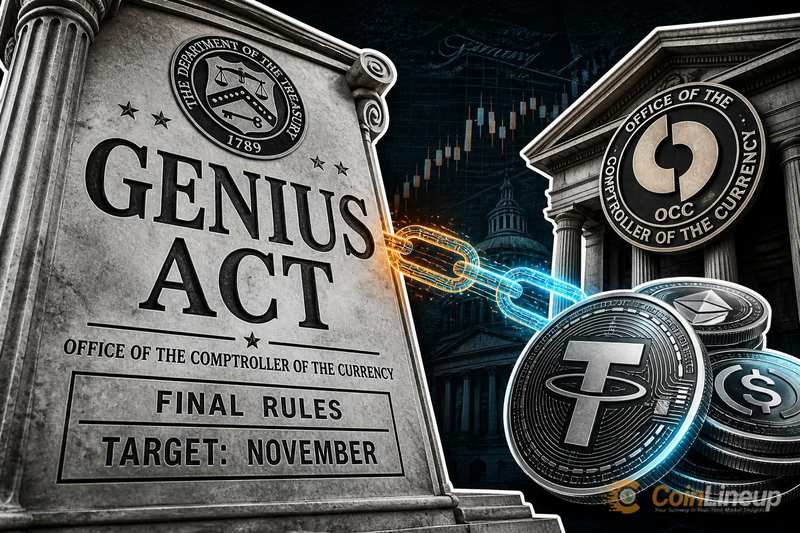
The Office of the Comptroller of the Currency (OCC) is targeting November for its final GENIUS Act rules, setting a near-term deadline that crypto firms and stablecoin issuers will be watching closely as federal digital asset oversight takes shape.
The timeline appears in the federal regulatory agenda, where the OCC's rulemaking is tracked under RIN 1557-AF41. The entry lists the agency as the rulemaking authority and points to a November target for finalizing the rules.
The broader regulatory agenda that houses this rulemaking was published in the Federal Register, part of the government-wide list of pending and upcoming actions maintained through the unified agenda.
Why the November target matters now
A defined target month turns an open-ended policy process into a concrete milestone. For banks and crypto firms operating under federal supervision, a fixed rulemaking window gives compliance and legal teams a date to plan around rather than an indefinite wait.
The OCC oversees national banks and federal savings associations, so its final GENIUS Act rules would carry direct weight for any regulated institution engaged in digital asset activity. That makes the November target a signal worth tracking for firms mapping their own timelines.
The statute behind the rulemaking is the GENIUS Act — the Guiding and Establishing National Innovation for U.S. Stablecoins Act of 2025, signed into law in July 2025 — which created the first federal regulatory framework for payment stablecoins. It requires issuers to be federally or state-permitted, to back their coins one-for-one with reserves held in cash, short-term Treasury securities, and other high-quality liquid assets, and it prohibits issuers from paying interest on stablecoins. Under the law, the OCC serves as primary federal regulator for federal qualified nonbank payment stablecoin issuers and for stablecoin-issuing subsidiaries of the national banks and federal savings associations it supervises, extending the agency's remit beyond traditional charters into nonbank issuance.
What final rules could mean for crypto firms
Once the rules are finalized, attention typically shifts from speculation about what the framework might say to the practical work of implementation. Exchanges, custody providers, and issuers following the process would need to translate the final text into operational and compliance changes.
Given the GENIUS Act's focus, the rulemaking is most relevant to stablecoin and broader digital asset oversight. The specific scope of the OCC's rules is not detailed in the available filing beyond the agenda entry.
The OCC's rules are also one piece of the statute's multi-agency implementation. The Federal Reserve and the FDIC hold corresponding responsibilities for subsidiaries of the institutions they supervise, and Treasury is charged with determining whether state stablecoin regimes are substantially similar to the federal framework — a finding that affects whether larger state-qualified issuers can continue relying on state oversight.
It is worth separating two things: the timing of rule finalization and the eventual date firms must actually comply. A November target refers to when the OCC aims to issue final rules, not necessarily when every requirement takes effect.
What to watch before the rules are finalized
The most direct signal to monitor is the OCC's own issuances. The agency communicates supervisory expectations through bulletins such as Bulletin 2026-3, and further guidance or updates could clarify the shape of the coming rules ahead of November.
The rulemaking also sits within a wider push on digital asset regulation, running alongside efforts like the SEC's proposed Reg Crypto framework and international moves such as Ireland's 2030 AML strategy for crypto wallets. Firms tracking one thread are increasingly watching all of them.
As November approaches, agency updates and agenda revisions are likely to be read as indicators of direction, and final rules can influence how firms and investors position themselves even before formal compliance dates arrive.
