OCC Finalizes GENIUS Act Stablecoin Rules Ahead of January 2027 Deadline
Key Takeaways
- •The OCC finalized rules on October 21 implementing the GENIUS Act, establishing federal standards for reserve assets, redemptions, risk management, and regulatory supervision of payment stablecoin issuers.
- •The regulations take effect on January 18, 2027, after which businesses generally must qualify as permitted payment stablecoin issuers to issue stablecoins in the United States.
- •The rules' scope reaches beyond issuers to certain custody activities conducted by banks and other supervised financial institutions handling stablecoin-related assets.
- •Existing issuers with substantially complete applications pending by the effective date can request temporary waivers, which the law caps at 12 months from January 18, 2027.
- •The OCC has not yet opened the application and waiver process, which awaits Office of Management and Budget approval of the relevant information requirements.
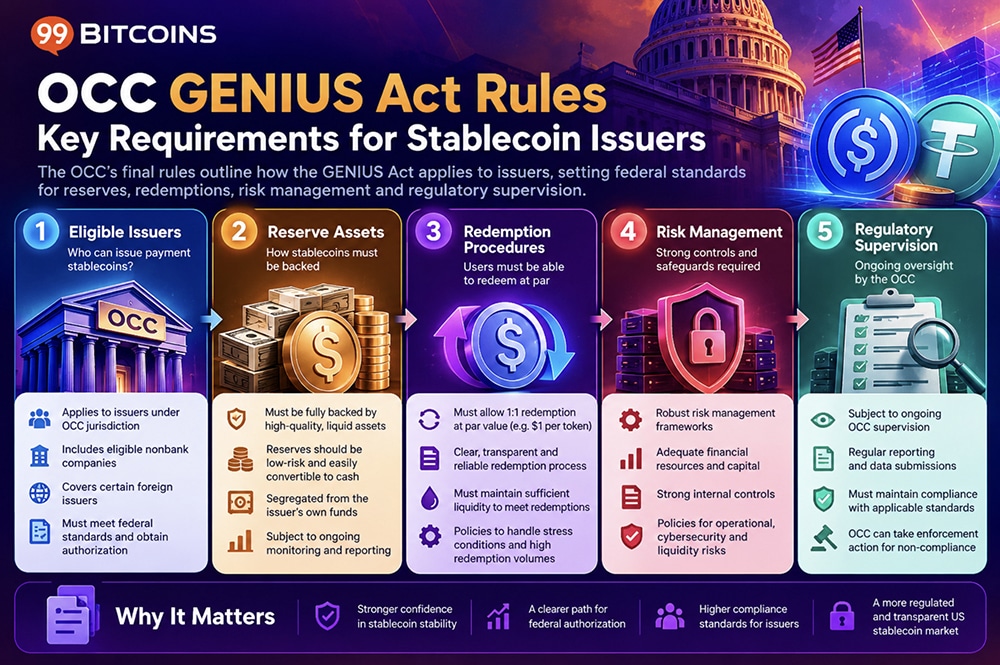
The US Office of the Comptroller of the Currency (OCC) has finalized rules implementing the GENIUS Act, establishing federal requirements for stablecoin issuers covering reserve backing, redemptions, and risk management. The rules will take effect on January 18, 2027, giving companies a clearer framework for operating in the US payment stablecoin market.
The OCC announced the final rule on October 21, following months of consultation with crypto companies, community banks, trade groups, and academics. The regulations also cover certain custody activities conducted by financial institutions under the agency's supervision — a scope that reaches the banks and other supervised institutions handling stablecoin-related assets, not only the issuers themselves.
BREAKING: Trump-signed GENIUS Act gets its FIRST final stablecoin rule ahead of Jan 2027 implementation. The OCC eases its approach to stablecoin rewards, dropping language that presumed certain third-party arrangements were unlawful. Those rewards will now face case-by-case… pic.twitter.com/4VVsmDc2ij
— Coin Bureau (@coinbureau) October 21, 2026
The OCC GENIUS Act rules mark a significant step in putting the legislation into practice. For stablecoin companies, the focus now shifts toward meeting regulatory requirements, securing authorization, and preparing for the new framework.
The New OCC GENIUS Act Rules Set Stablecoin Standards
The GENIUS Act — formally the Guiding and Establishing National Innovation for U.S. Stablecoins Act — was signed into law by President Donald Trump on July 18, 2025, establishing the first comprehensive federal framework for payment stablecoins in the United States. The OCC, a bureau of the US Treasury Department that charters and supervises national banks, has now detailed how the law will apply to issuers under its jurisdiction, including eligible nonbank companies and certain foreign issuers.
The rules establish requirements covering reserve assets, redemption procedures, risk management, and regulatory supervision. Issuers will need to demonstrate that their operations, financial resources, and internal controls meet the applicable standards.
Payment stablecoins — digital tokens designed to hold a steady value against the US dollar — have become core infrastructure for crypto trading and payments. The reserve and redemption rules address the sector's most persistent weakness: the 2022 collapse of the algorithmic stablecoin TerraUSD showed how abruptly a stablecoin can lose its dollar peg.
These requirements are intended to strengthen confidence that payment stablecoins can maintain their value and support redemptions. They also establish a more defined regulatory path for companies seeking to issue dollar-pegged tokens in the United States.
For crypto businesses, the framework creates a clearer route toward federal authorization. However, compliance will require preparation, documentation, and ongoing oversight rather than simply launching a token and maintaining its dollar peg.
Stablecoin Issuers Face a January 2027 Deadline
The new regulations and the GENIUS Act take effect on January 18, 2027. From that date, businesses generally must qualify as permitted payment stablecoin issuers to issue payment stablecoins in the United States, an approach comparable to the MiCA regime for crypto assets in the European Union.
The OCC has also published guidance explaining how existing issuers with pending applications may request temporary waivers. Companies with substantially complete applications pending by the effective date can seek relief from certain requirements while the agency reviews their submissions.
The OCC generally expects to grant waivers from the prior-approval requirement for qualifying existing issuers unless its review identifies stronger reasons to deny them. Any waiver is temporary, with the law allowing a maximum period of 12 months from January 18, 2027.
However, the agency has not yet begun accepting applications or waiver requests. It says the process will open after the Office of Management and Budget approves the relevant application information requirements, with a separate announcement to follow.
With the January 2027 effective date approaching, the next milestones will be the opening of the application process and further regulatory guidance on outstanding compliance requirements.

