Ex-White House Staffer Warns of Slipped Standards Around Trump Aide Natalie Harp
Key Takeaways
- •Greg Greene wrote that Trump’s social media operations have deteriorated compared with the more controlled approach used during Barack Obama’s presidency.
- •Natalie Harp has emerged as one of Trump’s closest aides and has reportedly helped manage his social media accounts.
- •Greene cited reports that Harp has supplied Trump with content from what he called the social media gutter, including an abusive video depicting the Obamas as apes.
- •MS NOW reported that Harp repeatedly declined to seek the security clearance usually obtained by West Wing staffers for about a year.
- •Greene did not accuse Harp of specific misconduct but said unanswered questions remain about oversight of her access to Trump’s communications and accounts.
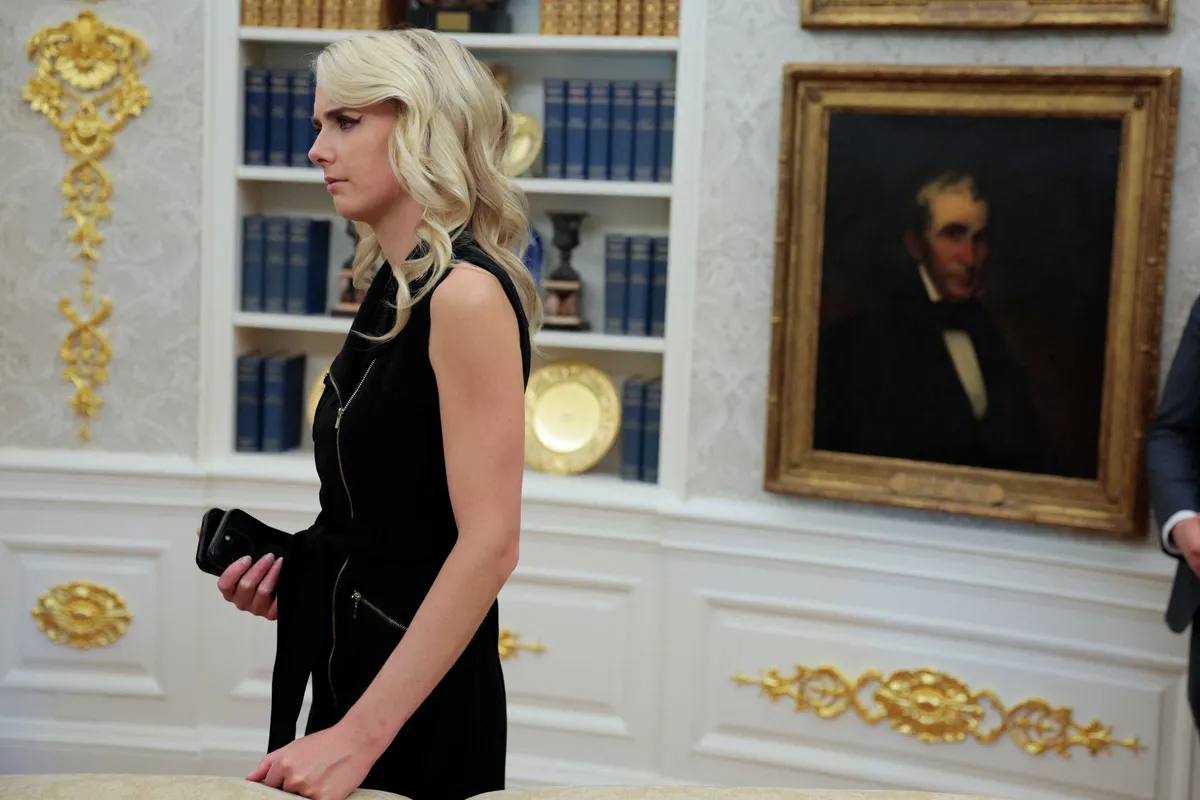
A former staffer who managed President Barack Obama's partisan social media accounts has warned that the standards governing President Donald Trump's social media presence have deteriorated sharply under aide Natalie Harp, drawing on his experience performing the same role.
Writing for The New Republic, Greg Greene laid out why the young aide's position is so alarming to observers. Natalie Harp has become one of the closest and most influential aides of Trump's second term, controlling the information the president is exposed to and treating her relationship with him with a level of devotion that many observers have likened to an obsession. Once considered a minor fixture of the administration, her profile has exploded into a mainstream scandal after details of her adoring letters to the president were exposed in the book "Regime Change," and following a mocking remark from Democratic Sen. Jon Ossoff.
Beyond acting as a "human printer" who shares stories and messages with Trump, Harp has also been among the staffers operating his social media accounts. Greene previously served in the same role, managing partisan accounts for Obama, and his piece detailed just how badly the job's standards have degraded under Harp.
"Handling a U.S. president's social media voice is a magisterial job," Greene explained. "The work involved ranges far and wide—from figuring out how to handle the president's receipt of a Nobel Peace Prize to huddling with colleagues to pull just the right clip from a speech. Or, if you're President Donald Trump's aide and traveling companion Natalie Harp, you might use AI to portray the president as a fighter pilot dropping payloads of poop on No Kings demonstrators."
He continued: "I know something about this particular job. I managed President Barack Obama's partisan social media accounts over much of the first year of his presidency. It's fair to say this was a more innocent age. The watchwords I took to the work were ones like safeguards and restraint, instead of poop jet and What if we depicted the president as Jesus Christ. A president's statements, I knew, could move markets even if ventriloquized by twenty- and thirtysomethings working to channel the top guy's voice. At every point, my colleagues and I took intentional steps to guard against loose words."
Greene explained that, during his time on the job, he helped create a system in which no single person controlled the entire apparatus behind an official account: different people drafted content while others controlled the login information and posting duties. Conceding that he "may have gone overboard with the approval steps we put into place," he argued that it was still important to ensure no single person had "sole ownership over the digital persona of a president of the United States," even at the cost of "nimbleness in quick-moving moments." The logic behind that overhead is straightforward: whoever holds the login controls a channel that speaks with the authority of the presidency, and separating drafting, approval, and posting duties is among the most basic safeguards in institutional communications.
Greene argued further that "it hardly takes a genius to spot how the standards around Trump's social media accounts have slipped," highlighting reports that Harp "supplies [the president] with content she fishes out of the social media gutter," including the infamous video depicting the Obamas as apes. He also stressed that there is "strong reason to wonder what else the woman who 'texts with world leaders on the president's behalf' and operates 'entirely outside the usual chain of command' is doing with her prized, rare access."
"How has Harp handled her touch-screen access to Trump's private communications with world leaders? I can't say. More worryingly, government agencies can't say, either; MS NOW reports that for a year, Harp repeatedly declined to seek the security clearance that West Wing staffers usually obtain," Greene continued. "I also had no clearance—at the DNC, that wasn't required—but that's precisely why my colleagues and I built a process where people with clearances had visibility and could step in."
He concluded: "Maybe she's on the up-and-up with her access to the president and his accounts. Maybe she sees devotion to Trump as its own reward, even if that means squeezing herself behind an SUV's seats like a stowaway. But that Harp fights so hard for both proximity to the president and a free hand to post on his behalf is why I don't trust her at all—and neither should you."
Greene alleges no specific misconduct—he allows that Harp may be "on the up-and-up"—but his piece frames the situation as a set of unresolved questions: whether Harp will obtain the security clearance that West Wing staffers usually hold, and what oversight applies to an aide whom reports describe as operating "entirely outside the usual chain of command." On the question of how her access has actually been used, he notes, not even government agencies can currently say.
