Oath Keepers Founder Stewart Rhodes, Who Got a Trump Tattoo in Prison, Now Calls Him a 'Traitor'
Key Takeaways
- •Stewart Rhodes, founder of the Oath Keepers, publicly announced at a gathering in Irving, Texas, that he is 'absolutely done with Trump,' labeling the president a 'traitor' and one of the worst in U.S. history.
- •Rhodes was sentenced to 18 years for seditious conspiracy over Jan. 6, the longest such sentence at the time, but received only a commutation from Trump while hundreds of other defendants were fully pardoned.
- •While incarcerated, Rhodes had an image of Trump's fist-pumping response to the July 2024 assassination attempt in Butler, Pennsylvania, tattooed on himself, underscoring his former devotion.
- •Rhodes cited Trump's war with Iran, the dismissal of Epstein files demands as 'PAST supporters,' and allegations that pardons were 'pay-for-play' as further reasons for the break.
- •The Justice Department vacated Rhodes' conviction earlier this year, restoring his gun rights and lifting his felon status, though the initial clemency snub remained a lasting grievance.
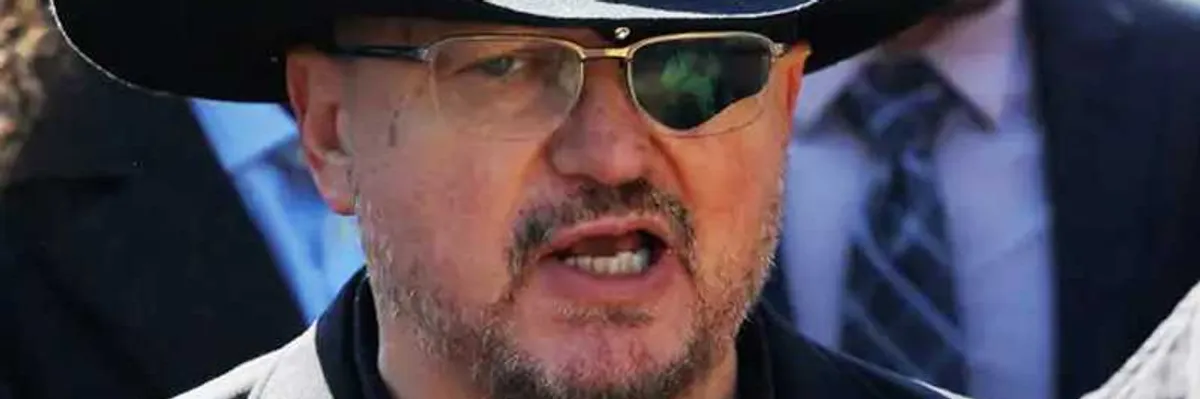
Stewart Rhodes, founder of the right-wing militia group the Oath Keepers, has publicly broken with President Donald Trump — a striking reversal for a man who served prison time for his role in the Jan. 6, 2021, attack on the U.S. Capitol and once had a tattoo honoring the president inked while behind bars.
Rhodes, a Yale-trained lawyer and Army veteran, founded the Oath Keepers in 2009, and the group drew many of its members from the ranks of current and former military personnel, law enforcement officers, and first responders.
According to an Associated Press report published Saturday, Rhodes declared at a gathering in Irving, Texas, that his loyalty to Trump is over.
“I am absolutely done with Trump,” Rhodes told the AP during an after-party for a three-day conference titled “Christ is King: America After Trump.” He went on to label the president a “traitor” and “one of the very worst in our nation’s history.”
The rupture marks a stark turn for Rhodes, who was sentenced to 18 years in prison for seditious conspiracy — a rarely used, Civil War–era statute — over his efforts to keep Trump in power after the 2020 election. At the time, his sentence stood as the longest handed down in the Jan. 6 cases. While incarcerated, he watched coverage of the July 2024 assassination attempt against Trump in Butler, Pennsylvania, and had an image of the president’s defiant, fist-pumping response tattooed on himself.
Rhodes told the AP that his disillusionment began shortly after Trump returned to office. The president granted full pardons to hundreds of Jan. 6 defendants, but extended only a commutation to Rhodes — a move that freed him from prison without wiping his criminal record clean. Although the Justice Department later vacated his conviction earlier this year, restoring his gun rights and lifting his felon status, the initial snub left a lasting mark.
Beyond his personal legal grievances, Rhodes cited several political and policy complaints in severing ties with the administration:
- Foreign policy: Rhodes argued that Trump’s war with Iran broke campaign promises to end foreign conflicts.
- The Epstein files: He said he felt insulted when Trump dismissed supporters demanding the release of government files related to Jeffrey Epstein as “PAST supporters.”
- Allegations of corruption: Rhodes accused the administration of abandoning its “drain the swamp” pledge, calling it “one of the most corrupt administrations in U.S. history” and alleging that pardons were “pay-for-play.”
The break carries weight beyond one man’s legal grievances. Rhodes was among the most high-profile beneficiaries of Trump’s Jan. 6 clemency, and his denunciation now comes not from the president’s longtime critics but from a onetime devotee who once marked his own body with Trump’s image. Coming, as it did, at a conference explicitly framed around politics after Trump — and amid Trump’s dismissal of “PAST supporters” pressing for the Epstein files — the episode highlights how disputes over clemency, foreign conflicts, and promised disclosures are being aired within the coalition itself rather than only by its opponents.
This article, based on reporting by the Associated Press, was originally published by Alternet.

